

The Most Expensive Room in the House
How Kitchen Remodels Became Montgomery County's Highest-Value Home Investment — Surpassing Even Additions

Published April 2026 | by Four Seasons Home Improvement
Data sourced from Montgomery County, MD Department of Permitting Services. Analysis by Four Seasons Home Improvement using RemodelTrends.com, a leading proprietary analytics platform.
Executive Summary
The kitchen has always been called the heart of the home. In Montgomery County, the permit data now proves it is also the most expensive room to remodel — and the one where homeowner ambitions have grown most dramatically.
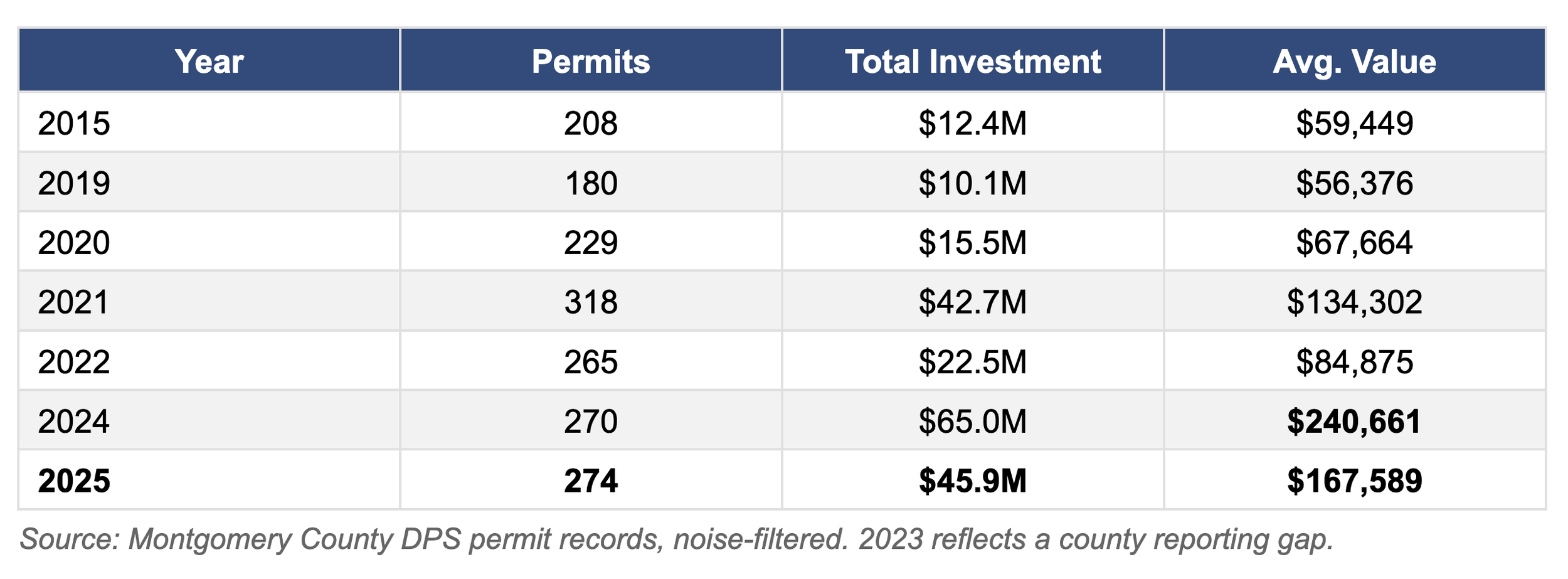
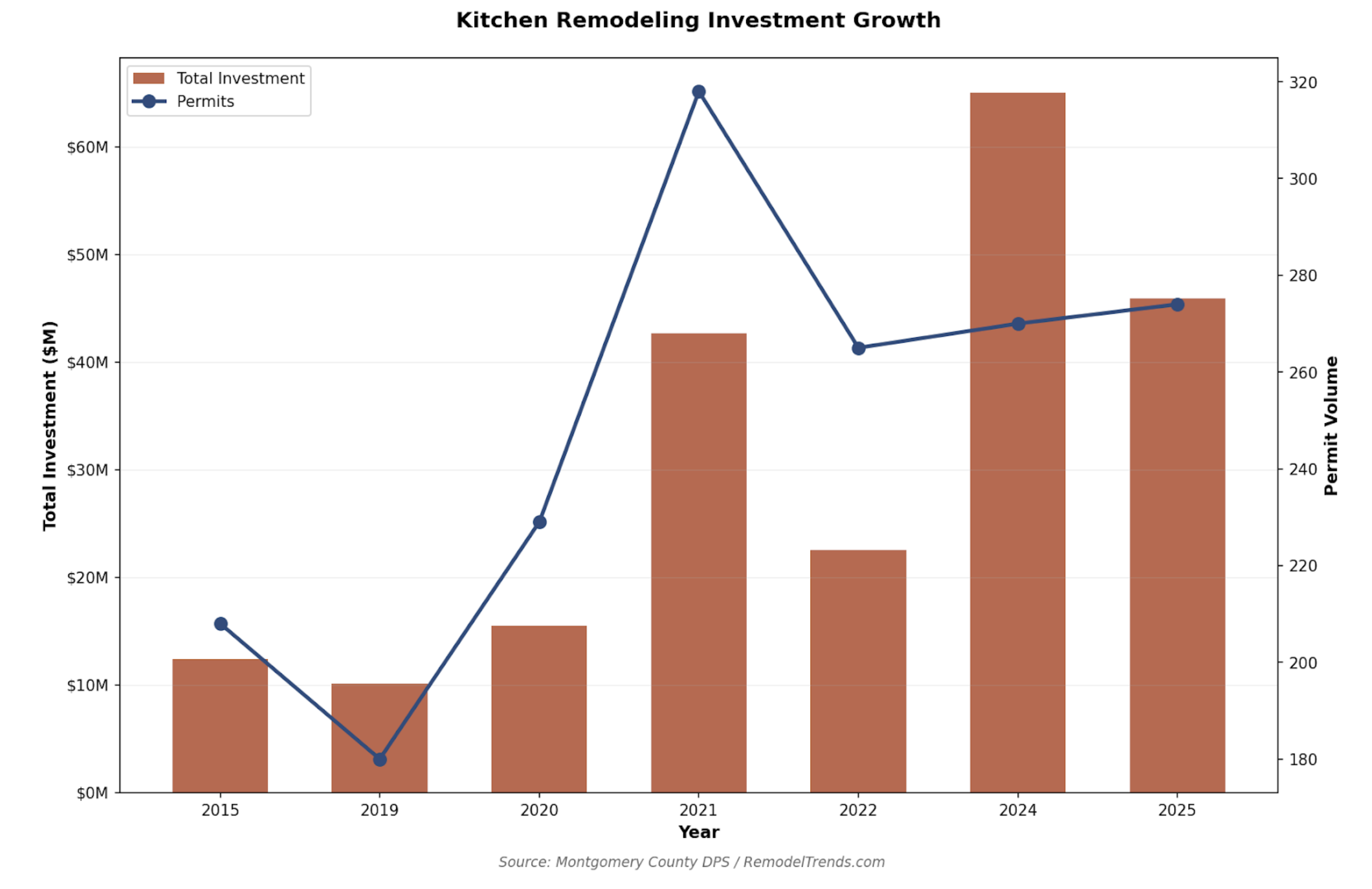
An analysis of 4,342 kitchen permits issued between 2000 and March 2026 reveals a market that has undergone a remarkable transformation. In 2019, the average kitchen project in Montgomery County was valued at $56,376. By 2024, that figure reached $240,661 — a 327% increase that briefly made kitchen remodels more expensive, on average, than building an entirely new addition onto a home. Even as values moderated in 2025 to $167,589, the average kitchen project remains nearly three times its pre-pandemic level.
Perhaps most striking: kitchen remodels of existing spaces now cost significantly more than building a kitchen from scratch. The "Remodel or Improve" segment averages $260,159, while "Build or Add" averages $123,890. Tearing out and rebuilding what you have costs more than starting with a blank slate — a counterintuitive reality that reflects the complexity of working within existing structural, plumbing, and electrical constraints.
The Numbers: Three Times the Investment
Between 2015 and 2019, the Montgomery County kitchen market was small and stable: roughly 180 to 210 permits per year, averaging $46,000 to $60,000 per project. Total annual investment ranged from $9 million to $12 million. It was, by remodeling standards, a predictable category.
Montgomery County DPS Permit Records, 2015-2025
Kitchen Remodeling Investment Growth, 2015-2025
The Crossover Moment: Kitchens vs. Additions
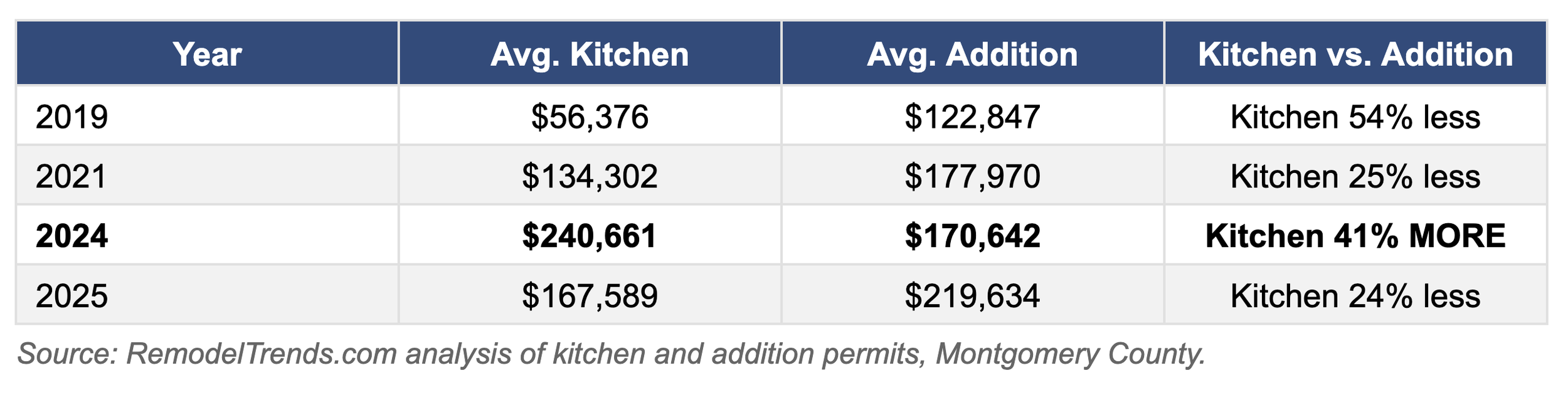
In 2024, something unprecedented happened in the permit data: the average kitchen remodel ($240,661) surpassed the average home addition ($170,642). A homeowner remodeling their existing kitchen was spending more, on average, than one adding an entirely new room to their house. While this gap narrowed in 2025 ($167,589 vs. $219,634), the convergence signals a fundamental shift in where homeowners are directing their most ambitious — and most expensive — renovation dollars.
Average Kitchen vs. Average Addition Investments Per Year, 2019-2025
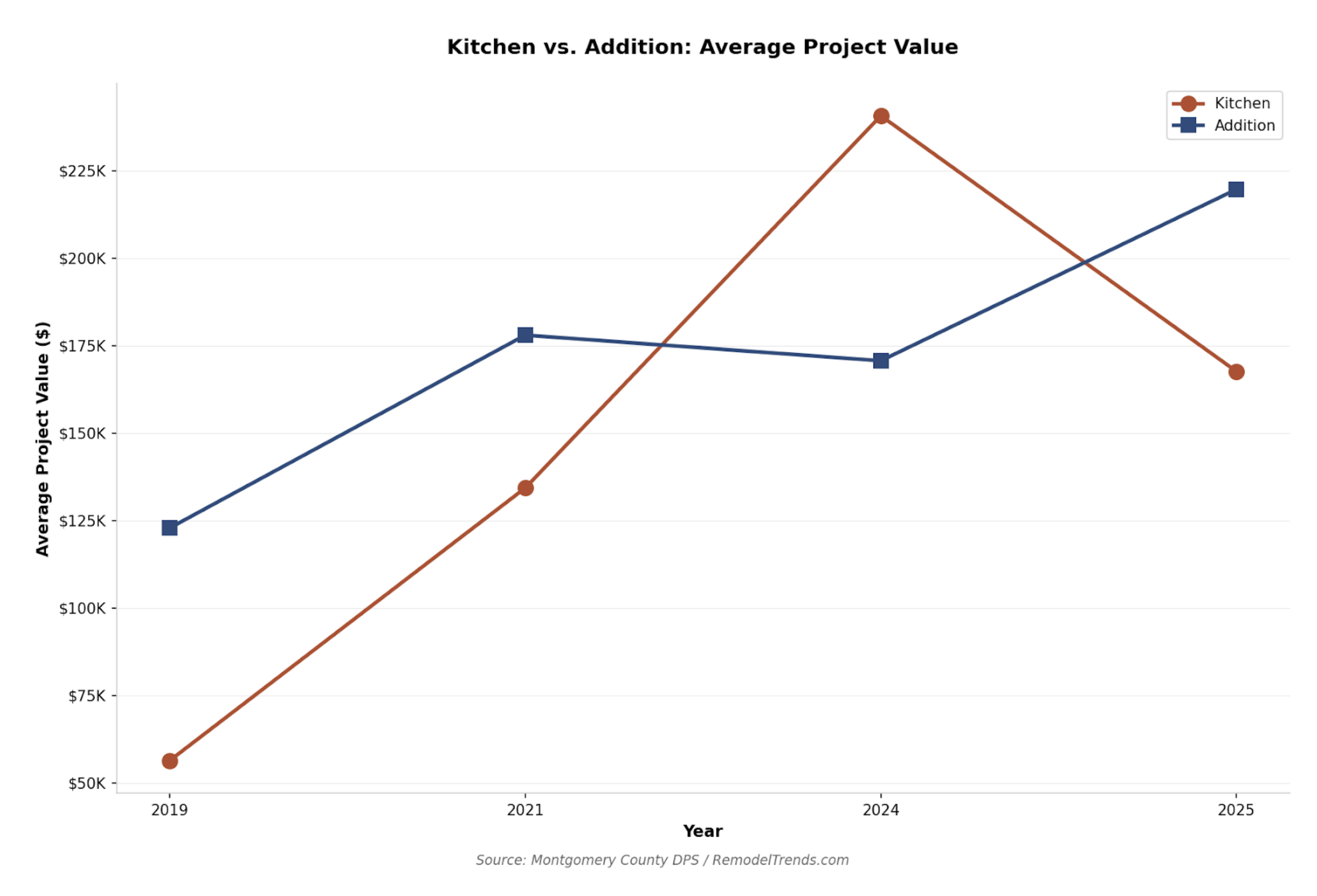
Kitchen vs. Addition: Average Project Value, 2019-2025
The Remodel Paradox: Why Updating Costs More Than Building New
The permit data reveals a counterintuitive pattern unique to kitchens. In the 2024–2025 period, kitchen projects classified as "Remodel or Improve" — updating an existing kitchen — averaged $260,159. Projects classified as "Build or Add" — creating a kitchen in new space — averaged $123,890. Renovating what exists costs more than twice as much as starting fresh.
This paradox has a practical explanation. Remodeling an existing kitchen means working around load-bearing walls, relocating plumbing stacks, upgrading electrical panels to support modern appliances, and managing the phased demolition of a space that homeowners often want to keep partially functional during construction. Every existing condition is a constraint. A new build starts with clean framing and runs utilities to where the design dictates. The difference in cost reflects the difference in complexity.
Where Kitchen Investment Is Concentrated
The most dramatic value increases are happening in communities that were historically mid-market for kitchen work. Bethesda's average kitchen project value rose 93% from the pre-pandemic baseline. Takoma Park climbed 128%. Olney jumped 117%. These are not wealthy enclaves bidding up luxury finishes — they are middle-market communities where homeowner expectations have simply risen to match what they see in design media, open houses, and their neighbors' recent renovations.
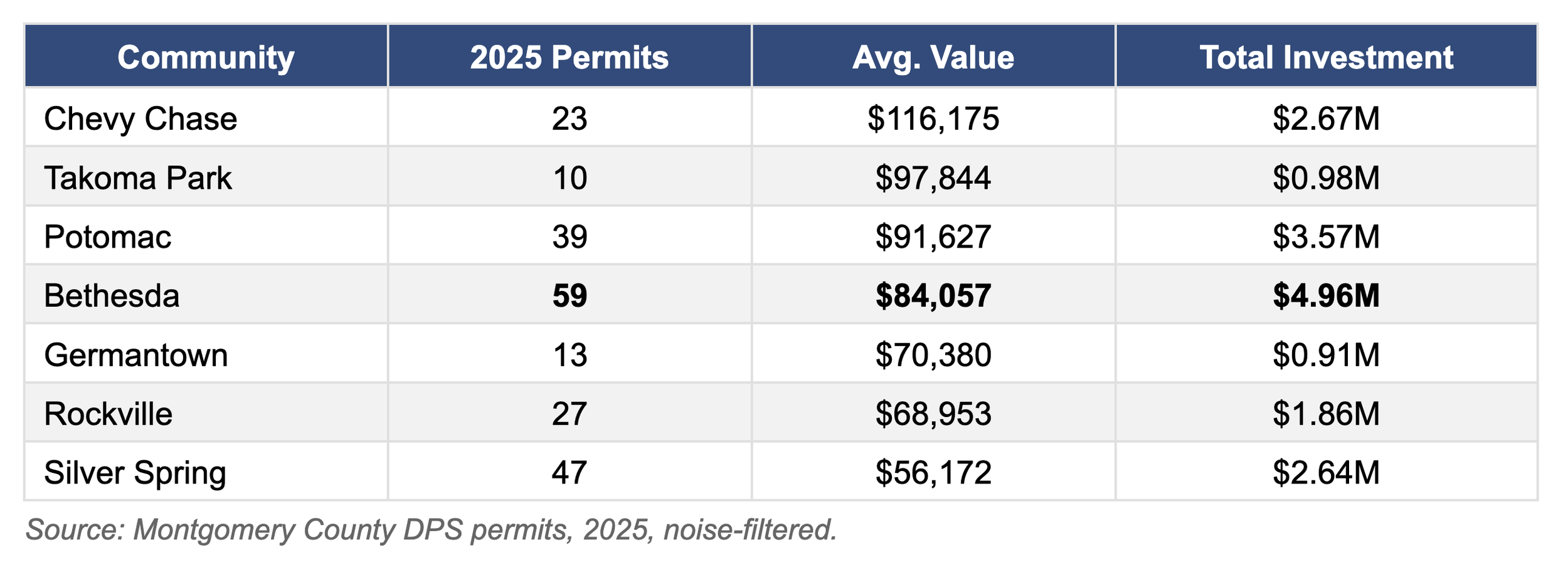
Montgomery County 2025 Permit Data
Bethesda leads in total kitchen investment at nearly $5 million across 59 projects in 2025. Potomac follows with $3.6 million across 39 projects. But average values tell a more nuanced story: Chevy Chase kitchens average $116,175, reflecting the high-specification remodels typical of its historic housing stock. Takoma Park, with its concentration of mid-century homes, averages $97,844 — a figure that reflects the growing willingness of homeowners in more modest markets to invest at levels that would have been unthinkable five years ago.
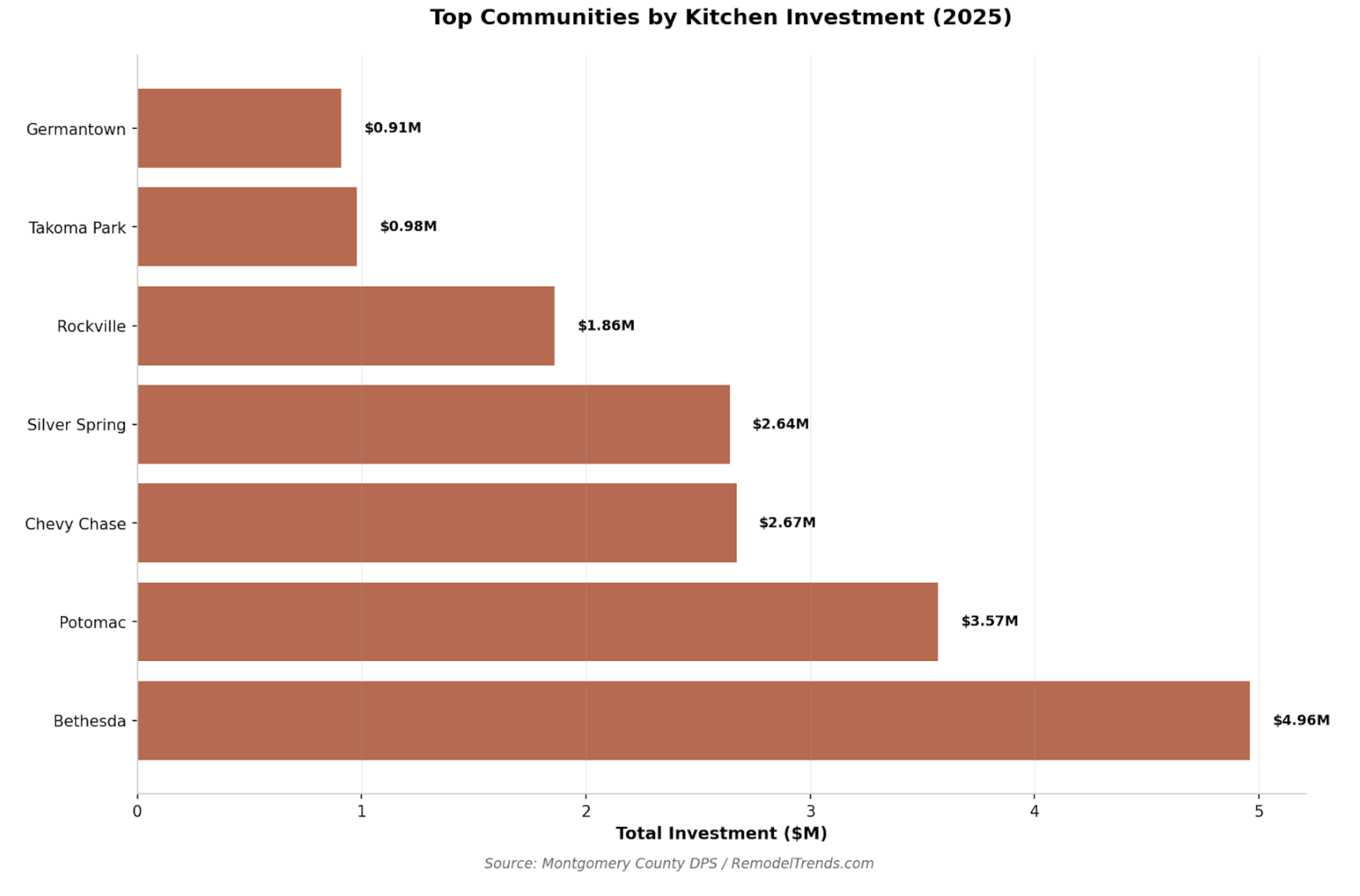
Top Kitchen Investment Communities in MD, 2025
The Value Shift: From Cosmetic to Structural
In 2019, four out of ten kitchen permits were for projects under $25,000 — cabinet refacing, countertop swaps, appliance upgrades. By 2025, that share dropped to 29%. The growth is concentrated in the $100K+ tiers, where projects now represent 25% of all kitchen permits, up from 16.5% in 2019. The kitchen remodel has evolved from a cosmetic refresh to a structural reinvention.
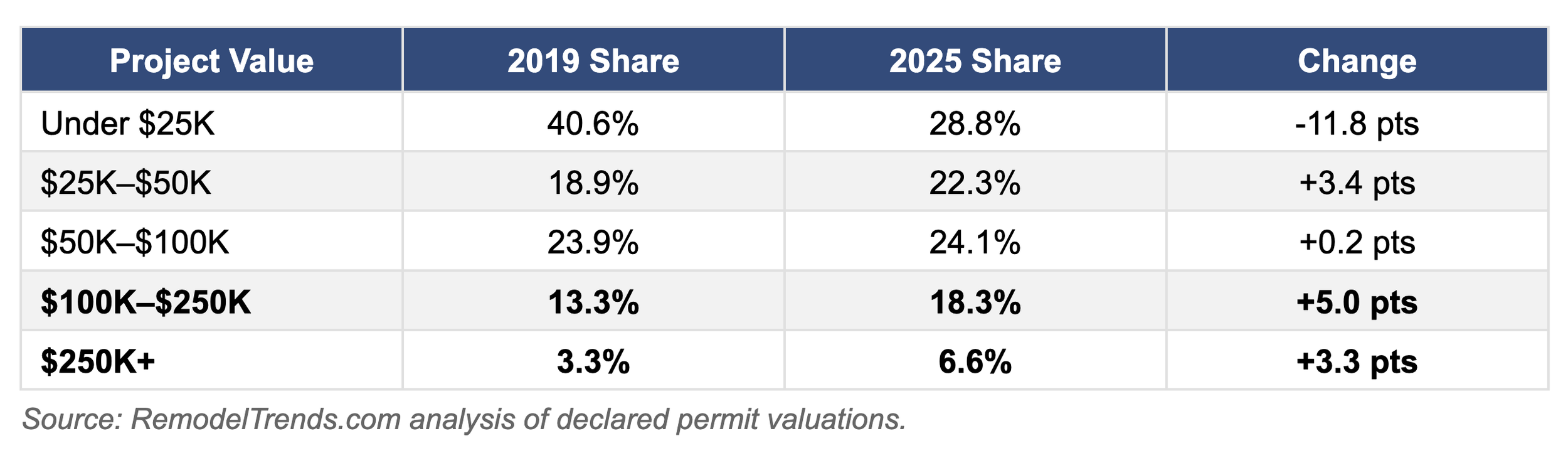
Growth in Kitchen Project Size, 2019-2025
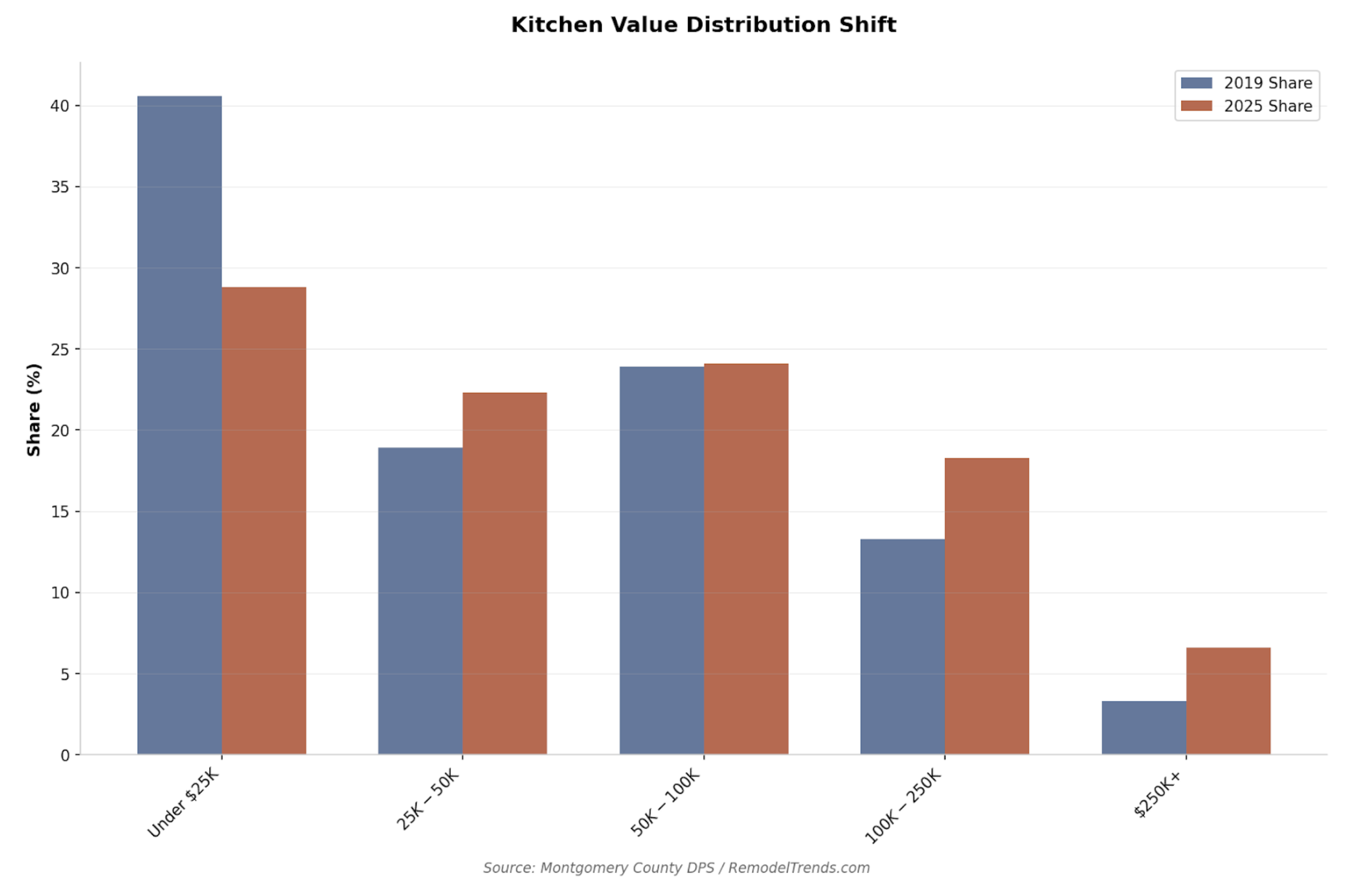
Kitchen Value Distribution Shift, 2019-2025
Why Kitchens, Why Now
1. The Kitchen as Social Infrastructure
The open-concept floor plan has been the dominant residential design trend for over a decade, and its logical conclusion is a kitchen that functions as the living room, dining room, and entertainment center simultaneously. The projects driving the $100K+ segment are not about better cabinets. They are about removing walls, relocating islands, adding seating for eight, and integrating the kitchen into the home's entire social footprint. This is structural work that requires engineering, permitting, and trade coordination far beyond a cosmetic refresh.
2. Appliance Complexity and Electrical Demands
Modern kitchen appliances have become dramatically more powerful and more numerous. Induction cooktops, double wall ovens, built-in steam ovens, wine columns, and commercial-grade ventilation systems all demand dedicated circuits, upgraded panels, and in some cases new gas lines. Many Montgomery County homes built before 1990 have 100-amp or 150-amp electrical service — inadequate for a modern kitchen's load. Panel upgrades alone can add $3,000 to $8,000 to a project, and the cascading requirements (new conduit runs, subpanel installations, GFCI protection) compound the cost.
3. The Design Media Effect
Platforms like Instagram, Pinterest, and Houzz have created a visual standard for kitchens that did not exist a decade ago. Homeowners arrive at consultations with mood boards featuring waterfall-edge quartz islands, integrated panel-ready appliances, and custom millwork. These finishes are beautiful — and expensive. The gap between what homeowners expect and what their existing kitchen contains has widened, and the permit data reflects the cost of closing that gap.
4. The Stay-and-Renovate Decision
With mortgage rates significantly higher than the sub-3% loans many homeowners locked in during 2020–2021, the financial incentive to stay in place and renovate rather than sell and buy has never been stronger. A homeowner with a 2.8% mortgage who wants a better kitchen is far better served by a $150,000 remodel than by selling, buying at current prices, and taking on a 6%+ mortgage. The permit surge in kitchens is, in part, a direct consequence of the mortgage rate lock-in effect.
What This Means for Homeowners
Budget for the Kitchen You Actually Want
The most common source of kitchen remodel frustration is a budget set for cosmetic work applied to a project that requires structural changes. If your project involves moving walls, relocating plumbing, or upgrading electrical — and most ambitious kitchen remodels do — the data suggests budgeting in the $100,000 to $200,000 range for a mid-to-upper market result in Montgomery County. Projects under $50,000 are viable for surface-level updates (counters, cabinets, flooring, paint) but will not support layout changes.
Expect a Four-to-Six-Month Timeline
A permitted kitchen remodel in Montgomery County involves design (4–6 weeks), permitting (2–4 weeks), demolition, rough-in inspections (electrical, plumbing, HVAC), framing inspections if walls are moved, finish installation, and final inspection. Realistic timelines for a full kitchen remodel run four to six months from signed contract to final walkthrough. The permit data shows July as the peak month for kitchen starts (69 permits), suggesting homeowners targeting a holiday-season completion should begin planning no later than early spring.
The Permit Is Not a Formality
Kitchen remodels that involve structural changes, electrical work, or plumbing modifications require building permits in Montgomery County. This is not bureaucratic overhead — it is the mechanism that ensures your contractor's work meets code, your home's structural integrity is maintained, and your investment is protected at resale. Unpermitted kitchen work can surface during a home sale inspection and create significant liability. In a market where the average kitchen project now exceeds $167,000, the cost of not permitting is far greater than the cost of compliance.
Looking Ahead
Early 2026 data shows 71 kitchen permits through mid-March — an annualized pace that would exceed 2025 if sustained. The mortgage rate lock-in effect, the design media influence, and the aging housing stock all point to continued strong demand for kitchen remodeling across Montgomery County.
The kitchen has become the room where homeowners make their most consequential renovation decisions — and where the gap between ambition and budget is widest. Understanding the true cost landscape, planning realistically, and working with contractors who navigate the permitting process as standard practice are the keys to a successful outcome.
Methodology
This analysis draws on 4,342 kitchen permits from the Montgomery County Department of Permitting Services, spanning January 2000 through March 2026. Permits were classified using keyword analysis of permit descriptions and filtered to exclude non-residential and noise records. Project intent ("Build or Add" vs. "Remodel or Improve") is derived from the permit's stated work type. Declared valuations are self-reported by permit applicants. 2023 data reflects a county reporting gap and is excluded from trend comparisons.
About Four Seasons Home Improvement
Four Seasons Home Improvement is a full-service home improvement contractor serving the greater Washington, D.C. metro area, Maryland, Northern Virginia, specializing in roofing, siding, windows, exterior renovations, bathrooms, and kitchen remodels. We aim to bring transparency to the local remodeling market through permit data analytics — because homeowners deserve to make decisions based on real data, not just sales pitches.
If you’re ready to start your home improvement project with a proven team that has served the DMV since 1976, get in touch for a free estimate today.
