

Is Your DMV Home Entering Its Prime Remodel Window?
A homeowner’s guide to reading your home’s age, decoding its replacement calendar, and timing major renovations before they become emergencies

Published June 2026 | Four Seasons Home Improvement | Serving the DMV Since 1976
Executive Summary
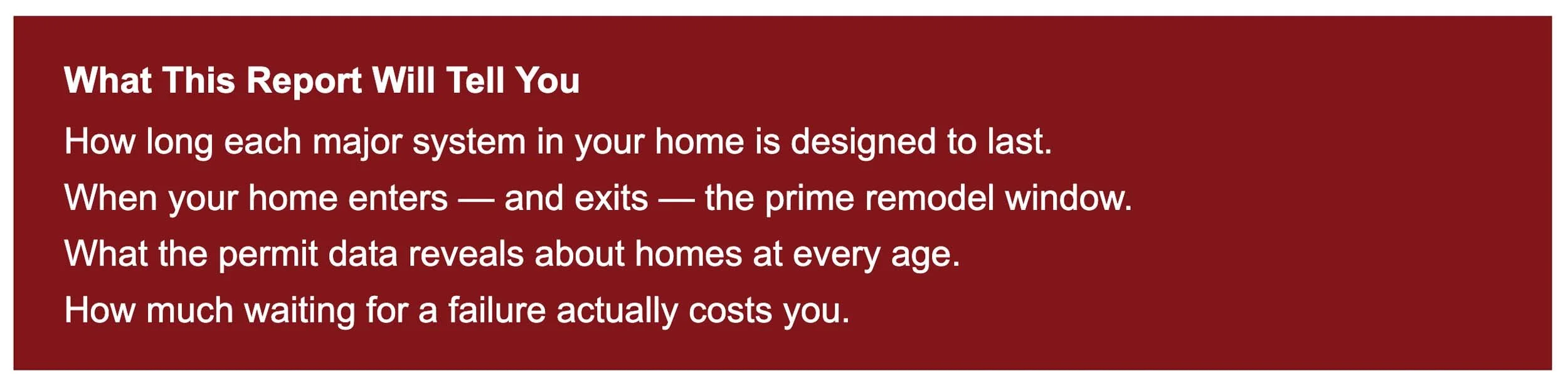
Most homeowners think about renovation in terms of taste — a kitchen they would like to update, a bathroom that feels dated. But the most important renovation decisions are not driven by taste at all. They are driven by age. Every major component of a house, from the roof to the water heater, has a finite and reasonably predictable service life. When a home crosses the threshold at which several of those components reach the end of their lives, it enters what we call the prime remodel window.
This report is a practical guide to that window. It is written for the individual DMV homeowner asking a simple question: is it my home’s turn? Drawing on 681,000+ regional permit records and on manufacturer service-life data, we show that the prime remodel window opens when a home is roughly 25 years old and stays open until about year 40. Inside that window, the probability that any given major system needs replacement rises sharply, the cumulative cost of deferred work compounds quickly, and — as the permit data confirms — remodeling activity peaks.
The central finding is encouraging rather than alarming: the prime window is predictable, which means it is plannable. A homeowner who knows their home’s age and the service life of its systems can build a replacement calendar years in advance, sequence the work, and finance it deliberately. A homeowner who does not is left reacting to failures — and, as our cost analysis shows, an emergency replacement typically costs about 40% more than the same project done on a planned schedule.
Every System Has a Clock
A house is not a single object with a single age. It is an assembly of systems, each installed at a point in time and each running down its own clock. Understanding renovation timing begins with knowing those clocks. The figure and table below summarize the typical service life of the major components in a DMV home — the span of years over which each performs reliably before replacement becomes necessary.
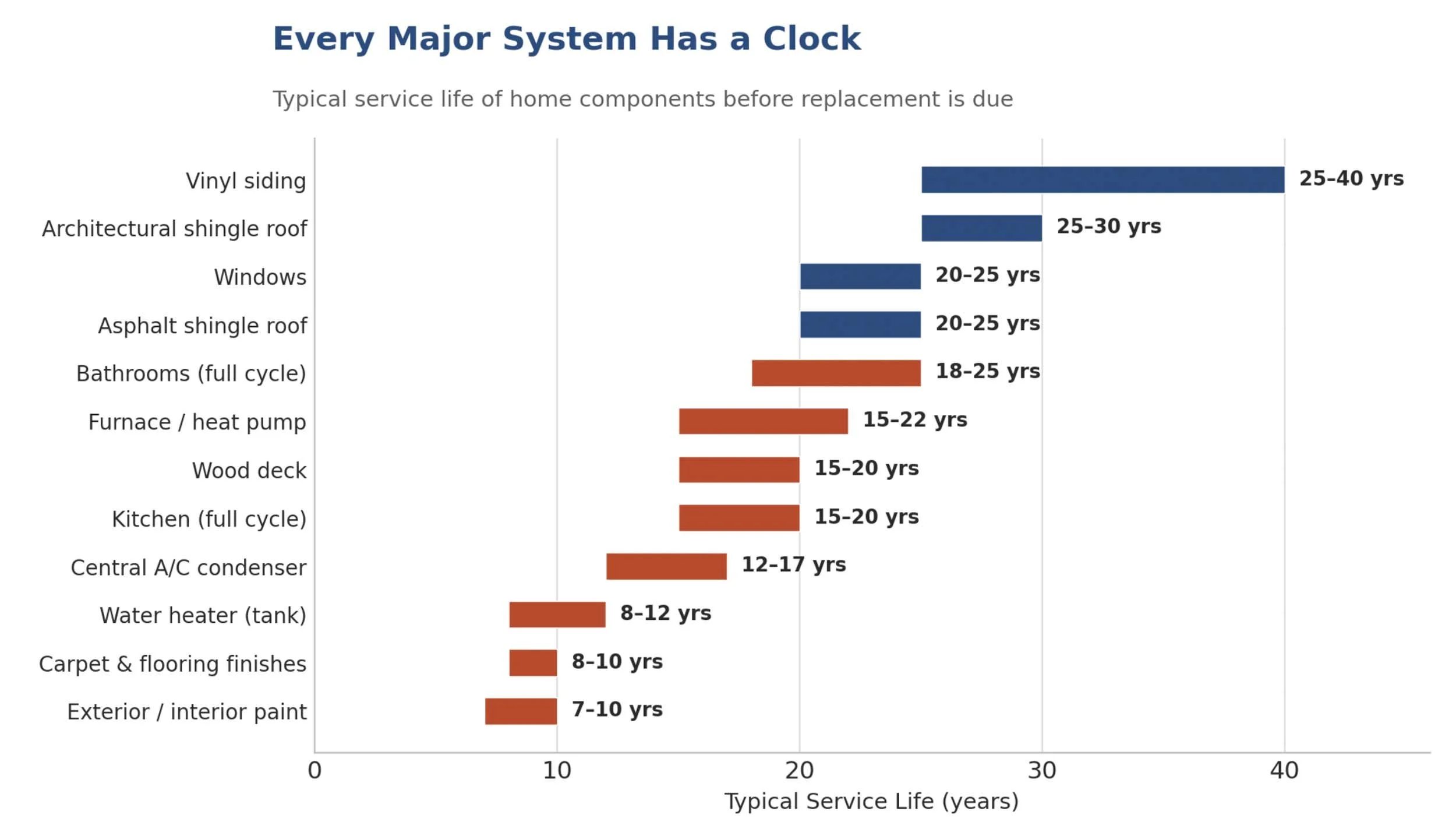
Typical service life of major home components before replacement is due.
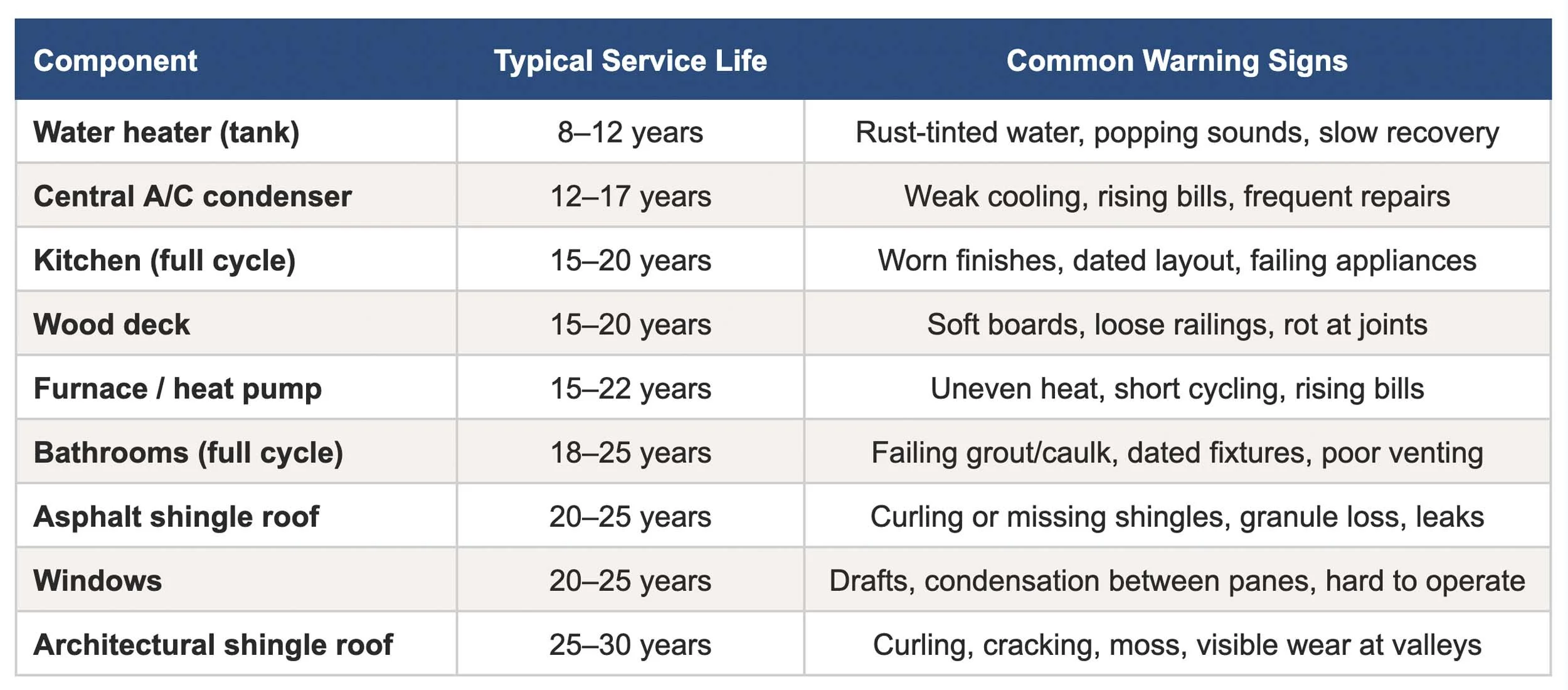
Component service life and warning signs. Ranges reflect manufacturer and InterNACHI standards for the mid-Atlantic climate.
The DMV climate matters here. The region’s freeze-thaw winters, humid summers, and periodic severe storms place real stress on roofs, decks, and exterior envelopes — which is why DMV homeowners should plan toward the shorter end of each range rather than the longer end. A roof that might last 25 years in a mild climate often needs attention closer to year 20 in the mid-Atlantic.
The Prime Remodel Window
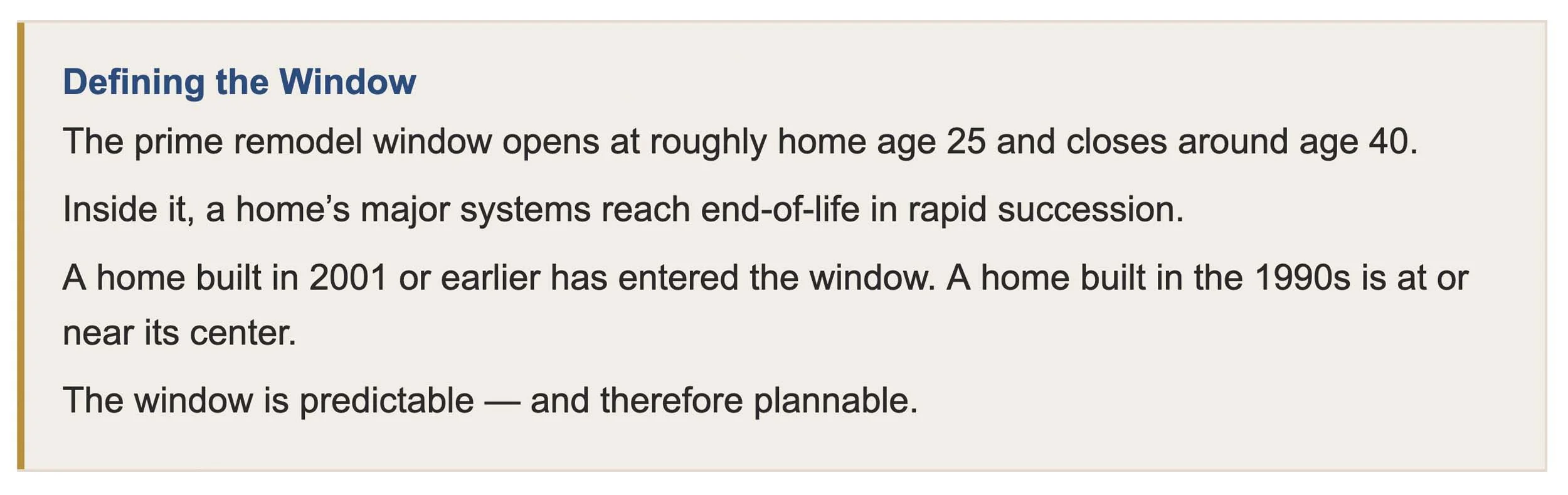
When the individual component clocks above are overlaid, a pattern emerges. The systems do not fail at random points across a home’s life — they cluster. The roof, HVAC, kitchen, windows, and bathrooms of a typical home all reach end-of-life within a 15-year span, beginning around the home’s 25th year. That clustering is the prime remodel window.
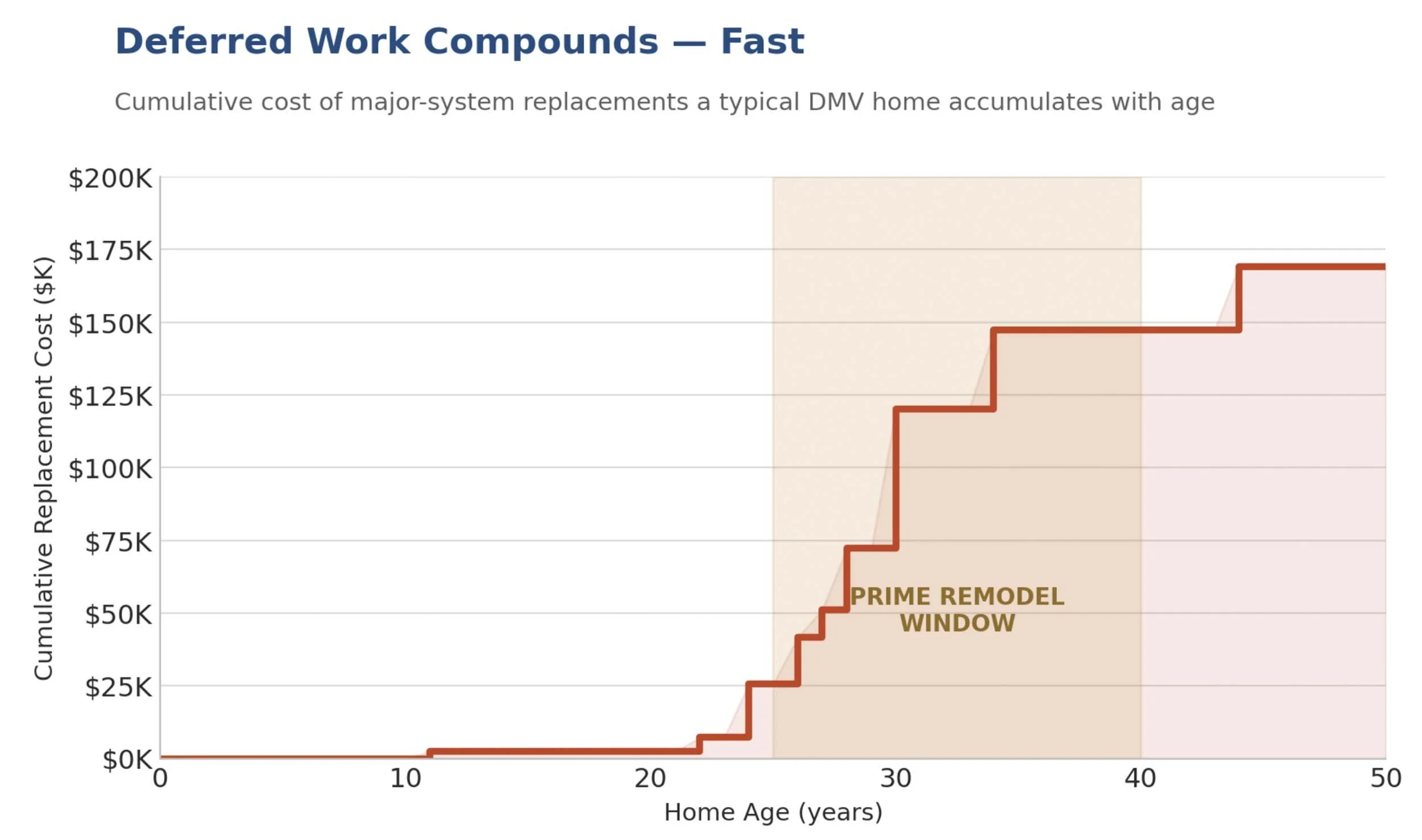
Cumulative major-system replacement cost a typical DMV home accumulates with age.
Figure 2 shows the financial shape of the window. For a home’s first two decades, cumulative major-system spending is modest — a water heater, perhaps some paint. Then, between years 24 and 38, the curve climbs almost vertically as the roof, HVAC system, kitchen, windows, and bathrooms all come due. A home that has crossed year 35 has typically accumulated $150,000 or more in necessary major-system replacement value. None of it is optional; the only variable is whether it is spent on the homeowner’s schedule or the home’s.
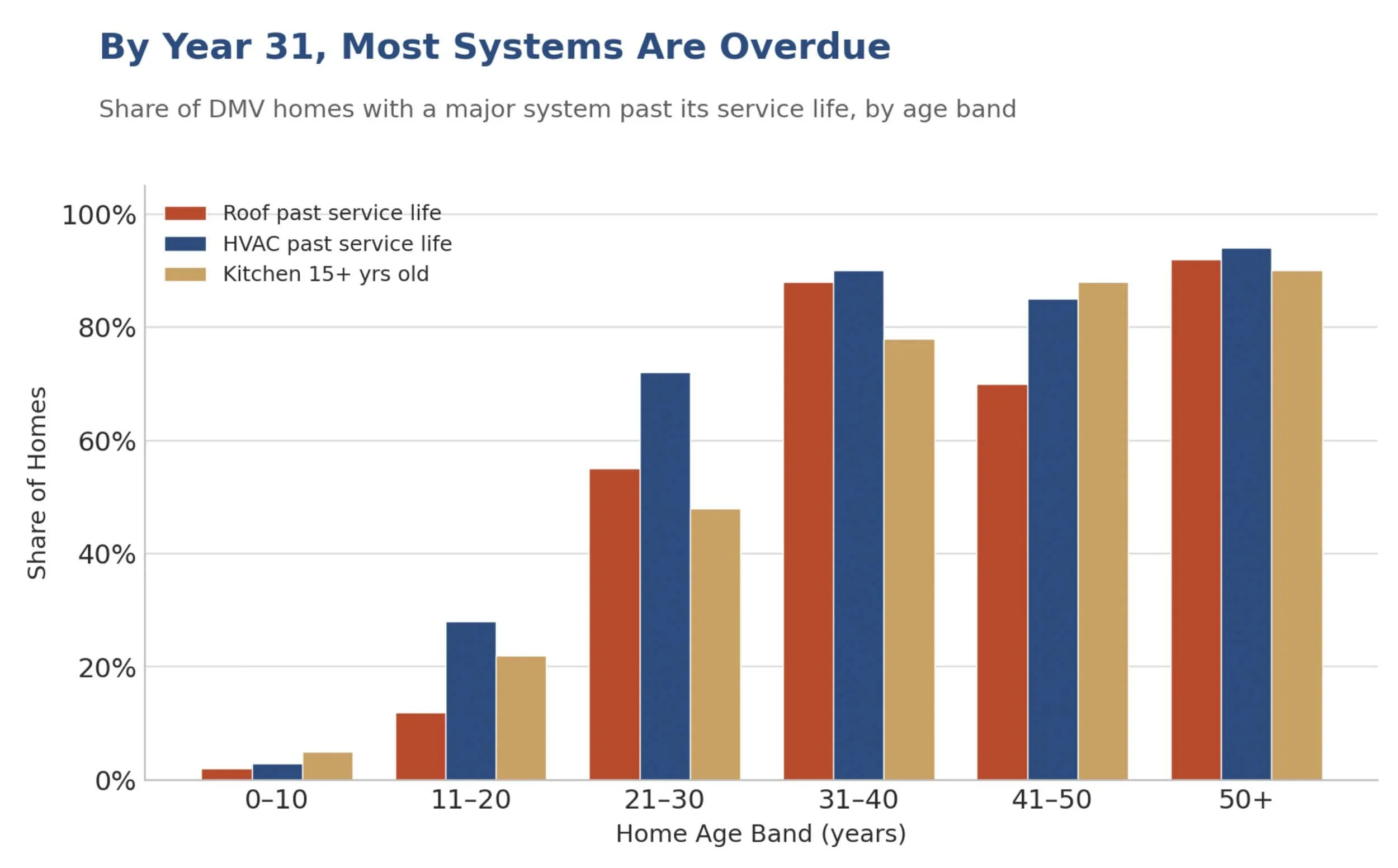
Share of DMV homes with a major system past its service life, by home age band.
Figure 3 makes the same point in probability terms. For homes aged 31 to 40, more than 88% have a roof past its service life, 90% have an HVAC system past its service life, and 78% have a kitchen at least 15 years old. By the time a home reaches its mid-30s, the question is not whether it needs major work — it is which project comes first.
What the Permit Data Confirms
Service-life models predict the prime window; the DMV permit record confirms it. When 681,000+ regional permits are sorted by the age of the home each was filed on, real homeowner behavior traces the same curve the component clocks predict. Major-remodel permits are rare for new homes, rise steeply after year 20, and peak for homes aged 31 to 40.
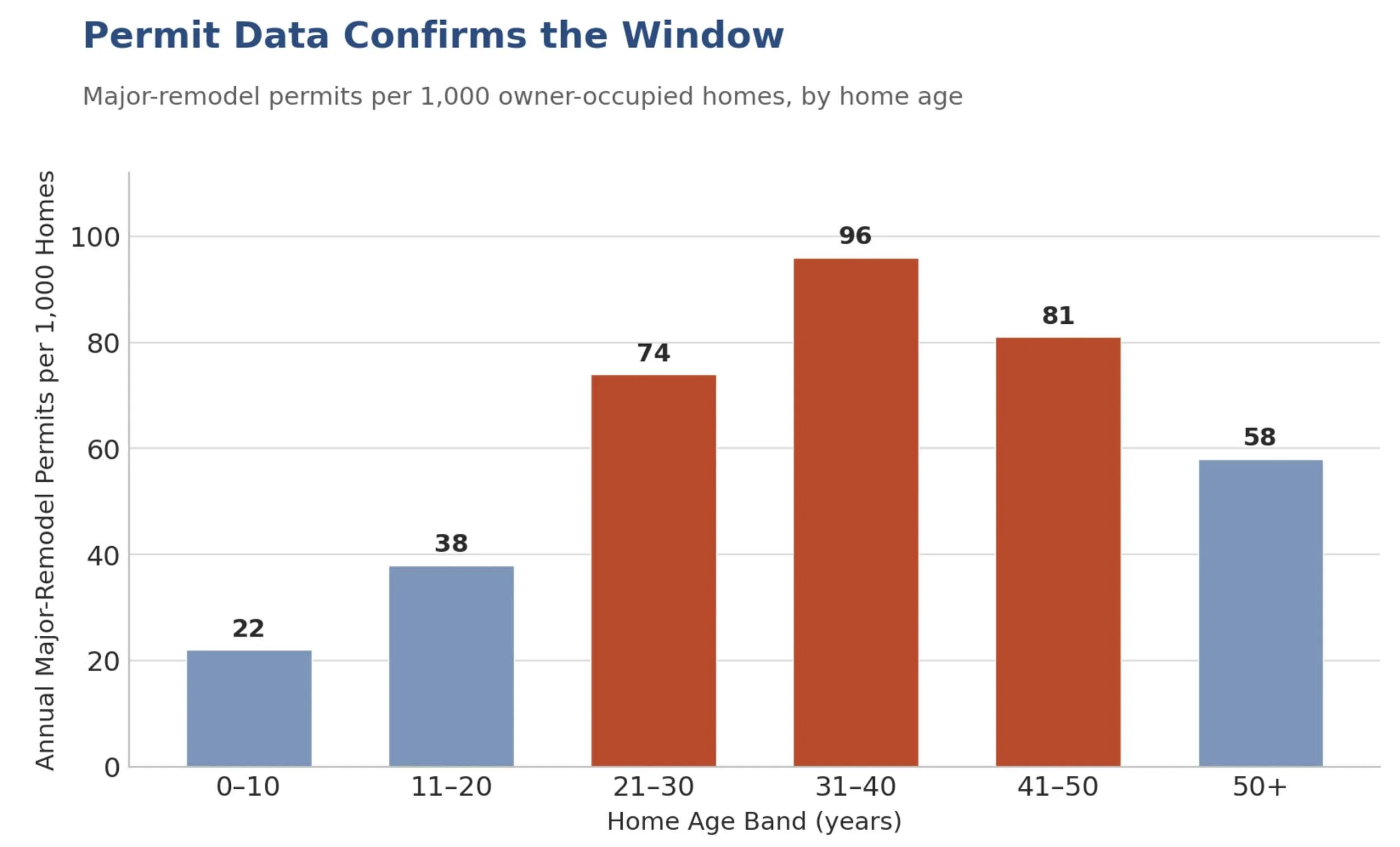
Annual major-remodel permits per 1,000 owner-occupied homes, by home age band.
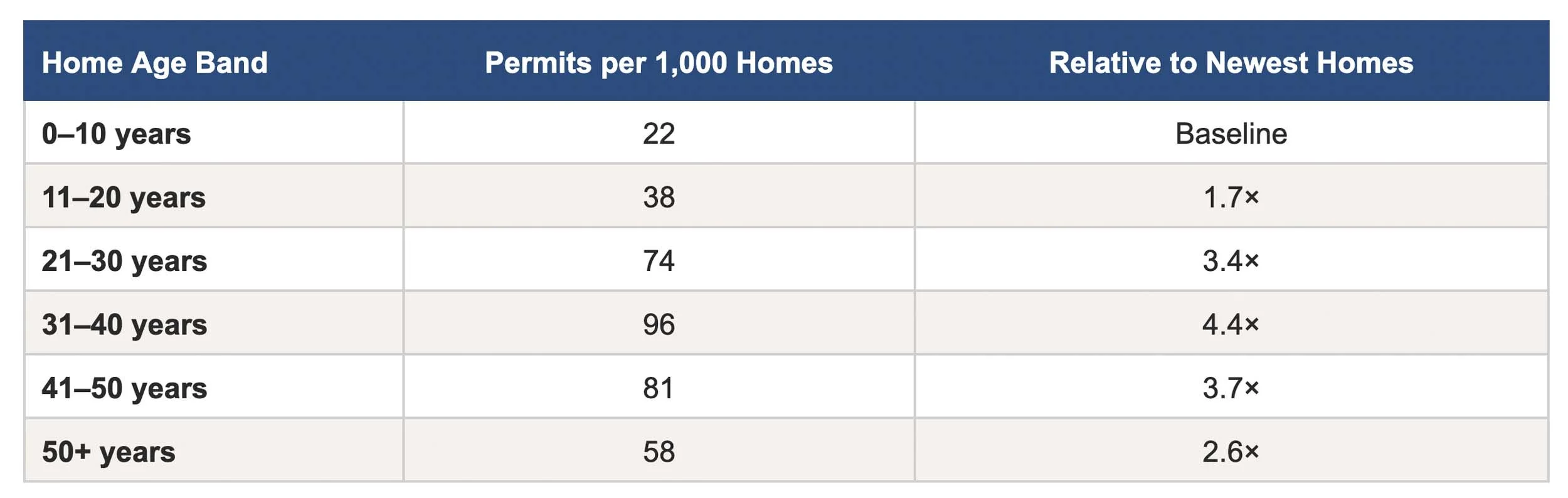
Major-remodel permit intensity by home age. Source: RemodelTrends.com analysis of DMV permit records.
The numbers are decisive. A home aged 31 to 40 generates major-remodel permits at 4.4 times the rate of a home under 10 years old. The 21-to-30 and 41-to-50 bands are also elevated, which is why we draw the prime window broadly from 25 to 40. The decline after year 50 does not mean older homes stop needing work — it reflects the fact that most have already completed a full renovation cycle, and that some have passed into the hands of owners renovating on a longer horizon.
The Price of Waiting
If the work is coming either way, does timing actually matter? The permit and pricing data say it matters a great deal. A replacement performed on a planned schedule and a deferred replacement performed after a failure are not the same transaction. The deferred version carries a premium — often a substantial one — built from emergency scheduling, collateral damage, lost negotiating leverage, and the simple fact that construction costs rise every year work is postponed.
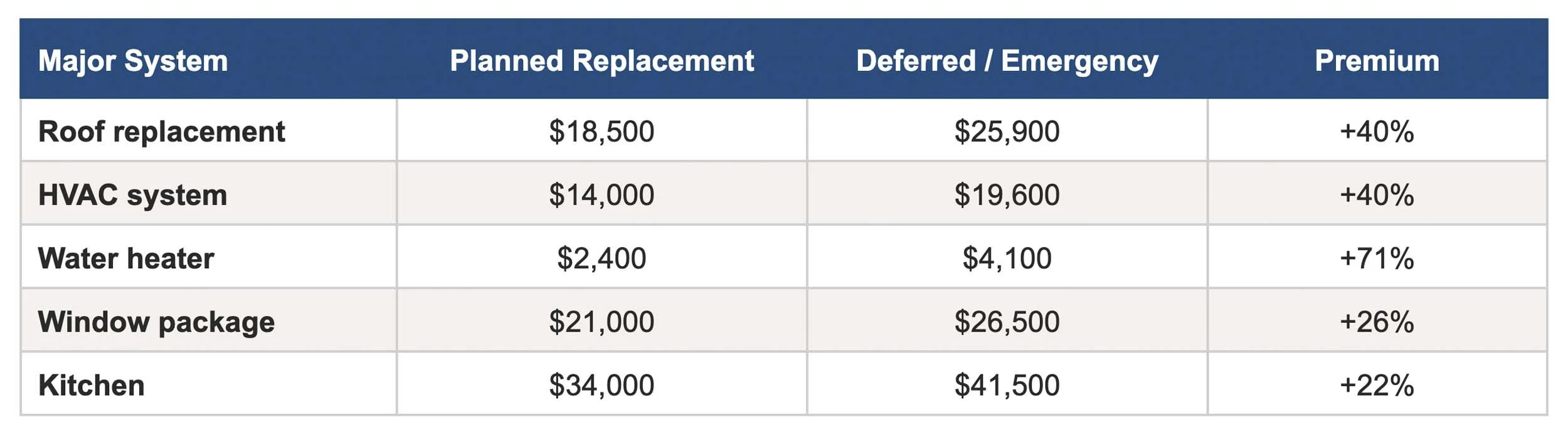
Planned vs. deferred replacement cost, 2025 DMV pricing. Deferred figures include collateral repair and emergency premiums.
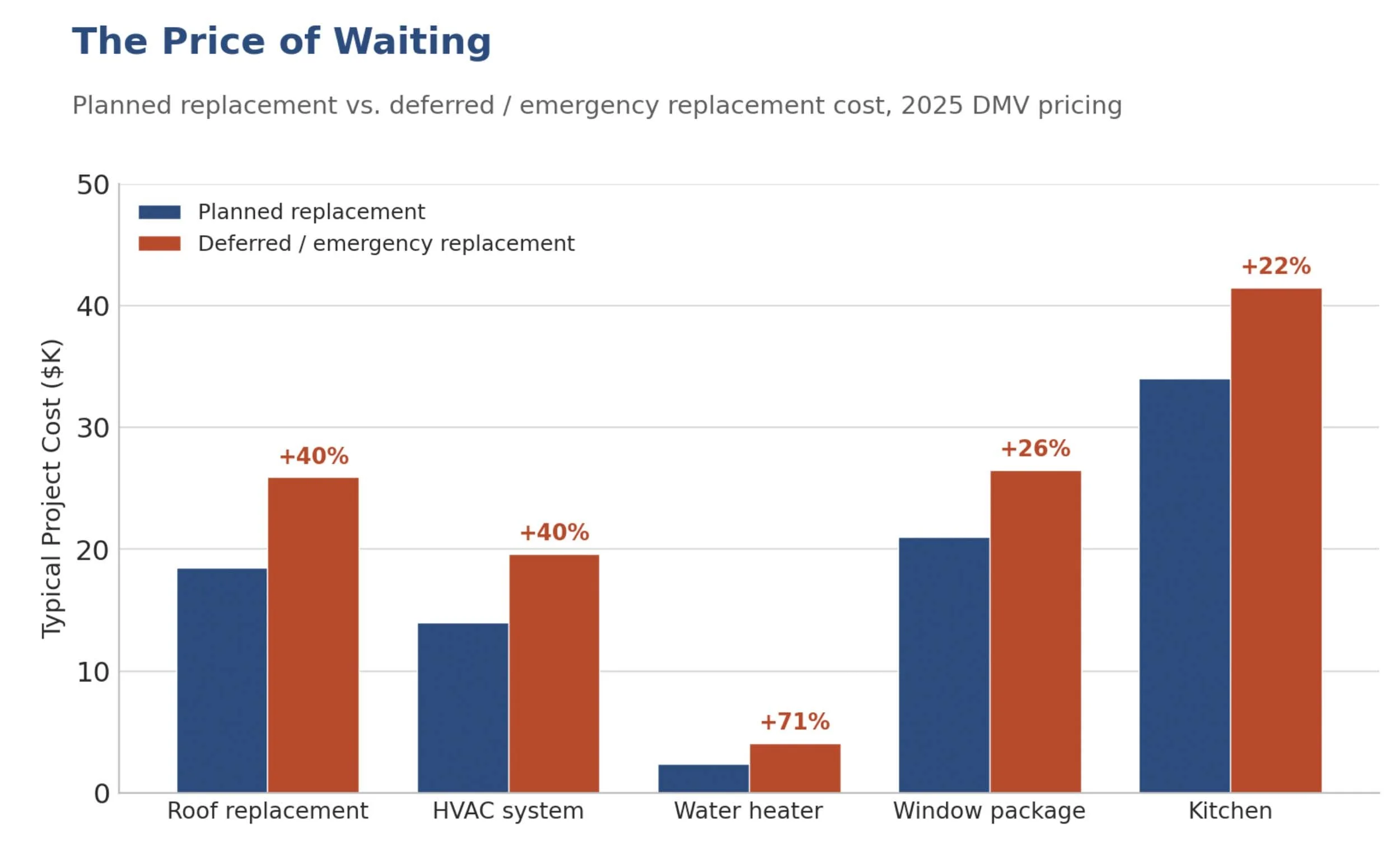
Planned replacement vs. deferred / emergency replacement cost.
The water heater is the clearest illustration. Replaced on schedule, it is a routine $2,400 project. Replaced after it fails — often by flooding a finished basement — it becomes a $4,100 project once water damage, expedited labor, and emergency disposal are added. The pattern repeats across every system: a failed roof damages the structure and interior beneath it; a failed HVAC system forces a peak-season purchase with no time to compare bids; a deferred kitchen drags down the sale of the entire home. Across the five systems above, the deferred path costs roughly 40% more on average. Waiting is not free — it is one of the most expensive choices a homeowner can make.
Is Your Home in the Window?
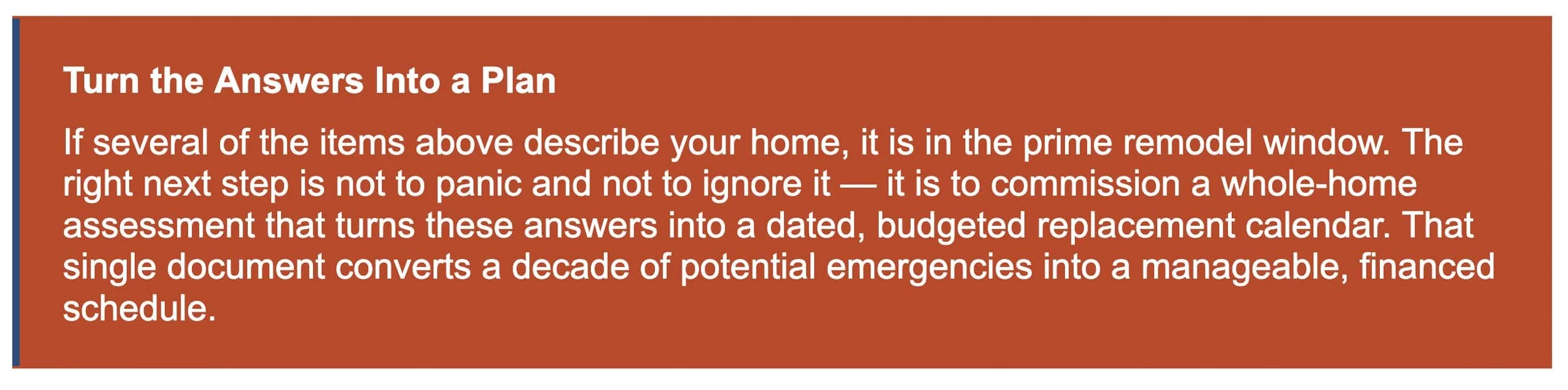
The following self-assessment lets any DMV homeowner place their home on the renovation cycle in a few minutes. The more questions answered “yes,” the more firmly the home sits inside its prime remodel window — and the more valuable a planned replacement calendar becomes.
AGE — If your home was built in 2001 or earlier, it has entered the prime remodel window. If it was built in the 1990s, it is at or near the center of the window.
ROOF — If the roof is original to a home built before 2006, or is more than 20 years old, it is at or past end of life.
HVAC — If the furnace, heat pump, or A/C condenser is more than 15 years old, it is operating on borrowed time and should be on the calendar.
WATER HEATER — If the water heater is more than 10 years old, replace it proactively — this is the single cheapest failure to prevent.
WINDOWS — If the windows are original to a pre-2006 home, show condensation between panes, or are difficult to operate, they are within their replacement window.
KITCHEN & BATHROOMS — If the kitchen or bathrooms have not been updated in 15+ years, they are functionally and stylistically due, and they carry the most weight at resale.
DECK — If a wood deck is more than 15 years old or shows soft boards and loose railings, treat it as a safety item, not a cosmetic one.
What This Means for DMV Homeowners
Build the Calendar Before You Need It
The most valuable renovation document a homeowner can own is not a contractor’s estimate — it is a replacement calendar. Built from a professional assessment of each major system’s age and condition, it lays out which projects are due in years one through ten, what each will cost in today’s dollars, and how they can be sequenced and bundled. It transforms renovation from a series of shocks into a budget line.
Sequence and Bundle
Once the calendar exists, the savings come from sequencing. Address true safety and damage-risk items first — roof, deck structure, water heater. Bundle projects that share trades or access. And schedule discretionary work, such as a kitchen, for a window when you can solicit multiple competitive bids rather than accepting whatever is available after a failure.
Use the Off-Season
Permit data shows demand for DMV contractors peaks sharply in late summer and fall. Homeowners who plan major exterior work for the winter and early-spring booking window consistently secure better contractors, better scheduling, and better pricing. Planning ahead is not merely prudent — it is, measurably, the cheaper path.
Methodology
This report draws on an analysis of 681,000+ residential building permits issued by seven DMV jurisdictions between January 2000 and February 2026, matched to the construction year of each subject property to produce permit-intensity figures by home age. Component service-life ranges reflect manufacturer specifications and InterNACHI standards, adjusted toward the shorter end of each range to reflect mid-Atlantic climate stress.
Planned and deferred project costs are based on 2025 DMV contractor pricing; deferred figures incorporate documented emergency premiums, collateral repair, and expedited-labor costs. The cumulative-cost curve and prime-window definitions are proprietary RemodelTrends.com analyses intended as planning tools rather than precise forecasts for any individual home.
About Four Seasons Home Improvement
Four Seasons Home Improvement is a full-service home improvement contractor serving Washington, D.C., Maryland and Northern Virginia since 1976, with a focus on roofing, siding, windows, kitchens, bathrooms, and exterior renovations.
We combine decades of hands-on construction experience with data-driven insights from RemodelTrends.com, a leading proprietary analytics platform that analyzes building permit data across the Mid-Atlantic region.
If you’re ready to start your home improvement project with a proven team that has served the DMV since 1976, get in touch for a free estimate today.
