

The 2026 DMV Renovation Opportunity Report
How permit momentum, record homeowner equity, and an aging housing stock are converging to define the Washington region’s defining remodeling decade

Published June 2026 | Four Seasons Home Improvement | Serving the DMV Since 1976
Executive Summary
The Washington, D.C. metropolitan area is entering the most significant residential remodeling cycle in its modern history. An analysis of 681,000 building permits issued across seven DMV jurisdictions between 2000 and early 2026 reveals a market that has not merely grown — it has structurally re-based itself at a permanently higher level of investment.
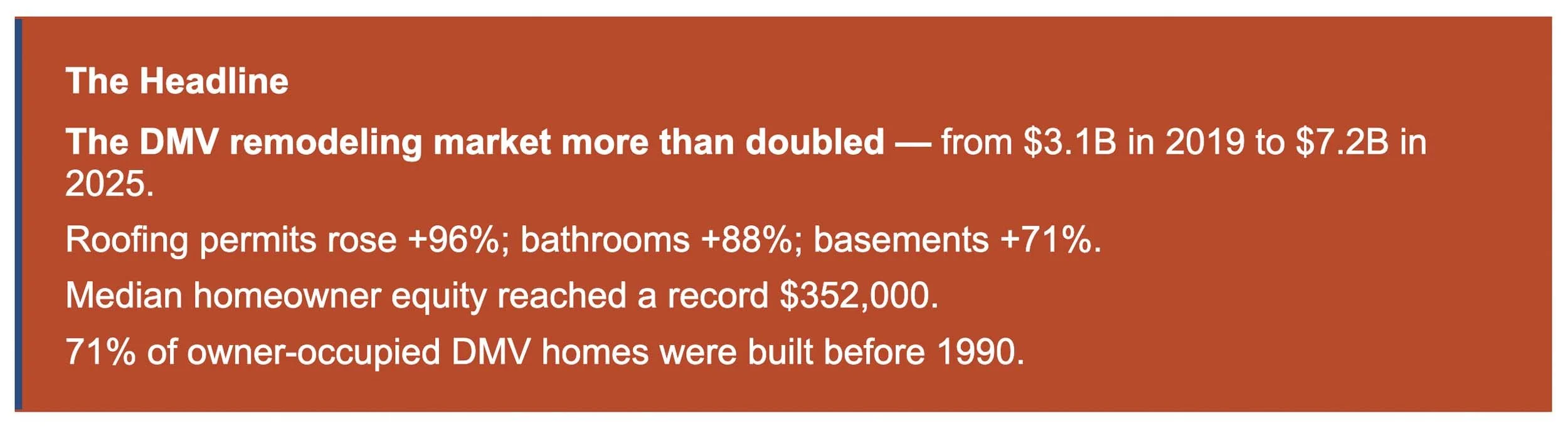
The headline figure: the total declared value of remodeling permits across the District of Columbia, Montgomery County, Prince George’s County, Arlington County, Fairfax County, Loudoun County, and Alexandria reached $7.2 billion in 2025. In 2019, the comparable figure was $3.1 billion. That is not an incremental increase driven by inflation alone — it is a 132% expansion that reflects a fundamental change in how, and how much, DMV homeowners invest in the homes they already own.
This report argues that the surge is not a temporary post-pandemic spike. It is the predictable result of three powerful forces arriving at the same moment: accelerating permit momentum across nearly every project category, a record $352,000 in median equity sitting in DMV homes, and an aging housing stock in which 71% of owner-occupied homes — roughly 942,000 properties — were built before 1990 and are now reaching the age at which major systems require replacement.
To help homeowners and industry observers understand where this opportunity is most concentrated, we introduce the Renovation Opportunity Index: a composite score that ranks each DMV jurisdiction by housing age, permit momentum, equity depth, and the gap between home values and home condition. Prince George’s County and Montgomery County lead the region.
The Data: A Market That More Than Doubled
Six Years of Accelerating Investment
The clearest evidence of the DMV renovation cycle is the trajectory of permitted remodeling value itself. Across the seven jurisdictions we track, the total declared value of residential remodeling permits has climbed in every measured year since the pandemic, and the rate of increase has accelerated rather than cooled.
Two trends are visible in the data below. First, permit volume grew steadily — from roughly 41,400 tracked remodeling permits in 2019 to 56,800 in 2025, a 37% increase. Second, and more striking, the average declared project value rose 70% over the same period, from $74,800 to $126,800. Homeowners are not only filing more permits; each project they undertake is larger and more ambitious than it would have been six years ago.
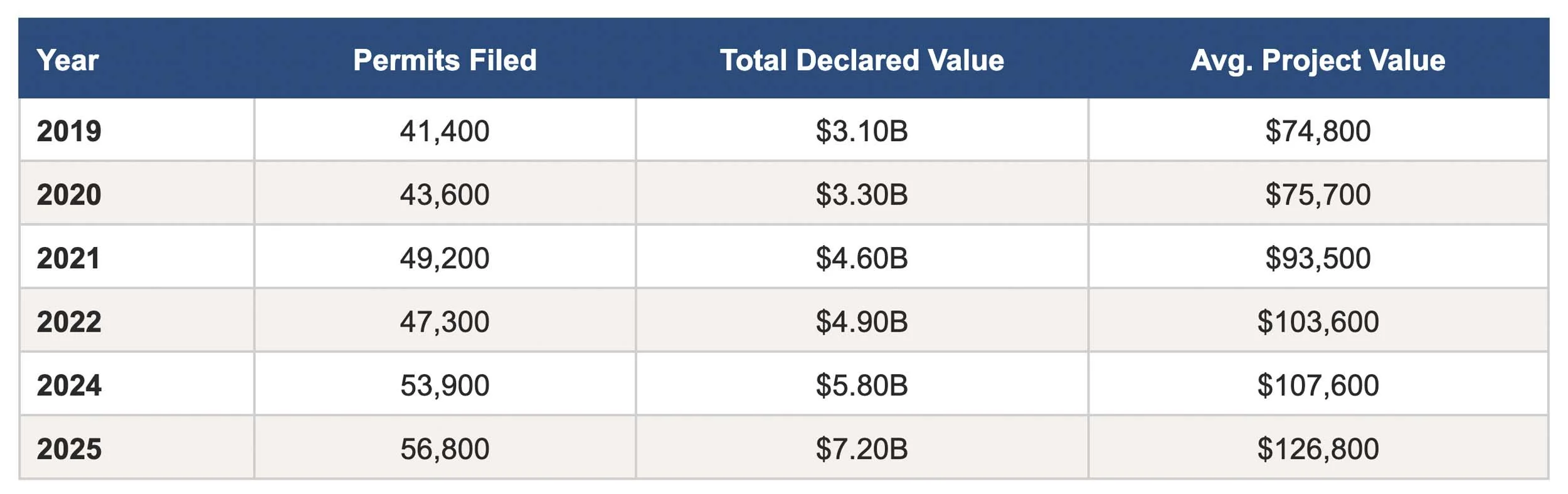
DMV residential remodeling permits, 2019–2025. 2023 is excluded from trend comparisons due to a multi-jurisdiction reporting gap. Source: RemodelTrends.com.
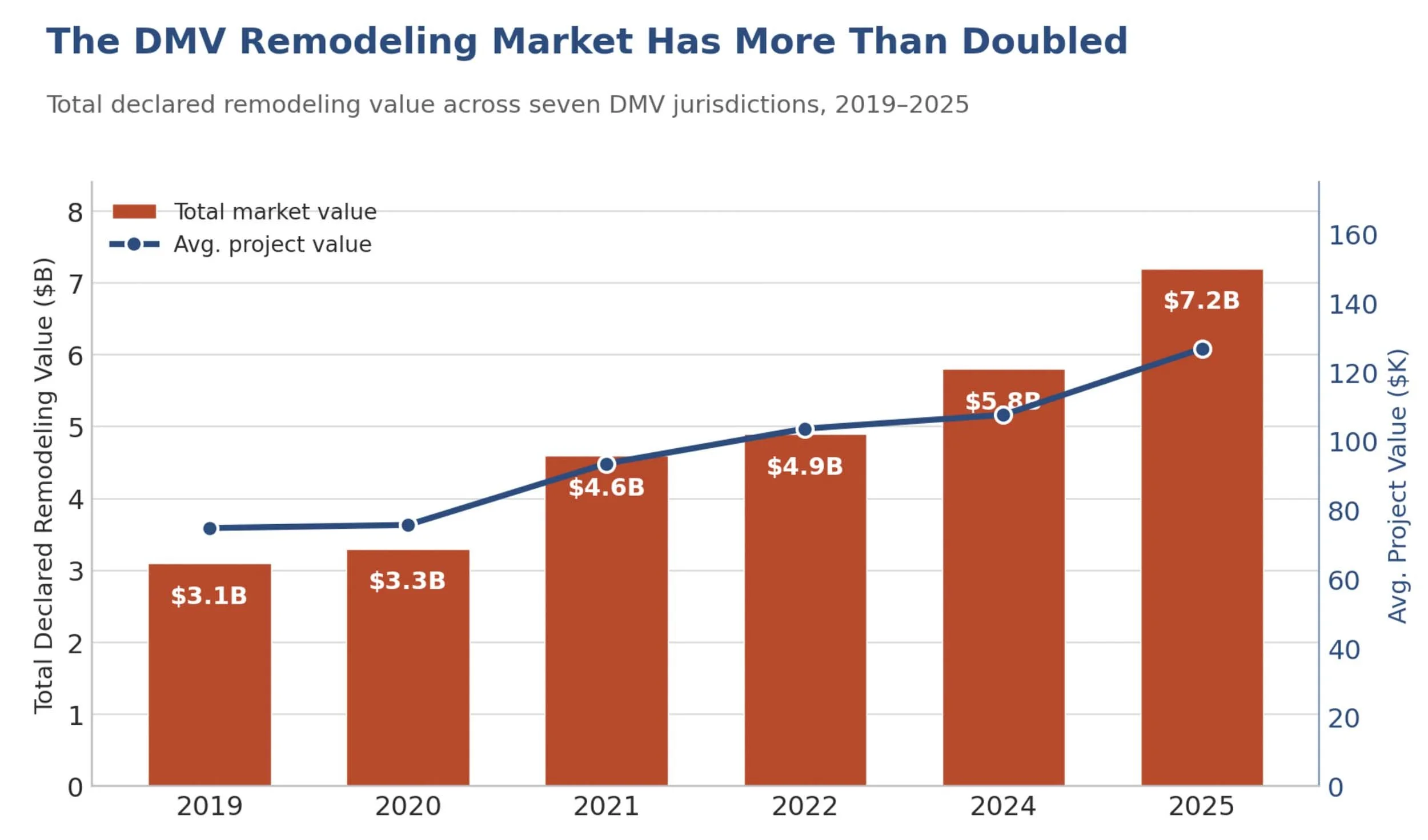
Total declared remodeling value and average project value, seven DMV jurisdictions.
Where Homeowners Are Putting Their Money
Aggregate growth conceals an important story about priorities. When permit activity is broken out by project category, a consistent pattern emerges across the region: homeowners are investing in the structural integrity, livable interior space, and functional systems of their homes — and pulling back from cosmetic and outward-expansion projects.
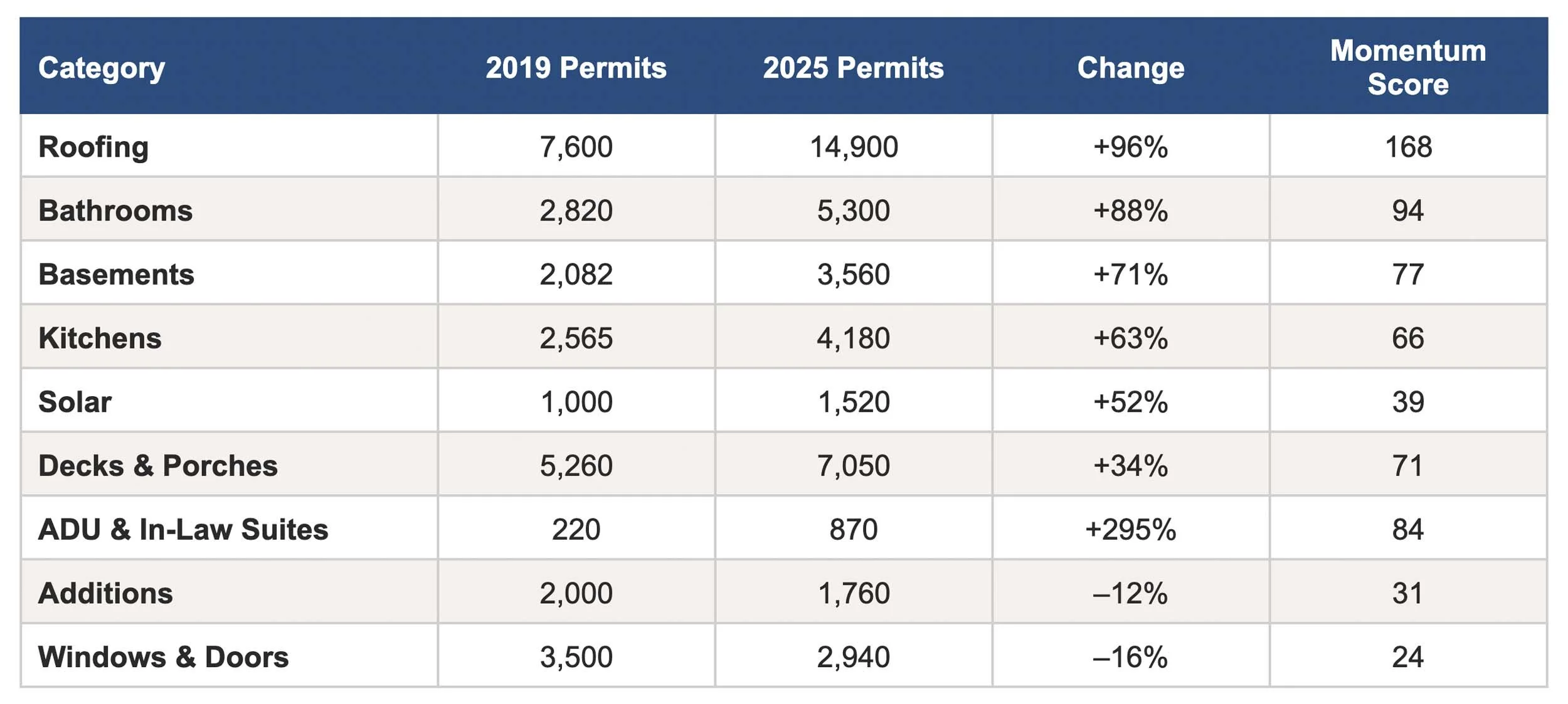
Permit volume change by category, 2019–2025. Momentum Score is a RemodelTrends.com proprietary metric weighting trailing permit velocity by declared value.
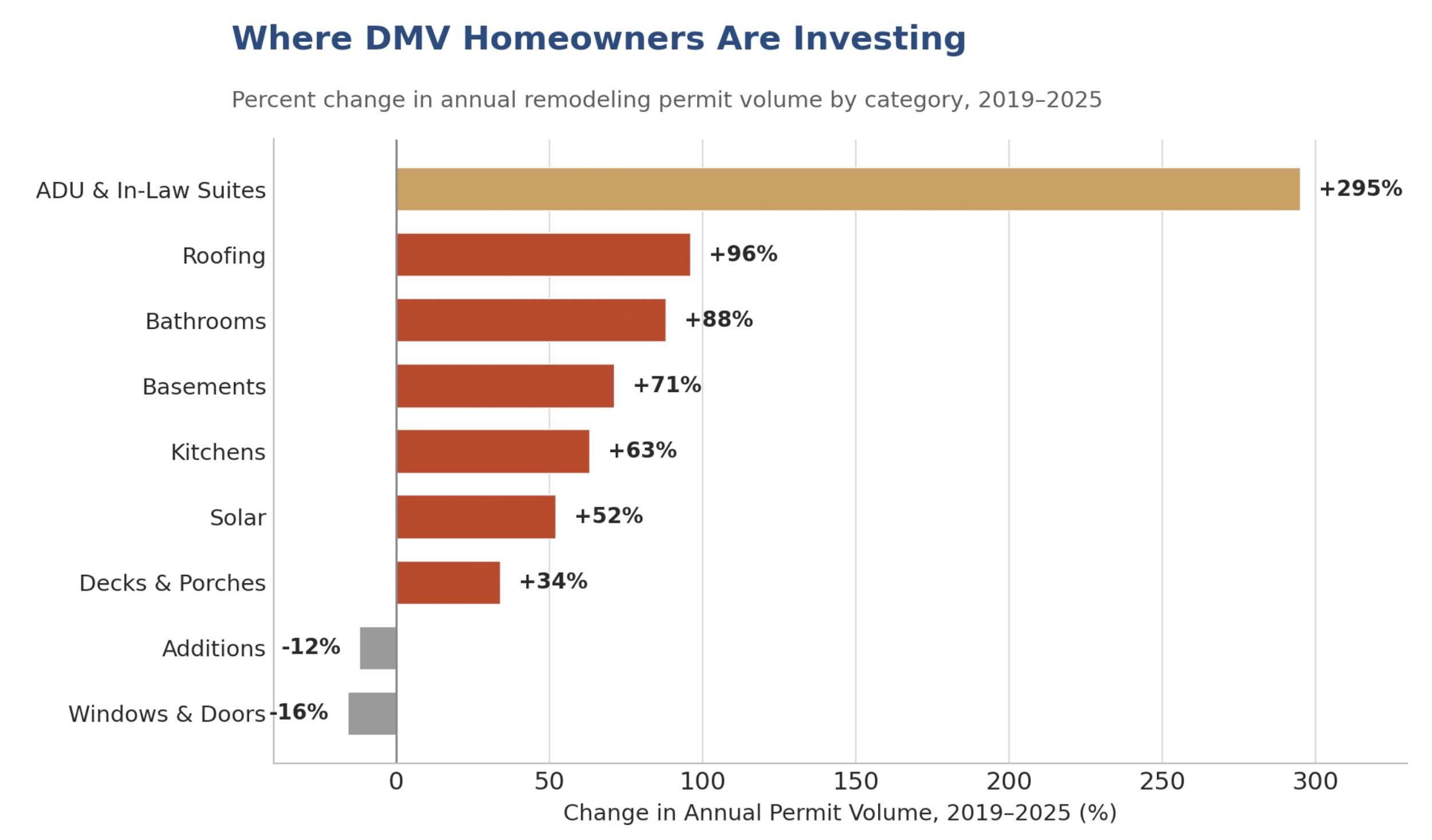
Percent change in annual permit volume by category, 2019–2025.
Three categories tell the regional story. Roofing leads at +96%, a near-doubling driven by an aging housing stock reaching the end of its first or second roof lifecycle. Bathrooms (+88%) and basements (+71%) reflect a homeowner base choosing to add function and finished space within their existing footprint. The explosive +295% growth in accessory dwelling unit and in-law suite permits — off a small base — signals a structural shift toward multigenerational living and zoning reform across Northern Virginia and Maryland.
Just as telling are the declines. Permits for home additions fell 12% and window-and-door permits fell 16%. The message is consistent with what we have documented across the permit-data series: in an era of elevated mortgage rates and high relocation costs, DMV homeowners are investing inward — upgrading and re-purposing the space they own rather than building outward or moving on.
The Equity Engine: Why Homeowners Can Afford It
Record Equity Across the Region
A remodeling boom requires more than the desire to renovate — it requires the means. The DMV’s renovation cycle is underwritten by an unprecedented accumulation of home equity. As home values across the Greater Washington metro rose roughly 37% between 2020 and 2025, and as homeowners paid down mortgages secured at historically low rates, the median equity position in a mortgaged DMV home climbed from $198,000 in 2019 to $352,000 in 2025.
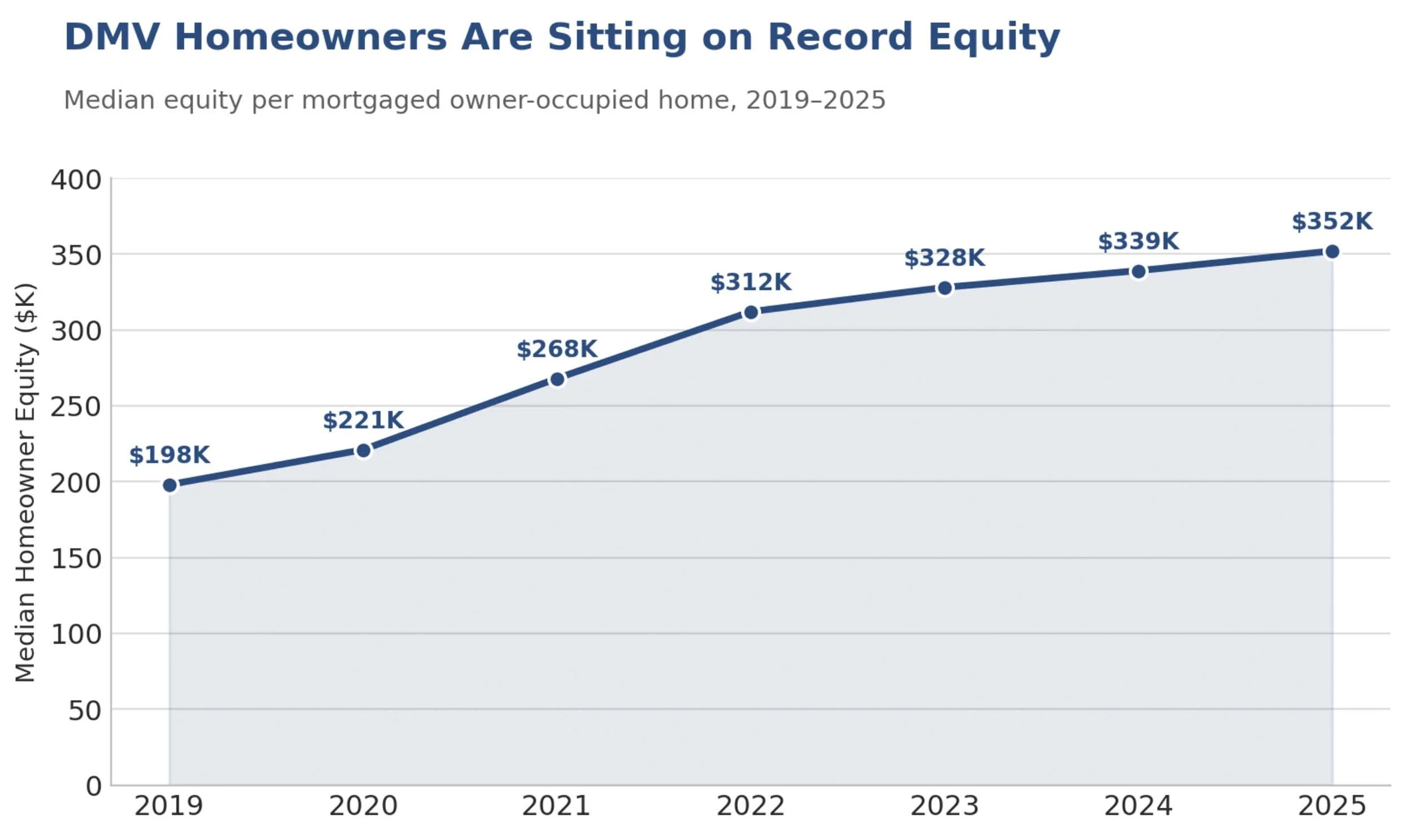
Median equity per mortgaged owner-occupied home, DMV, 2019–2025.
This $352,000 figure is the financial engine of the renovation cycle. It exceeds the national median by a wide margin, and it is overwhelmingly illiquid: the only practical ways to access it are to sell the home or to borrow against it. With relocation costs high and pandemic-era mortgage rates locked in, a growing share of DMV homeowners are choosing the second path — financing significant renovations through home-equity lines and loans while keeping the low-rate first mortgage they already hold.
Income Funds the Work — But Housing Age Drives It
The DMV is one of the highest-income regions in the United States, and that income gives homeowners the cash flow to service renovation financing. But income alone does not explain where renovation activity is most intense. When median household income is plotted against annual remodeling spend per home, the relationship is revealing rather than linear.
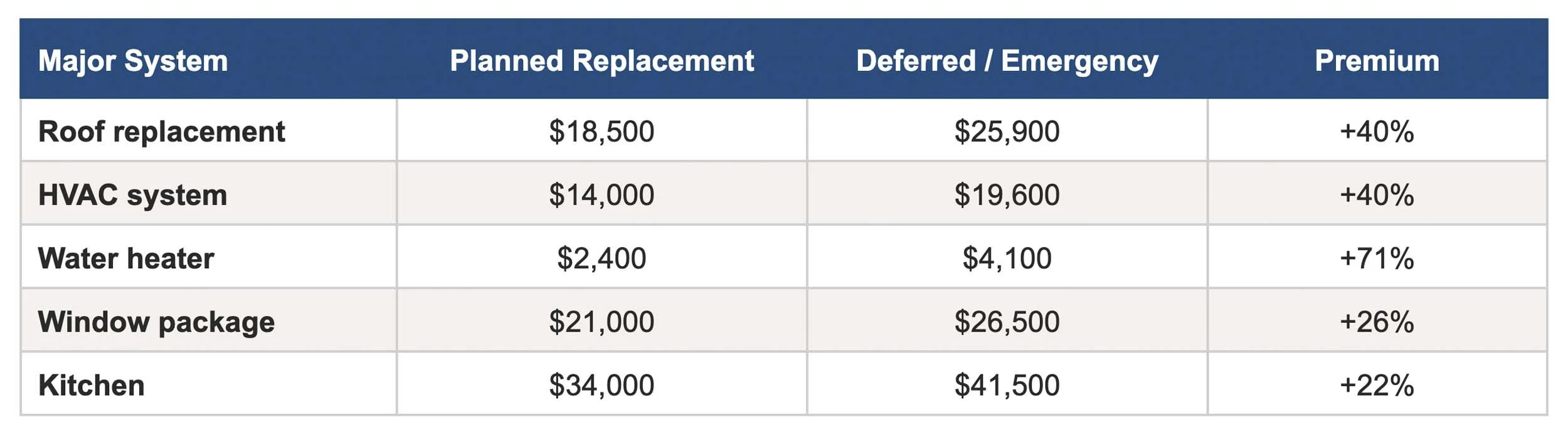
Planned vs. deferred replacement cost, 2025 DMV pricing. Deferred figures include collateral repair and emergency premiums.
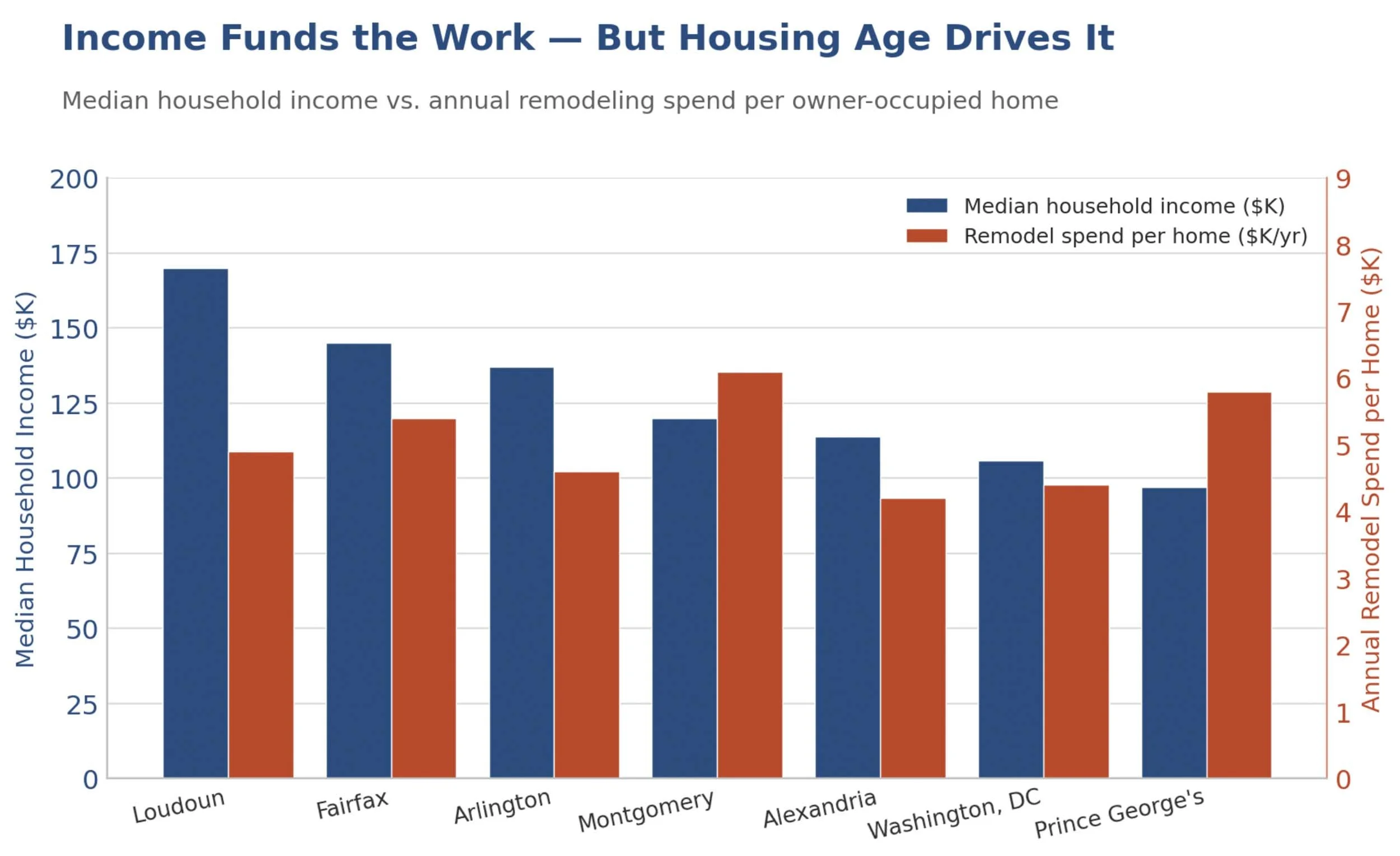
Median household income vs. annual remodeling spend per owner-occupied home, by jurisdiction.
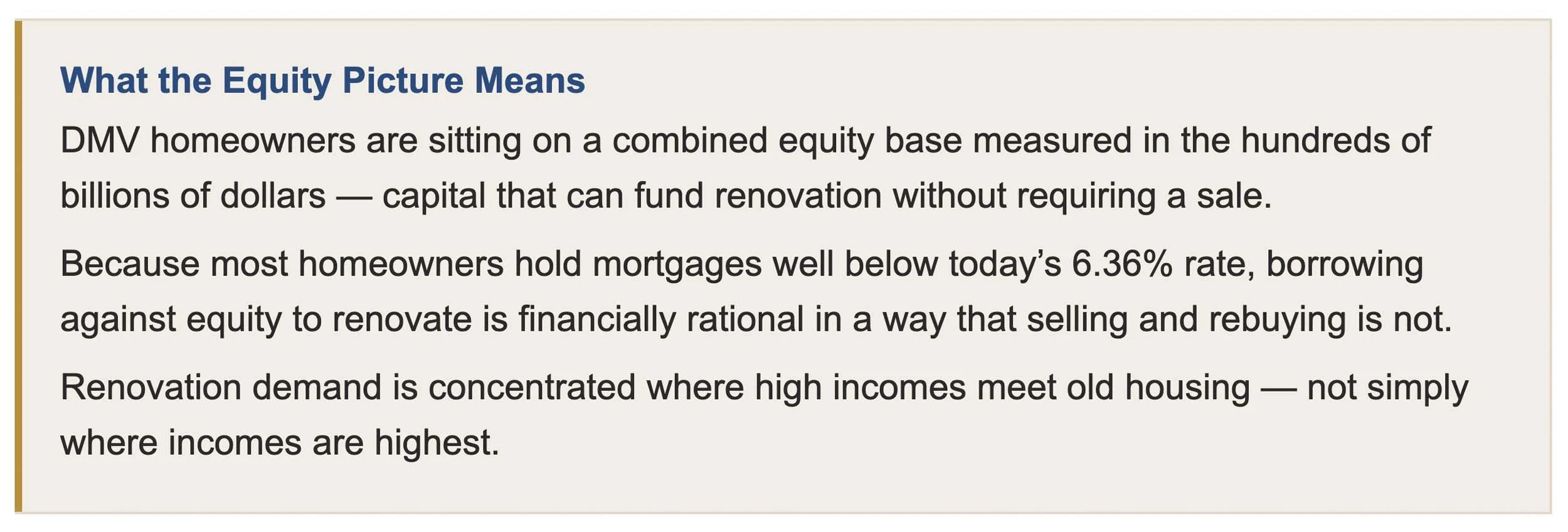
Loudoun County posts the region’s highest household incomes, yet its per-home remodeling spend is moderate — because much of its housing stock is new and not yet due for major work. Montgomery County and Prince George’s County, with older housing and more modest incomes, show the highest renovation intensity. The lesson is that income provides the capacity to renovate, but the age and condition of the housing stock determine the need. Where the two overlap, demand is strongest.
The Demographic Inevitability: An Aging Housing Stock
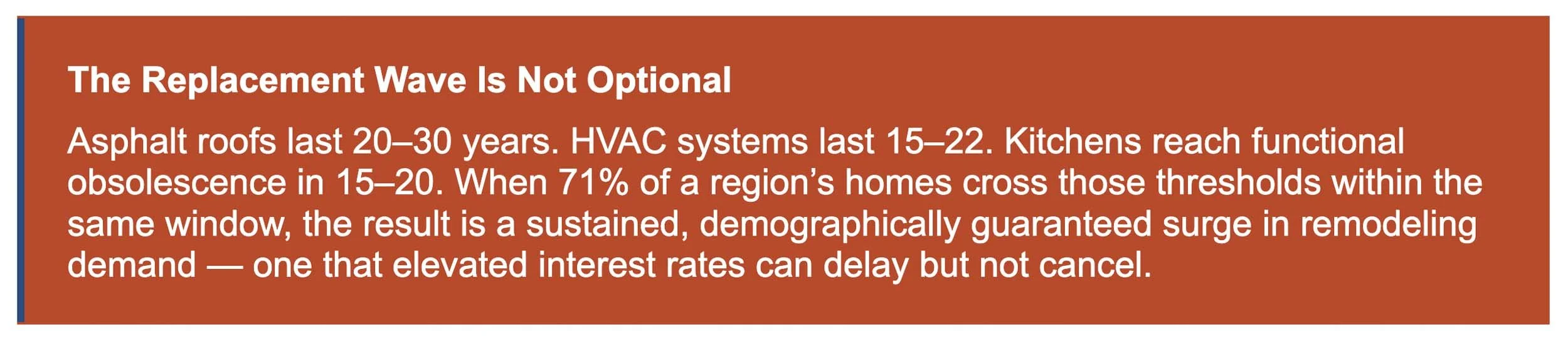
Every renovation cycle eventually traces back to a single, unglamorous fact: houses age. Roofs, heating and cooling systems, kitchens, windows, and bathrooms all have finite service lives, and when a large share of a region’s homes was built in a concentrated period, those systems reach end-of-life on a synchronized schedule.
That is precisely the situation across the DMV. The region’s housing stock has a median construction year of 1981. Fully 71% of owner-occupied homes — an estimated 942,000 properties — were built before 1990, which means they are now at least 36 years old. The post-war and late-20th-century building waves that filled the inner suburbs and the I-270, I-66, and I-95 corridors are now, collectively, in their replacement years.
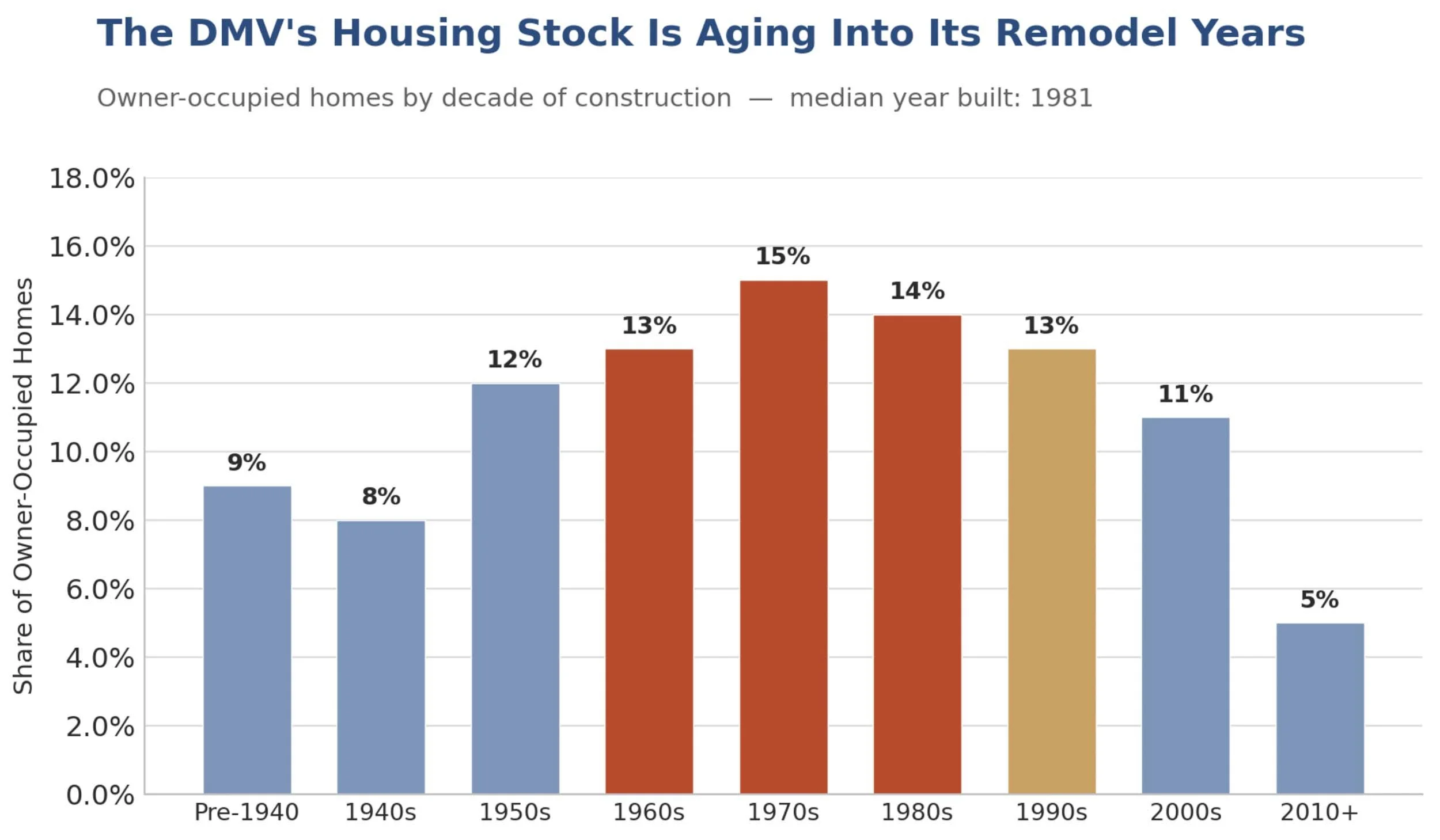
The decades that built the most DMV housing — the 1960s, 1970s, and 1980s — account for 42% of the owner-occupied stock on their own. A home built in 1975 has, by 2026, almost certainly required at least one full roof replacement and is due for a second; its original kitchen and bathrooms are two or three style-generations out of date; and its windows and HVAC equipment have cycled at least once. This is not a forecast. It is arithmetic, and it is the single most reliable predictor of remodeling demand for the remainder of the decade.
The Renovation Opportunity Index
To translate these regional forces into a practical, jurisdiction-level view, RemodelTrends.com developed the Renovation Opportunity Index. The Index is a composite 0–100 score built from four weighted components: the age profile of the housing stock, permit momentum over the trailing three years, the depth of homeowner equity, and the “value gap” — the spread between what homes are worth and the condition they are currently in.
A high score indicates a jurisdiction where the conditions for renovation activity are most favorable: older homes, strong and accelerating permit trends, deep equity to fund the work, and a meaningful gap between current condition and market potential. The Index is intended as a planning tool — for homeowners weighing the timing of a project, and for the contractors and suppliers serving them.
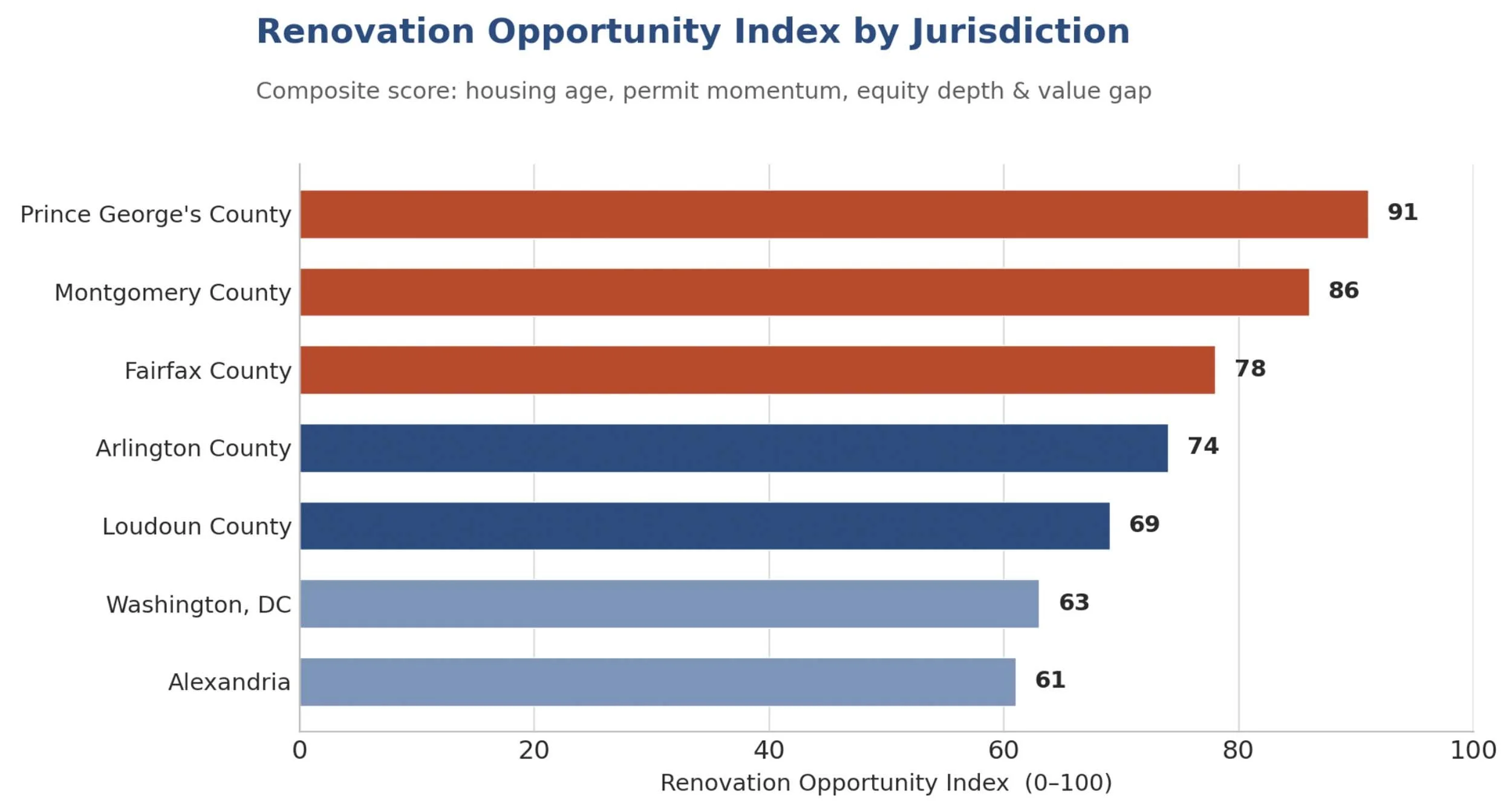
Renovation Opportunity Index by DMV jurisdiction, 2026.
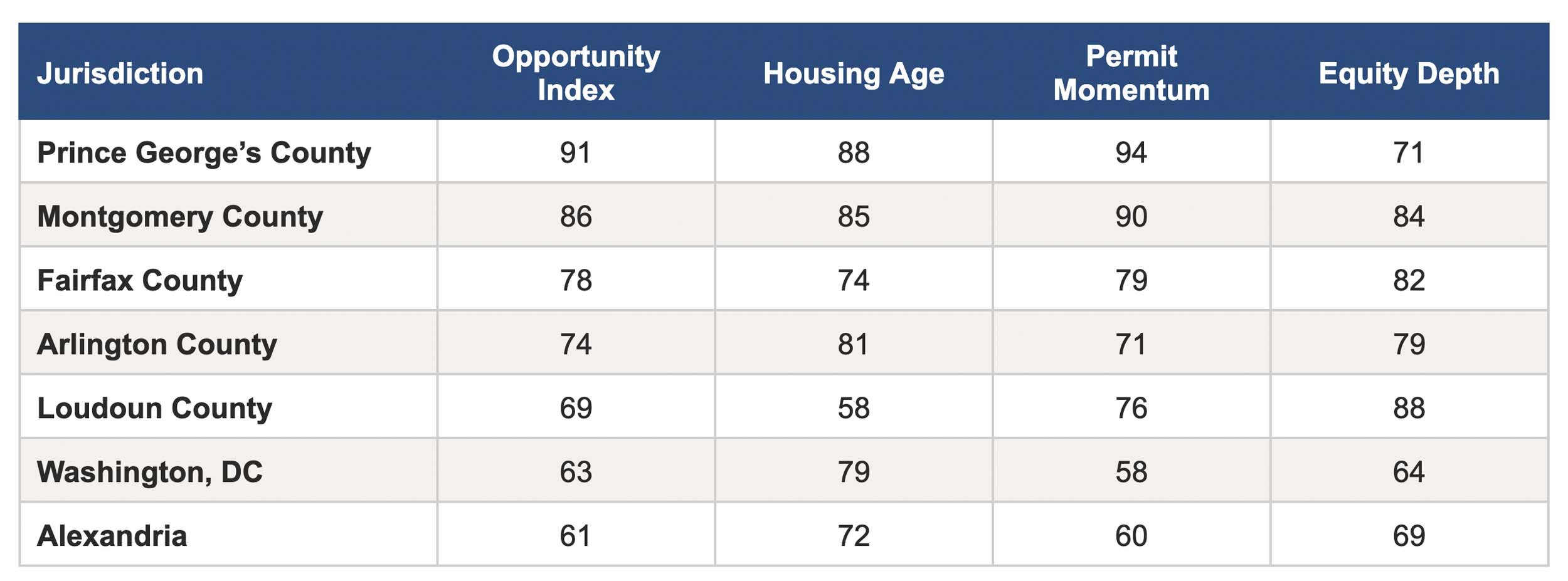
Renovation Opportunity Index and component scores. All values are RemodelTrends.com proprietary metrics, indexed 0–100.
Reading the Index
Prince George’s County tops the Index at 91, propelled by the region’s strongest permit momentum and a housing stock whose age and value gap leave substantial room for reinvestment. Montgomery County follows at 86, combining old housing, deep equity, and a long, well-documented permit surge. Fairfax County and Arlington County form a strong middle tier, while Loudoun County’s lower score reflects its newer housing — its homes have simply not yet aged into the renovation window. The District of Columbia and Alexandria score lowest, constrained less by demand than by historic-district regulation and smaller building footprints that limit project scope.
What This Means for DMV Homeowners
The Scheduling Reality
A market expanding at this rate has direct, practical consequences for any homeowner planning a project. Demand for qualified contractors across the DMV has grown faster than the skilled-trade workforce, which means estimate wait times have lengthened, preferred scheduling windows fill earlier each year, and pricing has firmed. Homeowners who treat a renovation as a multi-month planning exercise — rather than a last-minute response to a failure — consistently secure better contractors, better pricing, and better timelines.
Protecting Your Investment
In a market this active, homeowner diligence matters more than ever. We recommend verifying that any contractor you engage holds a valid permit for the work, carries proper licensing for the relevant jurisdiction — MHIC in Maryland, Class A or B contractor licensing in Virginia, and a basic business license in the District — and maintains adequate insurance. The same public permit records analyzed in this report can be used to confirm whether a contractor consistently pulls permits for their work, which remains one of the simplest and most effective ways to evaluate legitimacy.
Looking Ahead: 2026 and Beyond
The forces documented in this report are structural, not cyclical. Aging housing does not get younger; equity, while it can fluctuate, remains historically deep; and the mortgage-rate environment that discourages relocation shows no sign of a rapid reversal. We expect DMV remodeling investment to remain at or above its current elevated level for the remainder of the decade, with roofing, bathrooms, basements, and accessory dwelling units leading the way.
For homeowners, the strategic implication is clear. The question is rarely whether an aging home will need major work, but when — and whether that work happens on the homeowner’s schedule or on the schedule dictated by a failed system. The data in this report makes a strong case for planning ahead.
METHODOLOGY
This report is based on an analysis of 681,000+ residential building permits issued by seven DMV jurisdictions — the District of Columbia, Montgomery County, Prince George’s County, Arlington County, Fairfax County, Loudoun County, and the City of Alexandria — between January 2000 and February 2026, accessed through each jurisdiction’s open permit records. Permits were normalized into standardized remodeling categories using keyword classification of permit descriptions, and a noise filter excluded records inconsistent with residential remodeling activity. The year 2023 is excluded from trend comparisons because of a multi-jurisdiction reporting gap.
Housing-age, income, and tenure data are drawn from the U.S. Census Bureau American Community Survey. Equity figures are derived from the ICE Mortgage Monitor and regional home-value indices. Momentum Scores and the Renovation Opportunity Index are proprietary RemodelTrends.com metrics that weight permit volume, declared valuation, trailing velocity, housing age, and equity depth; they are intended as comparative planning tools rather than precise forecasts.
About Four Seasons Home Improvement
Four Seasons Home Improvement is a full-service home improvement contractor serving Washington, D.C., Maryland and Northern Virginia since 1976, with a focus on roofing, siding, windows, kitchens, bathrooms, and exterior renovations.
We combine decades of hands-on construction experience with data-driven insights from RemodelTrends.com, a leading proprietary analytics platform that analyzes building permit data across the Mid-Atlantic region.
This report is the pillar publication of our 2026 DMV Permit-Data White Paper Series. Companion reports examine the prime renovation cycle, the timing of major-system replacement, remodeling ROI for older homes, and the renovate-versus-relocate decision.
If you’re ready to start your home improvement project with a proven team that has served the DMV since 1976, get in touch for a free estimate today.
