

Remodeling ROI for Homes Built Before 1990
Why the DMV’s oldest homes deliver the strongest renovation returns — and how 942,000 equity-rich owners can capture them

Published June 2026 | Four Seasons Home Improvement | Serving the DMV Since 1976
Executive Summary
Conventional wisdom treats an older home as a liability — a property that will demand money rather than make it. The DMV renovation data tells a more interesting story. The region’s 942,000 owner-occupied homes built before 1990 are not a renovation burden. Measured properly, they are the region’s strongest renovation opportunity, and the homeowners who own them are unusually well positioned to act.
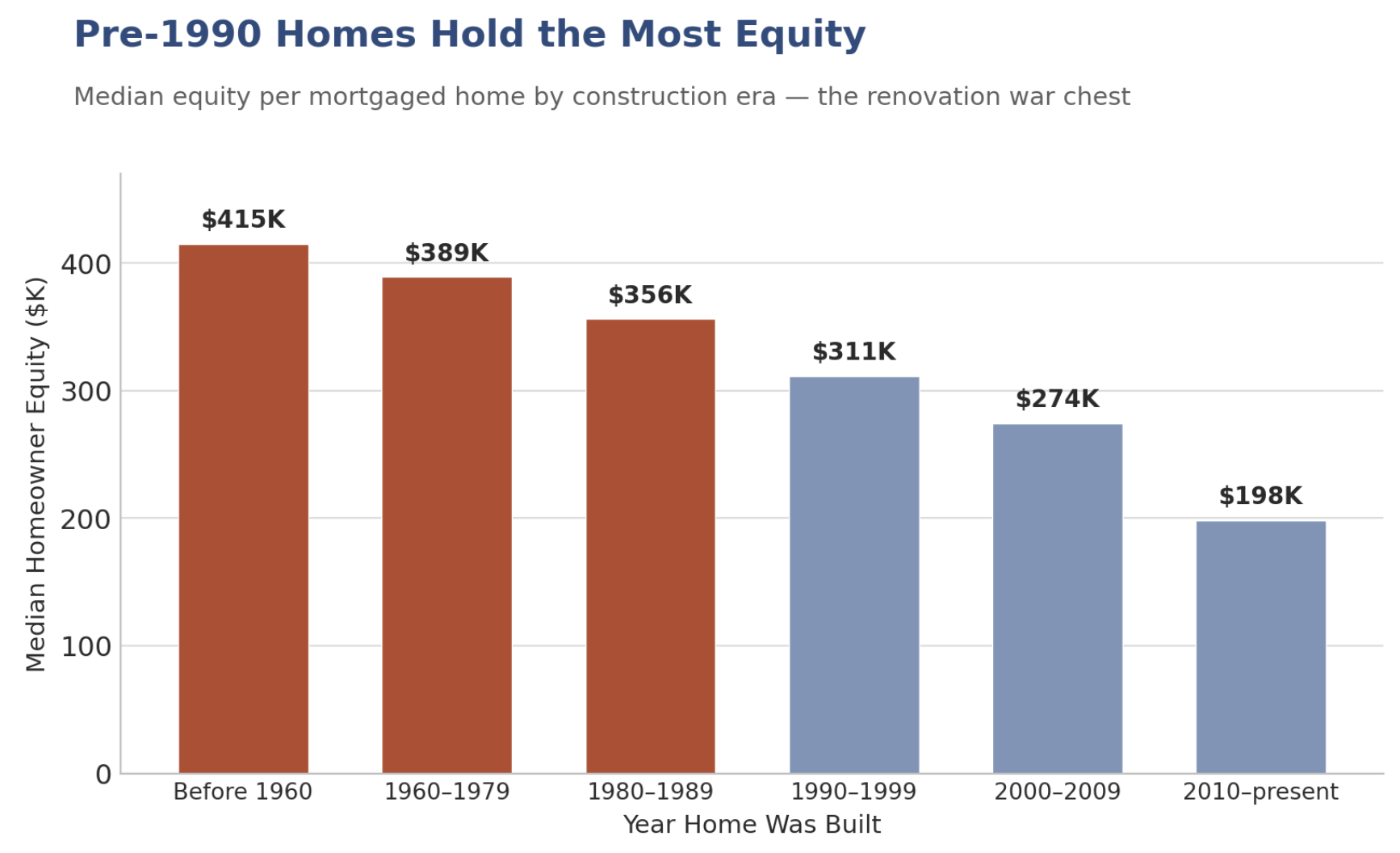
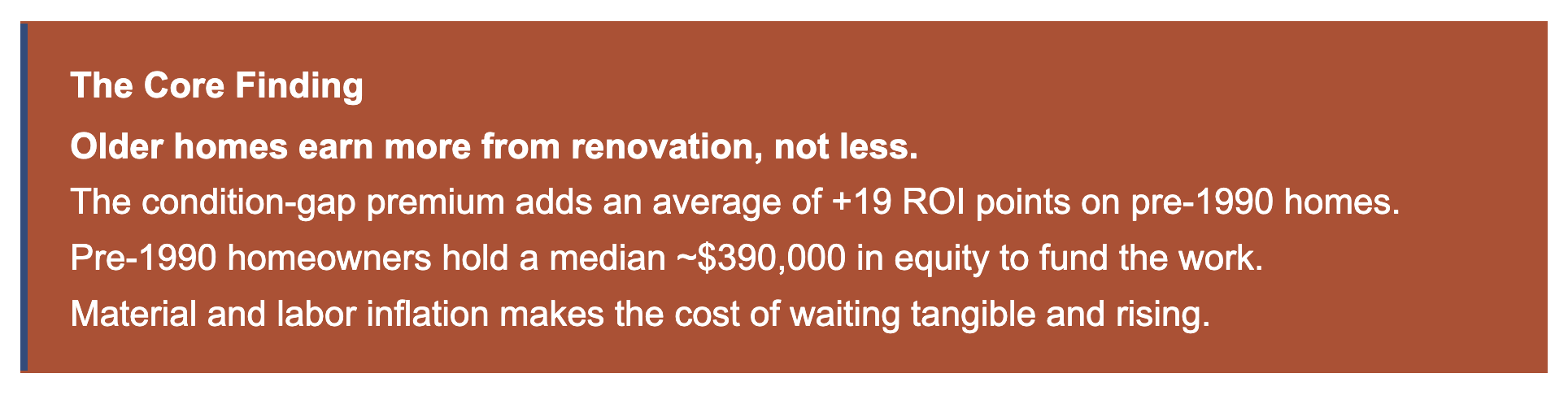
This report makes three connected arguments. First, renovation in the DMV delivers real, measurable returns: a well-chosen project recoups most — and in some cases all — of its cost at resale, with curb-appeal and midrange interior projects leading the field. Second, those returns are systematically higher for older homes. Because a pre-1990 home starts from a lower condition baseline, the same project closes a wider gap between the home’s current state and the market’s expectations — a phenomenon we call the condition-gap premium, worth an average of 19 percentage points of additional ROI. Third, the owners of pre-1990 homes hold the deepest equity in the region, a median of roughly $390,000, giving them both the means to renovate and the strongest reason to do so.
The report closes with a renovation strategy built specifically for pre-1990 homes: which projects to prioritize, how to sequence them, and why the cost of materials and labor makes the timing of that decision increasingly urgent.
The ROI Landscape: What DMV Renovations Return
Before examining older homes specifically, it is worth establishing the baseline: how much do DMV renovations return at resale? The figure and table below rank common projects by the share of their cost recovered in the home’s eventual sale price, based on Cost vs. Value data for the Washington metro and on regional MLS sales evidence.
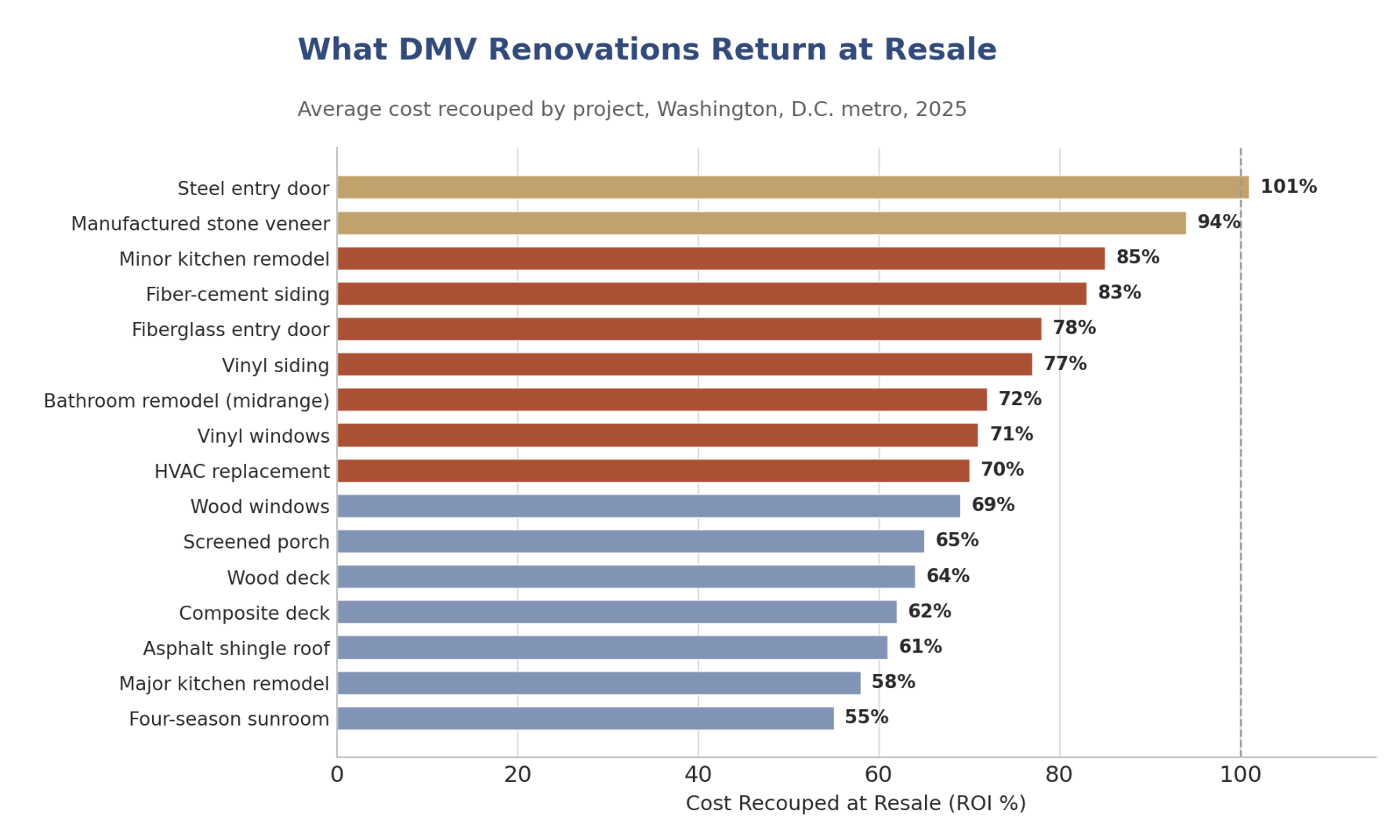
Average cost recouped at resale by project type, Washington, D.C. metro, 2025.
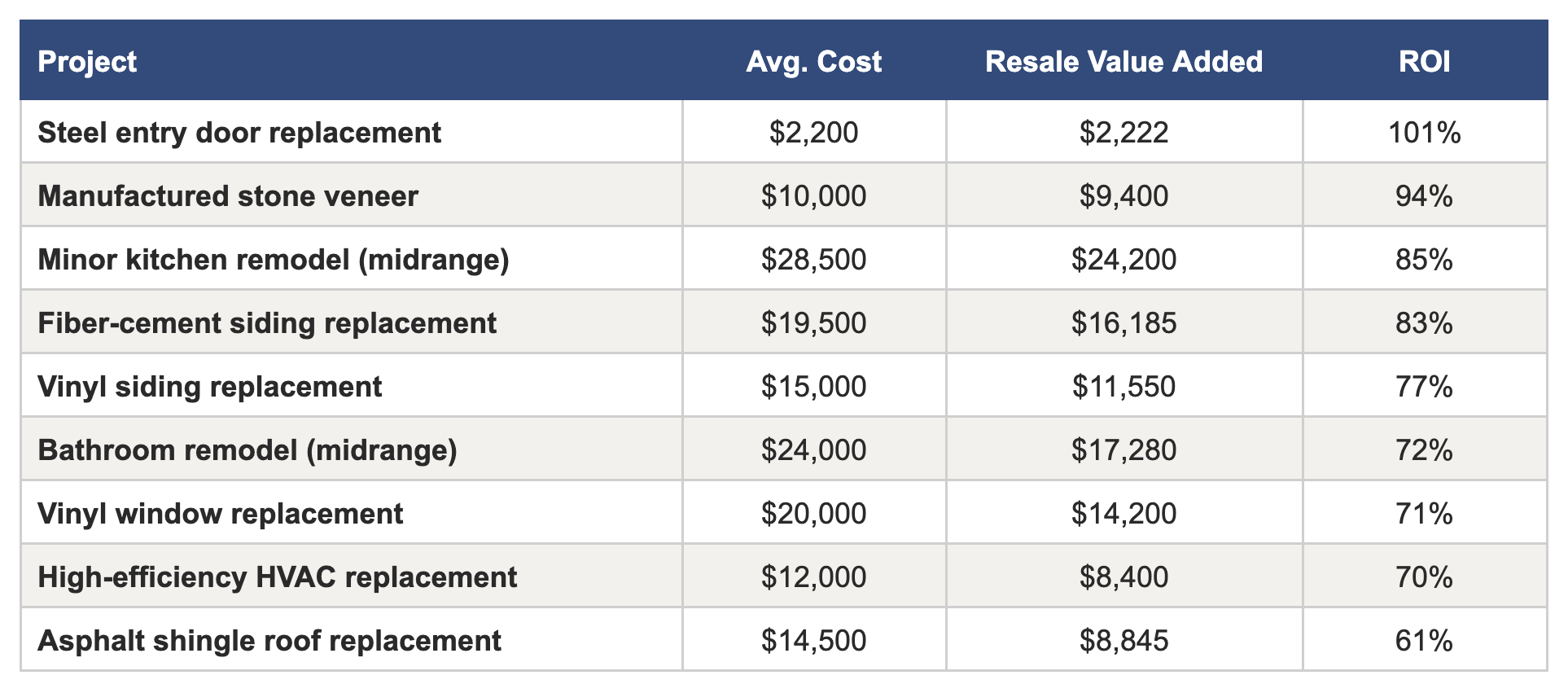
Project cost, resale value added, and ROI. Source: Remodeling Cost vs. Value 2025 (DMV metro); Bright MLS sales analysis.
Two patterns govern the landscape. First, curb-appeal projects lead: a steel entry door, manufactured stone veneer, and new siding top the rankings because they cost relatively little and transform a buyer’s first impression. Second, midrange beats upscale: a minor kitchen remodel returns 85%, while an upscale kitchen returns closer to 58%, because over-customized, high-cost finishes narrow the buyer pool. The homeowner’s objective is not the most expensive project — it is the project that closes the widest gap between perception and reality for the least cost.
The Condition-Gap Premium
Here is where the story turns specifically to older homes. ROI is not a fixed property of a project type — it depends on the home the project is performed on. The same kitchen remodel, the same window package, the same roof generates a different return depending on the condition the home started in. And pre-1990 homes start from a lower baseline, which means a renovation moves them further.
We call this the condition-gap premium. A buyer evaluating a 1985-built home with original windows, an aging HVAC system, and a dated kitchen mentally subtracts the cost of all that deferred work — and usually subtracts more than the work would actually cost. A renovation that closes those gaps does not merely add its own value; it also removes the buyer’s risk discount. On a newer home, where the baseline is already high, the same project simply has less gap to close.
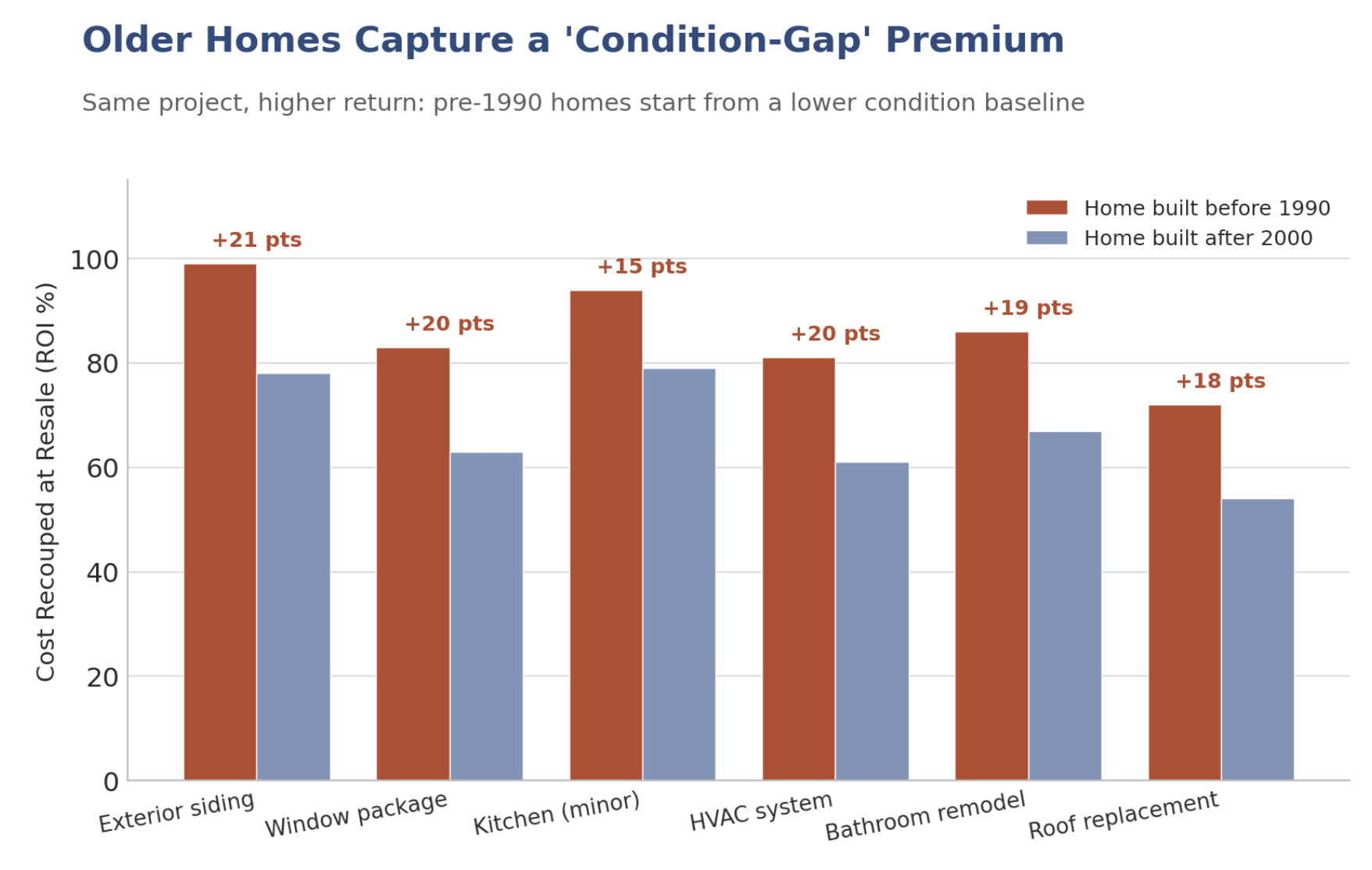
Project ROI on pre-1990 homes vs. homes built after 2000.
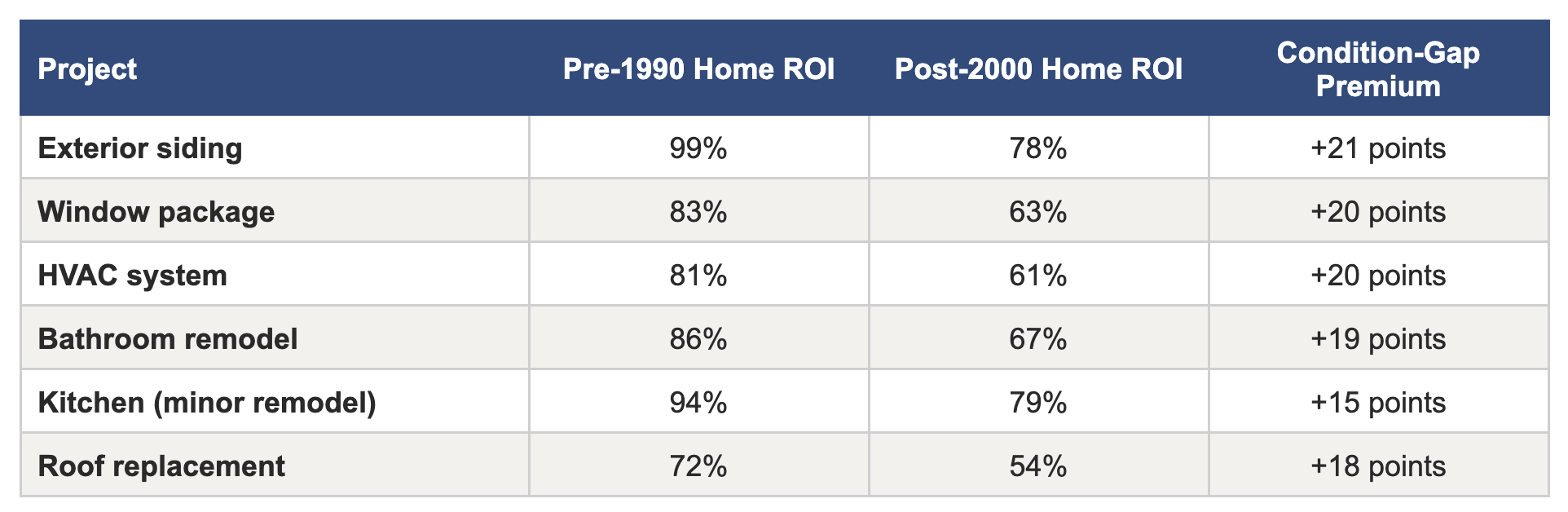
The condition-gap premium. ROI on the same project is consistently higher for pre-1990 homes. Source: RemodelTrends.com analysis; Cost vs. Value 2025; Bright MLS.
Across the six project types above, the condition-gap premium averages 19 percentage points. That premium is the single most important — and most overlooked — fact in renovation economics for older homes. It means a pre-1990 homeowner contemplating a window replacement is not looking at the 63% national-style return often quoted; on their home, the realistic return is closer to 83%. The age of the home is not eroding the return. It is creating it.
The Equity Advantage of Older Homes
A high return is only useful if a homeowner has the means to pursue the project in the first place. Here, again, the owners of pre-1990 homes hold the advantage. Because older homes have been owned longer, their owners have paid down more principal and captured more appreciation — producing the deepest equity positions in the region.
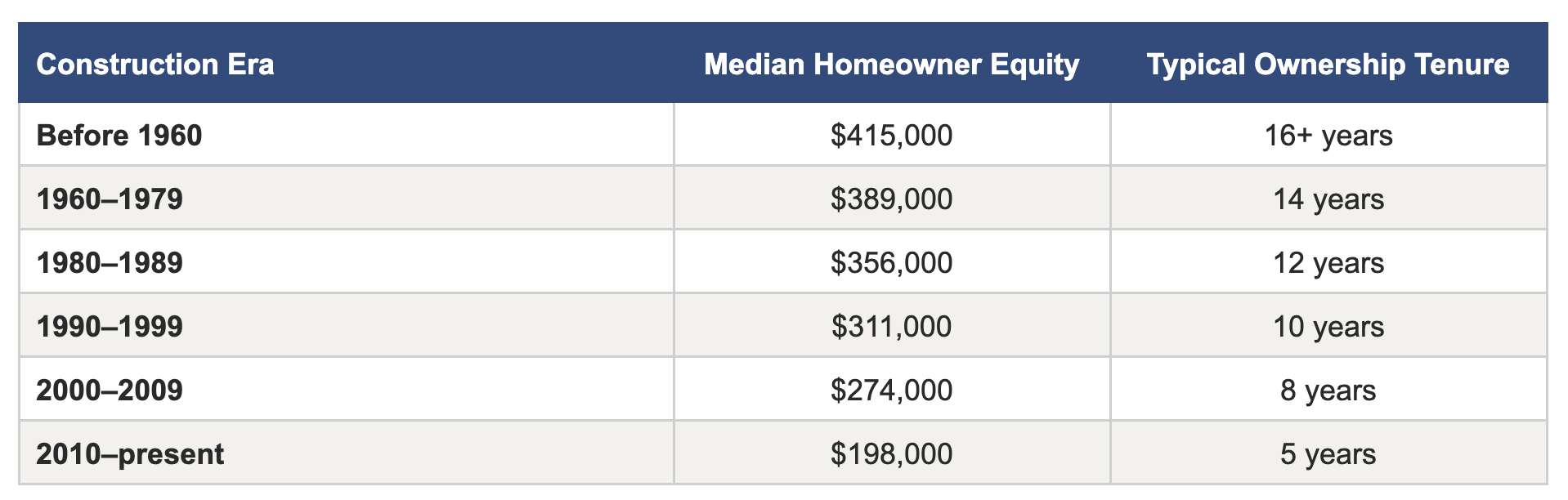
Equity and ownership tenure by construction era. Source: ICE Mortgage Monitor; RemodelTrends.com analysis.
Cost In, Value Out
The ROI percentages above are ratios; it helps to see them as dollars. The figure below pairs the typical cost of a high-return project against the resale value it adds. The projects that lead the ROI rankings do so not because they add the most absolute value, but because they add nearly as much value as they cost.
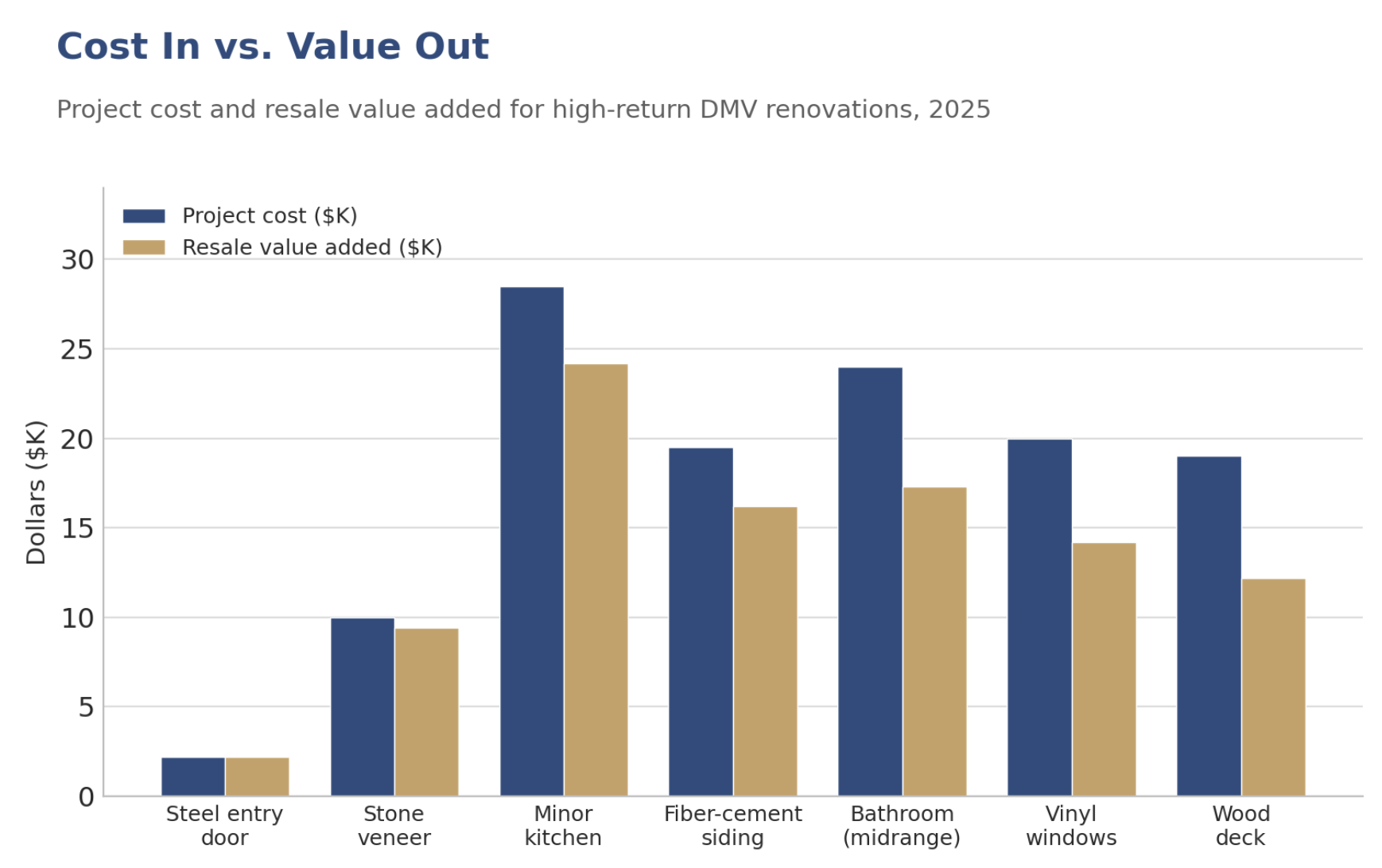
Project cost vs. resale value added for high-return DMV renovations, 2025.
A steel entry door costs about $2,200 and returns essentially all of it. Manufactured stone veneer costs $10,000 and adds $9,400. A minor kitchen remodel costs $28,500 and adds $24,200. These are the projects where cost and value nearly converge — and for a pre-1990 home, the condition-gap premium pushes several of them past full cost recovery. The strategic takeaway is to lead with projects where the bars are close together, then layer in larger projects whose value lies as much in livability as in resale.
The Inflation Clock
There is one force working against every renovation return: the rising cost of doing the work. Between 2021 and 2025, the materials and labor that go into a DMV renovation became markedly more expensive. Because ROI is a ratio of value added to cost, every increase in cost compresses the return — and every year a project is deferred, the cost side of that ratio grows.
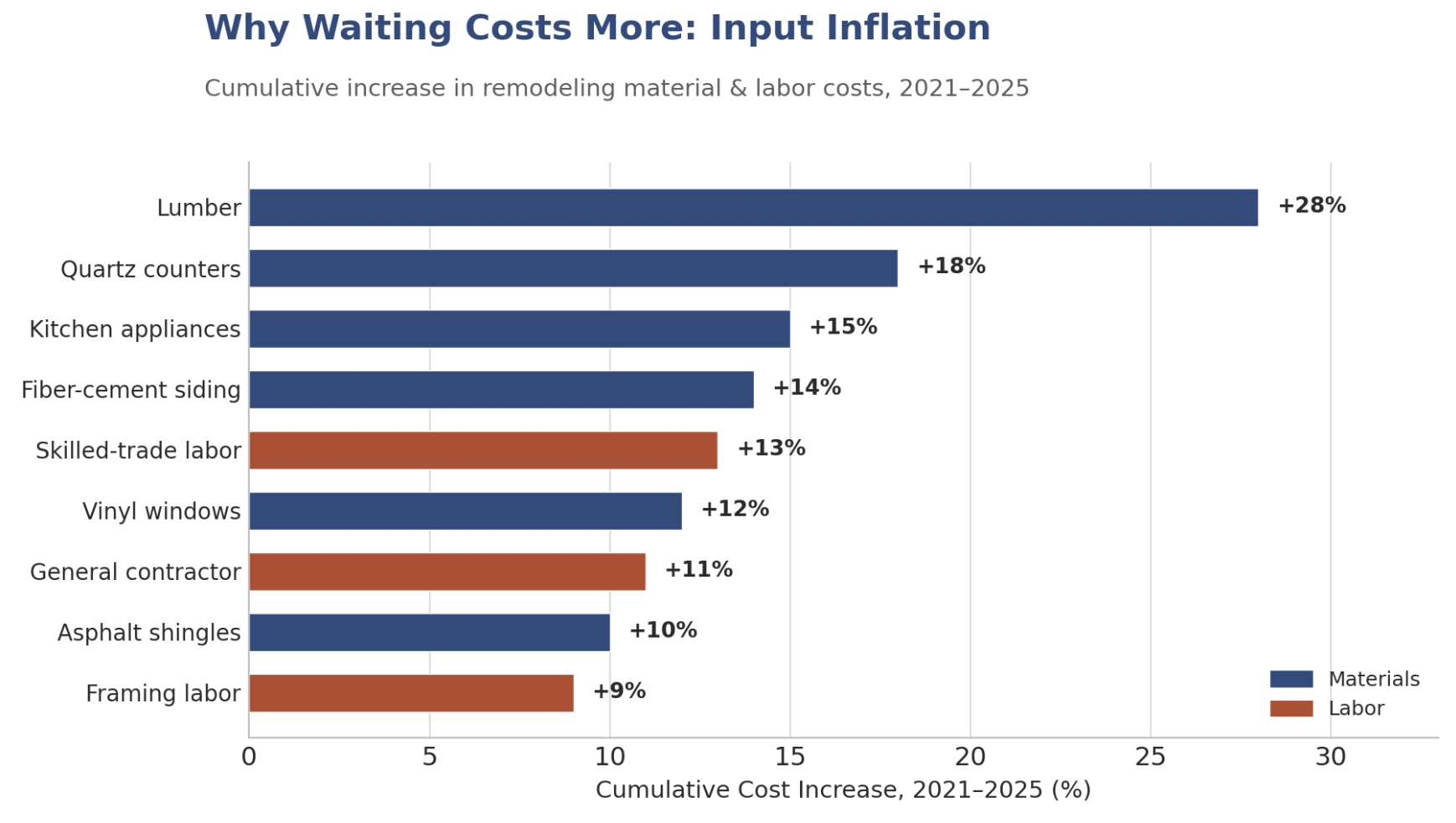
Cumulative increase in remodeling material and labor costs, 2021–2025.
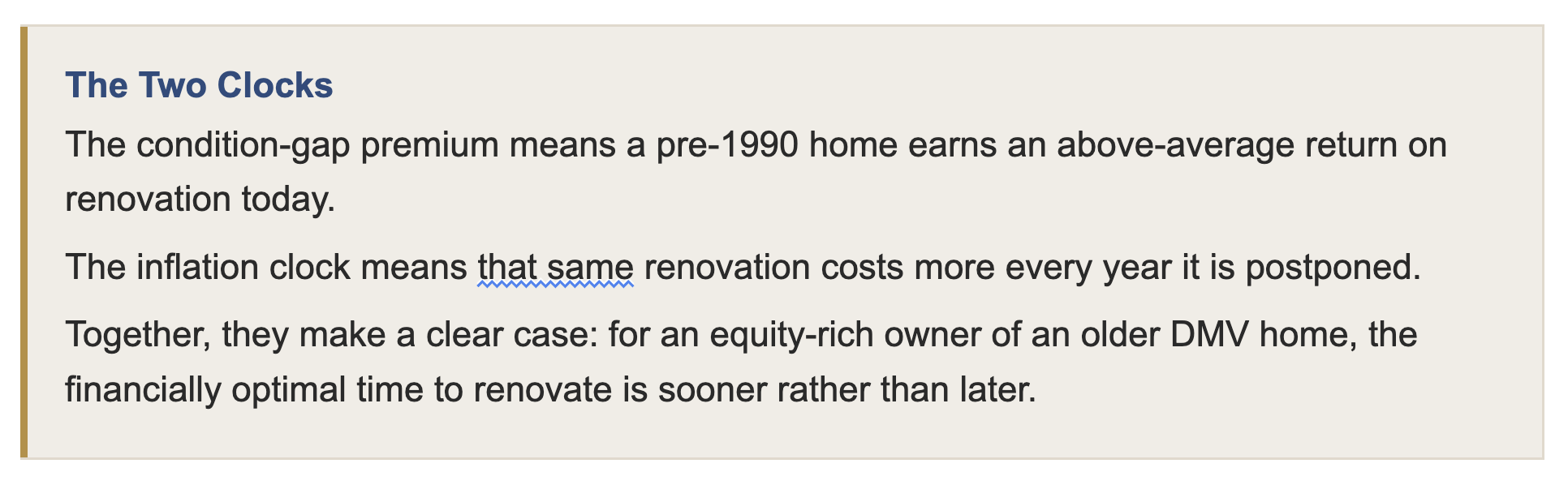
Lumber led the way, up 28% over the period; quartz countertops rose 18%, kitchen appliances 15%, and fiber-cement siding 14%. Skilled-trade labor — plumbers, electricians, HVAC technicians — rose roughly 13% as demand outpaced the available workforce. The compounding effect is significant: a renovation that would have cost $100,000 in 2021 costs meaningfully more today, and will cost more still next year. This is the quiet argument for acting inside the prime window rather than deferring. The condition-gap premium rewards pre-1990 homeowners for renovating; the inflation clock penalizes them for waiting.
A Renovation Strategy for Pre-1990 Homes
1. Lead With Curb Appeal and Deferred Maintenance
Begin with the projects that combine the highest ROI with the lowest cost: a steel or fiberglass entry door, fresh siding or manufactured stone veneer, and any visible deferred maintenance. On a pre-1990 home these projects are especially powerful, because they remove the “tired” first impression that drives a buyer’s risk discount. Address roof, gutter, and envelope issues here as well — buyers penalize visible neglect heavily.
2. Modernize the Kitchen and Baths at Midrange
Next, target the kitchen and bathrooms — the rooms that carry the most resale weight and, on a pre-1990 home, show their age most clearly. Choose durable, classic, midrange finishes rather than upscale ones. The data is unambiguous: a minor kitchen remodel returns 85%, an upscale one closer to 58%. Over-customization narrows the buyer pool and erodes the return.
3. Replace Aging Systems Before They Fail
Finally, schedule the replacement of aging windows and HVAC equipment proactively. On a pre-1990 home these projects carry both a strong condition-gap premium and a real risk premium if deferred to the point of failure. Replaced on a planned schedule, they protect the home, improve daily comfort and energy cost, and recover most of their cost at resale.
Match the Financing to the Strategy
The deep equity in a pre-1990 home is best deployed against this sequence through a home-equity line or loan, which preserves the low-rate first mortgage. Treat the renovation as a phased program funded from a single equity facility rather than a series of unrelated cash outlays — it is cheaper to finance, easier to budget, and it keeps the entire strategy on a deliberate schedule.
Methodology
ROI figures in this report are derived from the Remodeling Cost vs. Value report for the Washington, D.C. metropolitan area and cross-referenced against Bright MLS residential sales data for single-family homes and townhomes. The condition-gap premium was estimated by comparing realized resale outcomes for comparable renovated homes segmented by construction era; figures are RemodelTrends.com proprietary analyses and represent regional averages, not guarantees for any individual property.
Equity figures are drawn from the ICE Mortgage Monitor and regional home-value indices, segmented by the construction era of the home. Material and labor cost trends are based on the U.S. Bureau of Labor Statistics Producer Price Index and Mid-Atlantic construction wage data for 2021–2025. Housing-stock counts are drawn from the U.S. Census Bureau American Community Survey across seven DMV jurisdictions.
About Four Seasons Home Improvement
Four Seasons Home Improvement is a full-service home improvement contractor serving Washington, D.C., Maryland and Northern Virginia since 1976, with a focus on roofing, siding, windows, kitchens, bathrooms, and exterior renovations.
We combine decades of hands-on construction experience with data-driven insights from RemodelTrends.com, a leading proprietary analytics platform that analyzes building permit data across the Mid-Atlantic region.
This report is part of our 2026 DMV Permit-Data White Paper Series. It pairs with our companion reports on the regional renovation cycle and on the renovate-versus-relocate decision, which together give older-home owners a complete framework for the decade ahead.
If you’re ready to start your home improvement project with a proven team that has served the DMV since 1976, get in touch for a free estimate today.
