

The Great Basement Awakening
How the Pandemic Unlocked a $64 Million Hidden Market Beneath Montgomery County Homes

Published April 2026 | by Four Seasons Home Improvement
Data sourced from Montgomery County, MD Department of Permitting Services. Analysis by Four Seasons Home Improvement using RemodelTrends.com, a leading proprietary analytics platform.
Executive Summary
Beneath the homes of Montgomery County lies a market that most homeowners overlook and most industry reports ignore. An analysis of 11,740 basement permits issued between 2000 and March 2026 reveals that the pandemic did not just create a temporary spike in basement finishing — it triggered a permanent shift in how homeowners value and use their below-grade space.
In 2019, the county issued 393 basement permits. By 2021, that number reached 699 — a 78% surge that represented the single largest year-over-year jump in any remodeling category. What makes the basement story unique is that the elevated demand did not recede. Post-pandemic permit volumes have stabilized at approximately 550 per year, 38% above the pre-pandemic baseline. The basement, once the most neglected room in the house, has become one of the most invested-in.
This white paper examines the data behind the basement awakening, reveals a two-tier market that is reshaping how contractors and homeowners approach these projects, and identifies the communities where basement investment is most concentrated.
The Pandemic Effect: A Permanent Shift
The story of Montgomery County basements is the story of the pandemic's impact on the American home, compressed into a single data series. Before 2020, basement permits had been remarkably stable — hovering between 360 and 420 per year for more than a decade. Then, in the span of 18 months, the market nearly doubled.
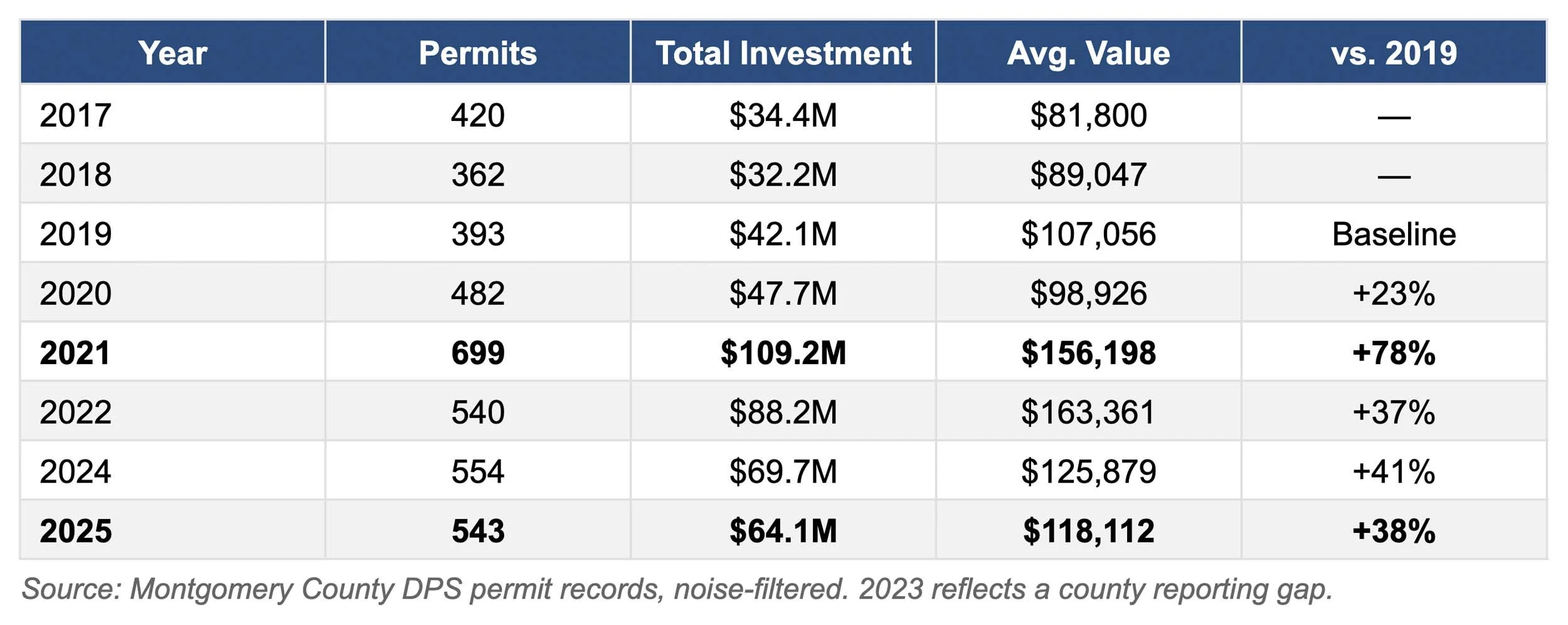
Montgomery County Records Permit Trends, 2017-2025
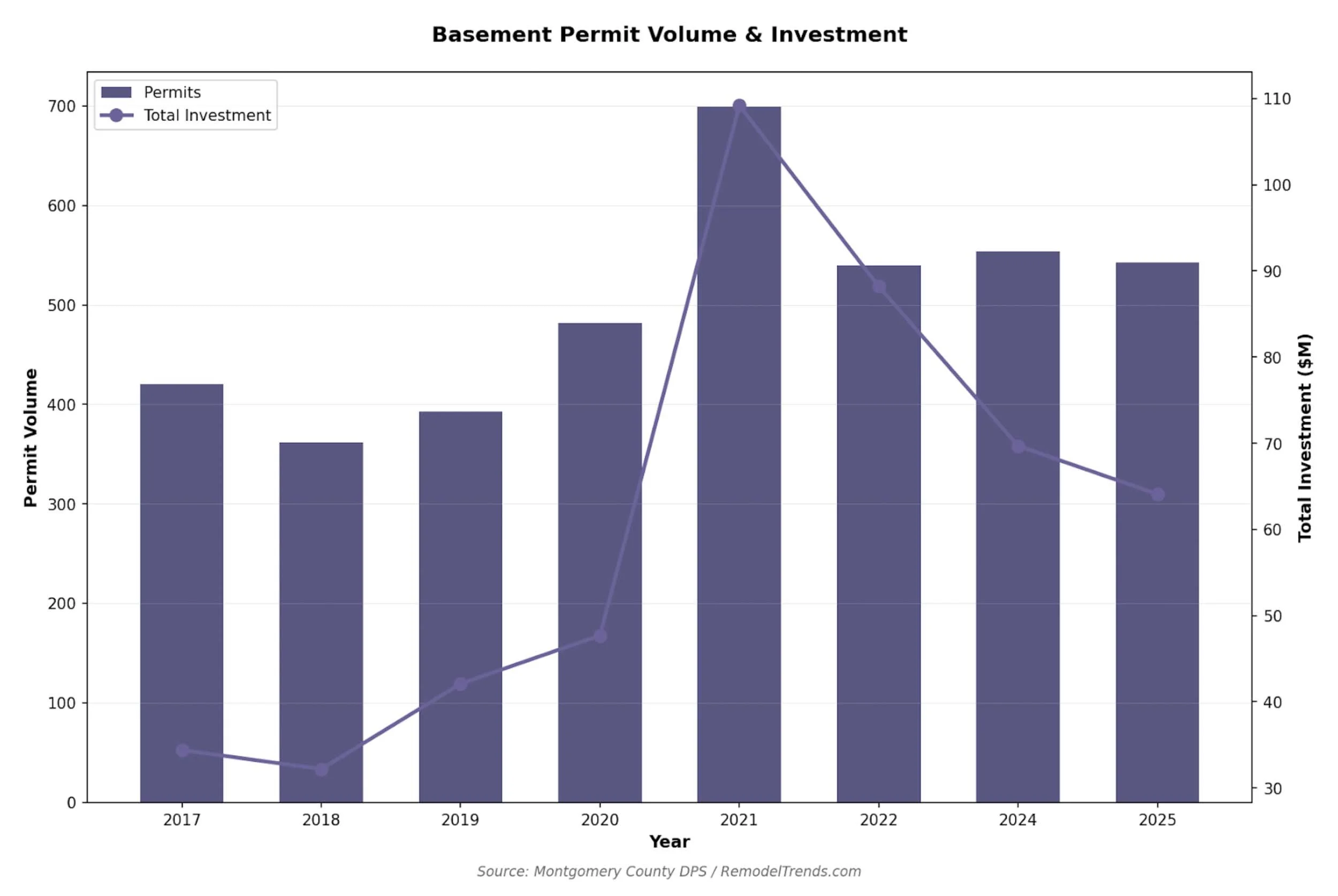
Basement Permit Volume & Investment, 2017-2025
The 2021 peak of 699 permits and $109 million in declared value was extraordinary — but what matters more for homeowners and the industry is the new baseline. Five years after the pandemic began, the county is still issuing roughly 550 basement permits per year. The pandemic did not create a bubble. It revealed latent demand that had been accumulating for decades beneath homes that were built with unfinished lower levels.
One Category, Two Markets
The most revealing finding in the data is that “basements” is not a single market. It is two distinct markets that happen to share a category label. The permit data draws a sharp line between them.
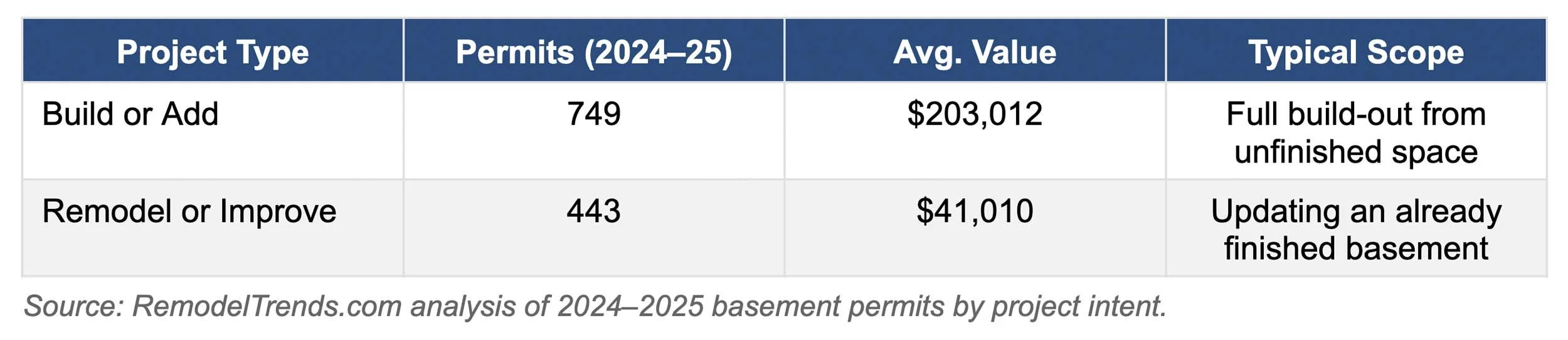
Basement Trends: New Build vs. Remodel
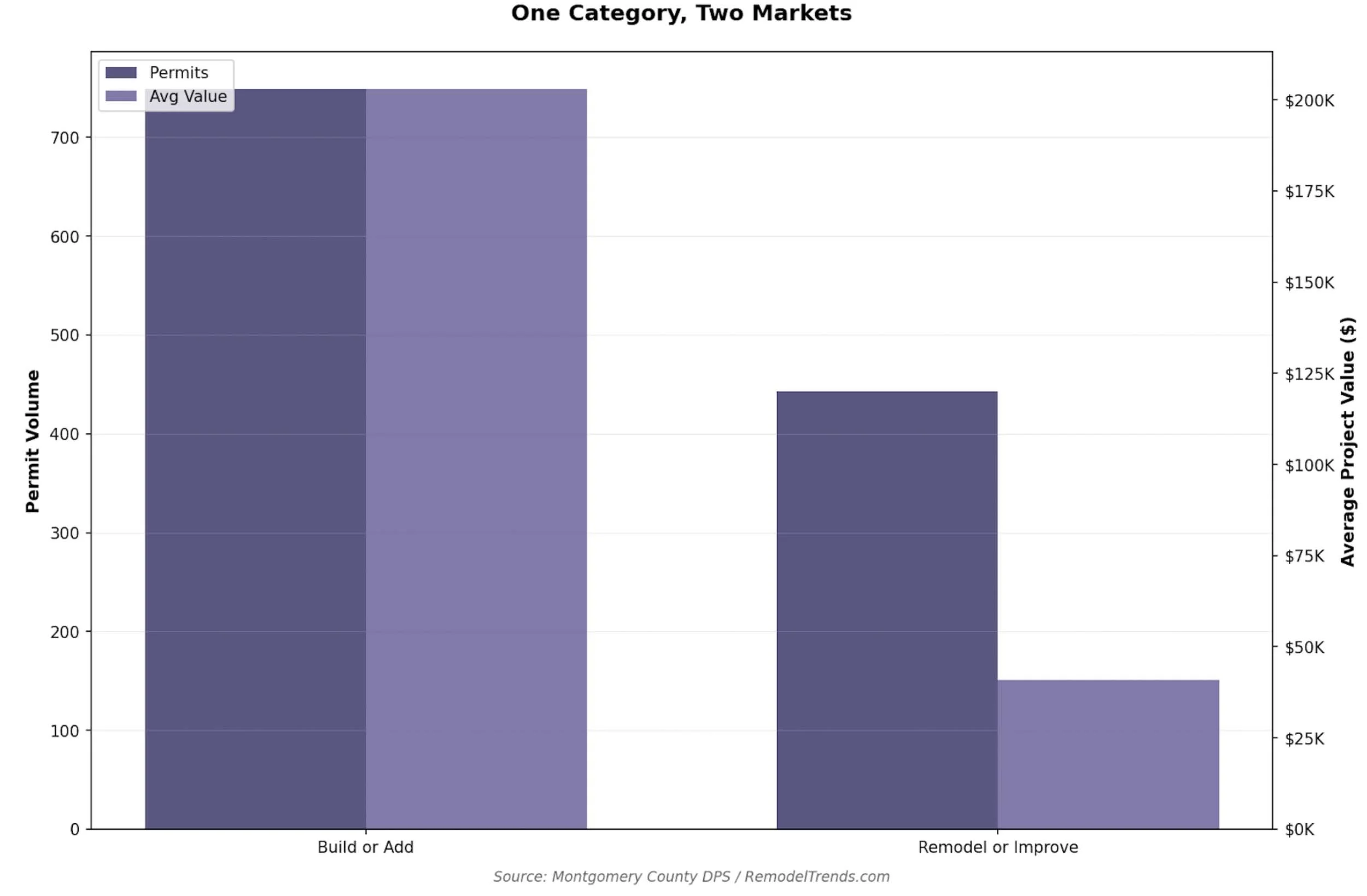
Basement Trends: New Build vs. Remodel, 2024-2025
The “Build or Add” segment — converting raw, unfinished basement space into livable area — averages $203,012 per project and accounts for 63% of all basement permits. These are major construction projects involving framing, electrical, plumbing, HVAC, egress windows, and full finishing. They effectively add an entire floor to a home's usable square footage.
The “Remodel or Improve” segment — updating an already-finished basement — averages $41,010 and represents 37% of permits. These are renovations of spaces that were finished in a previous era, often with dated materials, inadequate waterproofing, or layouts that no longer serve the homeowner's needs.
This distinction matters for homeowners because the two project types require fundamentally different expertise, timelines, and budgets. A contractor experienced in cosmetic renovations may not be equipped for the structural, mechanical, and waterproofing challenges of a full basement build-out — and vice versa.
Where the Investment Is Concentrated
Basement investment in Montgomery County follows a clear geographic pattern. The highest-value projects cluster in the county's affluent inner suburbs, where larger homes with full unfinished basements — often 1,500 to 2,500 square feet of raw space — offer the greatest potential for value creation.
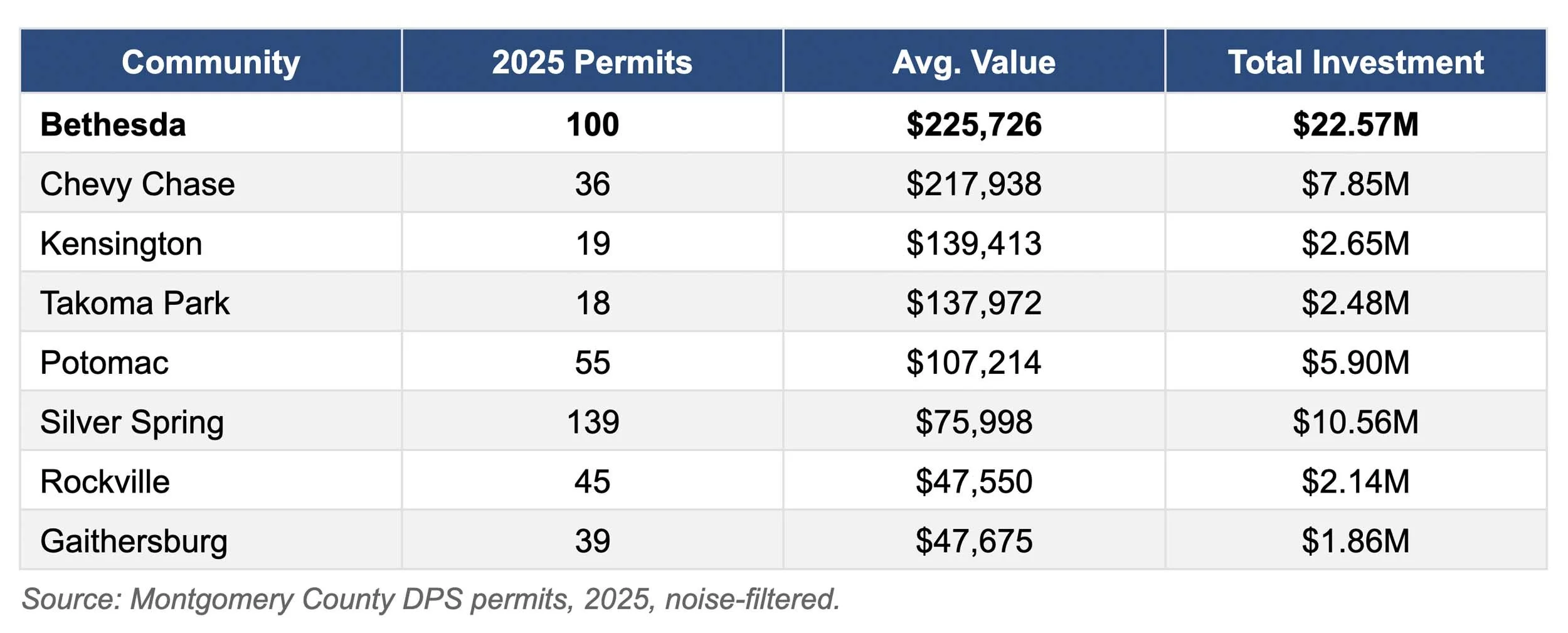
Top MD Communities with High-Value Basement Projects, 2025
Bethesda dominates the market with 100 basement permits in 2025, totaling $22.6 million. To put that in perspective, Bethesda's single-year basement investment exceeds the total pre-pandemic annual investment for the entire county in 2015. The average Bethesda basement project costs $225,726 — reflecting the complexity of building out large, high-specification spaces in homes where the finished product must meet the standards of a premium real estate market.
The Growth Communities
While the inner suburbs lead on value, some of the most interesting growth is happening further out. Boyds saw basement permit volume double (+102%) between the pre-pandemic baseline and the 2024–2025 period, with average values rising 39% to $185,530. Rockville grew 42% in volume. Montgomery Village, starting from a smaller base, surged 85% with average values nearly tripling. These communities represent the expanding frontier of the basement market — homeowners who may have initially considered moving up are instead choosing to build down.
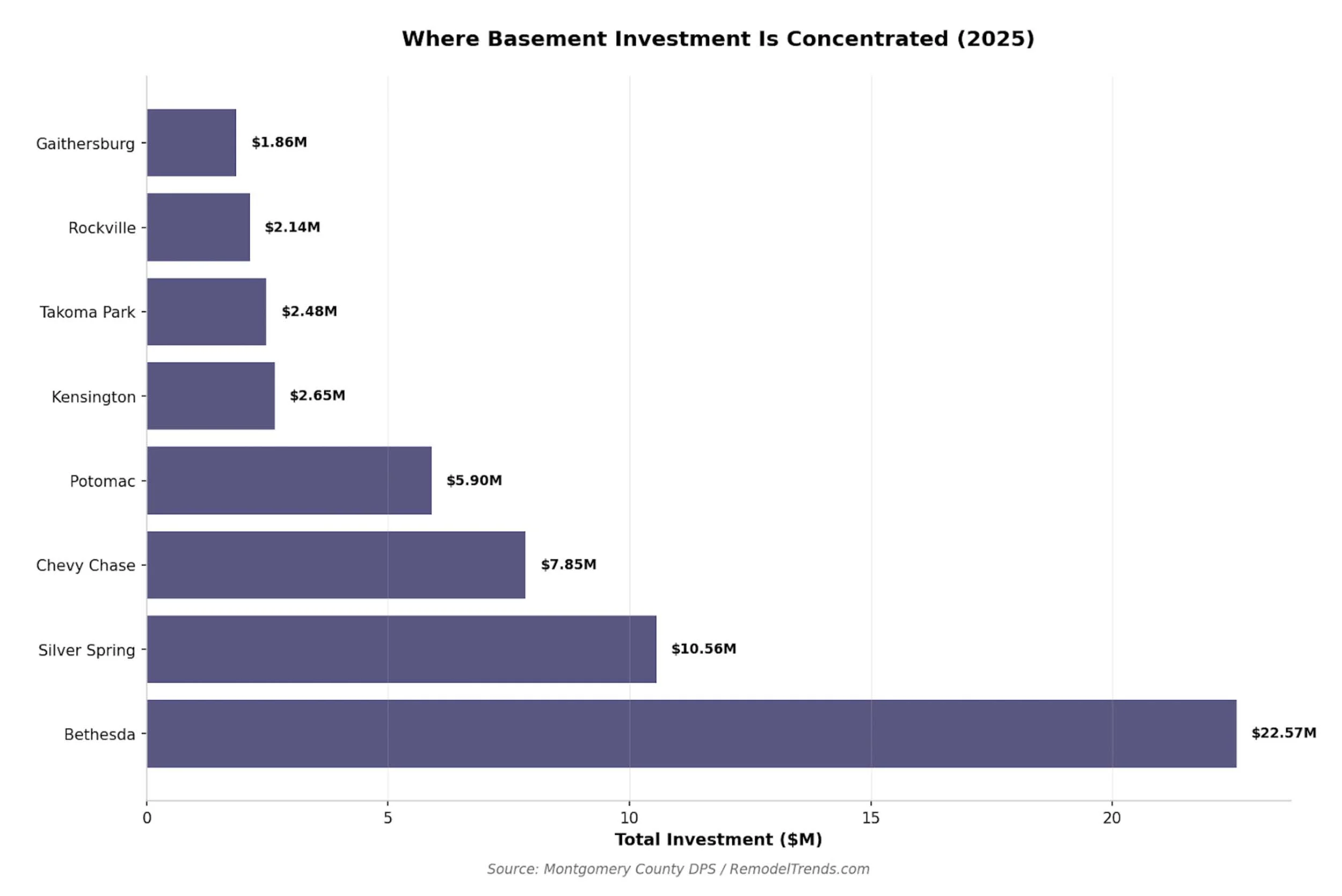
Basement Investment in MD Communities, 2025
Why Basements, Why Now
1. The Permanent Home Office
Montgomery County's economy is anchored by federal agencies, defense contractors, consulting firms, and technology companies — sectors where remote and hybrid work has become permanent. The basement offers something no other room in the house can: a physically separate workspace with a door, sound isolation, and dedicated climate control. For dual-income households where both partners work remotely, a finished basement often means the difference between a functional home and a dysfunctional one.
2. The Cost-Per-Square-Foot Advantage
Finishing a basement is one of the most cost-effective ways to add livable square footage to a home. The shell already exists — the foundation walls, the floor slab, the overhead structure. Compare this to a home addition (averaging $219,634 per project in 2025) or simply buying a larger home at current mortgage rates. A basement build-out at $203,000 typically delivers 1,000 to 2,000 square feet of new living space, putting the effective cost at $100 to $200 per square foot — well below the cost of building new or buying up in the current market.
3. Multi-Generational Living
Census data shows a sustained increase in multi-generational households across the DMV, driven by housing costs, elder care needs, and cultural preferences. A finished basement with a bedroom, bathroom, and separate living area provides the privacy and independence that multi-generational living requires. The permit data's emphasis on full build-outs (63% of all basement permits) rather than cosmetic updates suggests that homeowners are creating self-contained living quarters, not just recreation rooms.
4. Entertainment and Lifestyle Spaces
The post-pandemic home is expected to do more. Home theaters, wine cellars, gyms, gaming rooms, and entertainment bars have moved from luxury to mainstream in Montgomery County's higher-value markets. Bethesda and Chevy Chase's average project values ($225K and $218K respectively) reflect basements designed as premium lifestyle spaces, not utilitarian additions.
What This Means for Homeowners
Know Which Market You Are In
The single most important decision in a basement project is understanding whether you are undertaking a full build-out ($200K+ range) or a renovation of existing finished space ($30K–$75K range). These are fundamentally different projects requiring different contractors, different timelines, and different permitting processes. A full build-out in Montgomery County typically requires structural, electrical, plumbing, and mechanical permits — and each must pass separate inspections. Budget four to eight months from design to completion for a full build-out.
Waterproofing Is Not Optional
Montgomery County's clay-heavy soils and high water table make waterproofing the single most critical element of any basement project. This is not an area to economize. A finished basement with inadequate waterproofing is not just a maintenance problem — it is a structural liability that can destroy the entire investment. Interior drainage systems, sump pumps with battery backup, vapor barriers, and exterior grading should be addressed before a single wall is framed.
Egress Requirements Have Consequences
Any basement bedroom in Montgomery County must have a code-compliant egress window or door. This is not a suggestion — it is a life safety requirement enforced through the permitting process. Cutting an egress window into an existing foundation wall is a structural operation that typically costs $3,000 to $8,000 per opening. Homeowners should factor this into their project budgets early, as the cost and feasibility of egress openings can materially affect the layout of the finished space.
Timing: The Seasonal Window
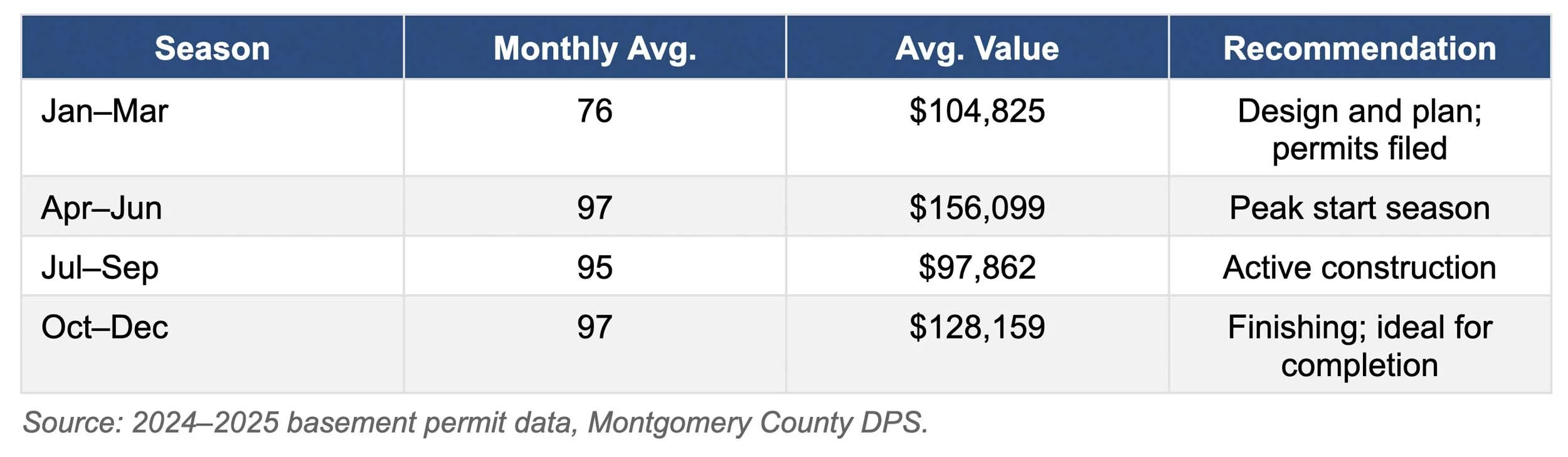
Average Basement Project Value by Season
Unlike roofing and decks, basement work is largely weather-independent — which makes it an ideal project for the fall and winter months when exterior contractors are less available. However, the permit data shows that most homeowners still initiate projects in the spring (April peaks at 116 permits), likely driven by the natural planning cycle of “new year, new project.” Homeowners who begin design and permitting in winter can often secure better contractor availability and start construction earlier in the spring.
Looking Ahead
Early 2026 data shows 103 basement permits already filed through mid-March, with an average value of $356,544 — the highest average on record, driven by several large-scale build-outs in Bethesda and Chevy Chase. While a single quarter is not a trend, the direction is consistent with the broader pattern: the basement market is not contracting, and the projects that are being permitted are becoming more ambitious.
The forces behind the basement awakening — remote work, housing affordability constraints, multi-generational living, and the cost-per-square-foot advantage — are structural, not cyclical. For homeowners sitting on 1,500 square feet of unfinished space beneath their living room, the data makes a compelling case: the most undervalued asset in your home is the one you are standing above.
Methodology
This analysis draws on 11,740 basement permits from the Montgomery County Department of Permitting Services, spanning January 2000 through March 2026. Permits were classified using keyword analysis of permit descriptions and filtered to exclude non-residential and noise records. Project intent (“Build or Add” vs. “Remodel or Improve”) is derived from the permit's stated work type. Declared valuations are self-reported by permit applicants. 2023 data reflects a county reporting gap and is excluded from trend comparisons.
About Four Seasons Home Improvement
Four Seasons Home Improvement is a full-service home improvement contractor serving the greater Washington, D.C. metro area, Maryland, Northern Virginia, specializing in roofing, siding, windows, flooring, bathrooms, kitchen remodels, and exterior upgrades. We aim to bring transparency to the local remodeling market through permit data analytics — because homeowners deserve to make decisions based on real data, not just sales pitches.
If you’re ready to start your home improvement project with a proven team that has served the DMV since 1976, get in touch for a free estimate today.
