

The End of the Addition
Why Montgomery County Homeowners Stopped Building Out and Started Investing In

Published April 2026 | by Four Seasons Home Improvement
Data sourced from Montgomery County, MD Department of Permitting Services. Analysis by Four Seasons Home Improvement using RemodelTrends.com, a leading proprietary analytics platform.
Executive Summary
For decades, the home addition was the default answer when a Montgomery County family outgrew its house. Need a home office? Add a room. Want a bigger kitchen? Bump out the back wall. Aging parent moving in? Build a suite over the garage. The permit data tells us that era is ending.
In 2005, Montgomery County issued 1,077 permits for home additions. By 2025, that number had fallen to 490 — a 55% decline that represents the longest sustained contraction in any remodeling category over the past two decades. But total remodeling investment did not fall with it. It surged. The county's total permitted remodeling economy reached $1.19 billion in 2025, an all-time high.
Where did the money go? Inward. Homeowners stopped building out and started reinvesting in the space they already owned. Interior renovations — kitchens, basements, and bathrooms — doubled from 706 permits in 2019 to over 1,000 in 2025. Outdoor living projects quadrupled in value. Roofing permits nearly doubled. The addition did not disappear because homeowners stopped investing. It declined because they found better ways to use the homes they already had.
The 20-Year Decline
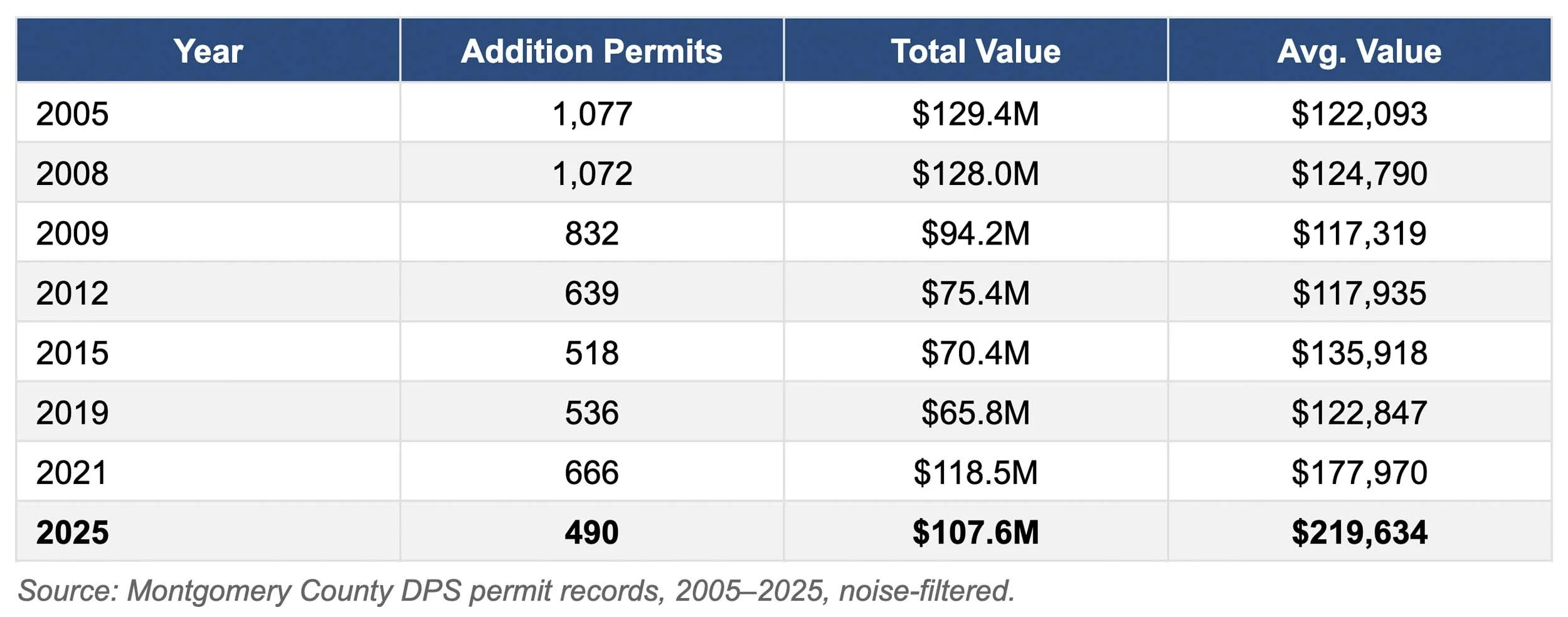
Total and Average Value of Home Addition Permits, 2005-2025
In 2015, homeowners completed 1.4 interior renovations for every addition. By 2024, the ratio reached 2.4 to 1. For every family that chose to build out, nearly two and a half others chose to renovate within their existing footprint. The interior renovation market grew from $42 million in 2015 to $165 million in 2024 — a fourfold increase that dwarfs the addition market's trajectory.
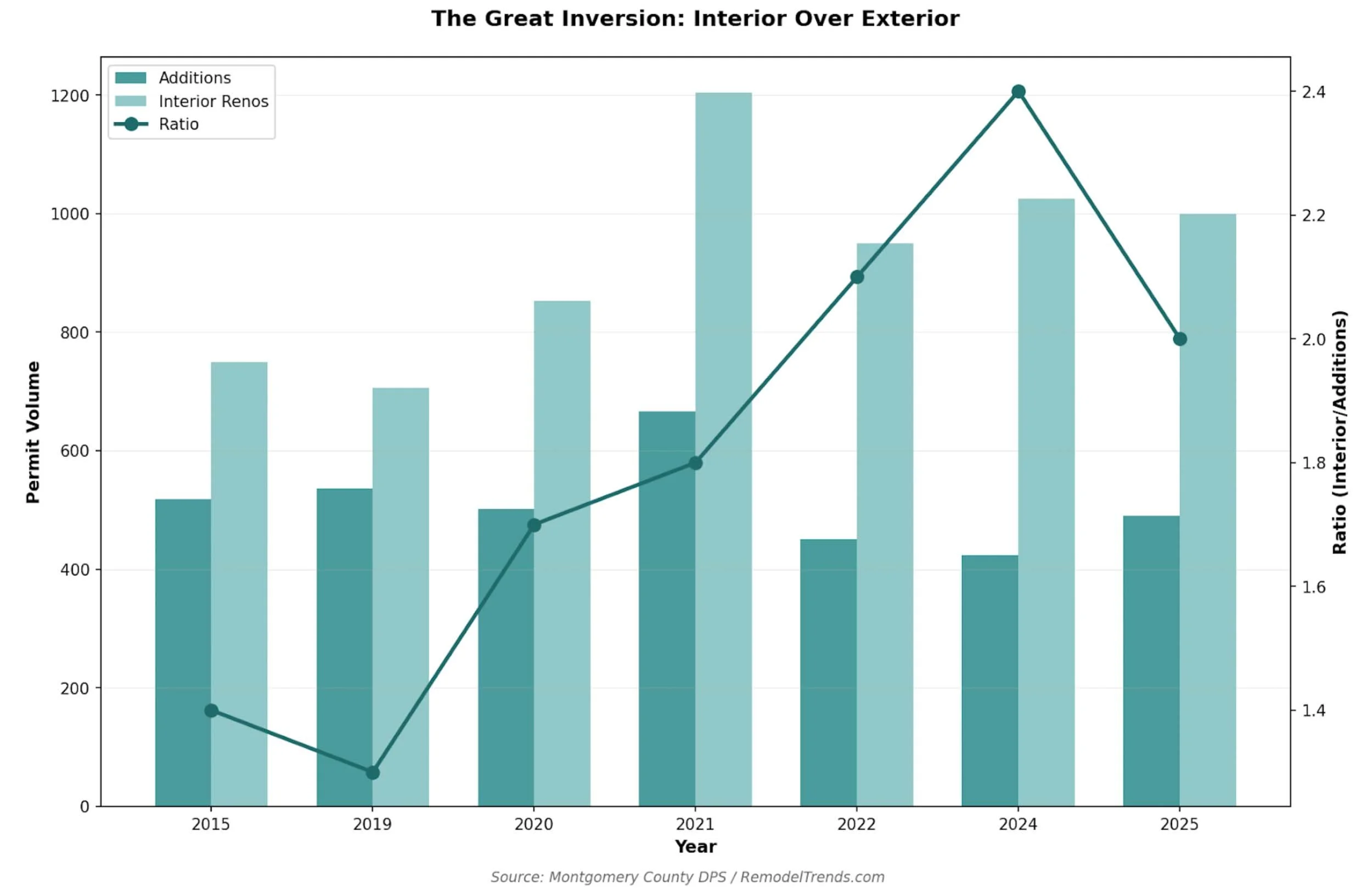
Greater Interior Renovations vs. Exterior Additions, 2015-2025
The Four Substitutes: Where Addition Dollars Went
The Mortgage Rate Lock-In Effect
Millions of homeowners locked in mortgage rates between 2.5% and 3.5% during 2020–2021. With current rates above 6%, selling and buying a larger home would mean doubling their monthly payment. This has created an unprecedented incentive to renovate rather than move — but it has also redirected renovation dollars away from additions and toward interior projects that improve daily living without the cost, timeline, and disruption of a structural build-out.
Construction Costs and Complexity
The average addition now costs $219,634 — nearly 80% more than in 2005, adjusted for the smaller volume of projects. Additions require foundation work, structural tie-ins, roofing integration, HVAC extensions, and zoning compliance. The permitting process is longer and more complex than for any interior renovation. In a county where setback requirements, lot coverage limits, and historic district restrictions constrain what can be built, many homeowners discover that the addition they envisioned is either impractical or cost-prohibitive.
The Discovery of Existing Space
The pandemic forced homeowners to re-examine their homes with fresh eyes. Many discovered that they were sitting on 1,500 square feet of unfinished basement, an underused attic, or a backyard that could function as a living room for eight months of the year. The economics of finishing existing space — where the shell already exists — are dramatically more favorable than building new. A basement finish at $100–$200 per square foot competes favorably with an addition at $300–$500 per square foot. The math has changed, and homeowners have noticed.
The County-Wide Picture: $1.19 Billion in Reinvestment
Montgomery County's total remodeling economy reached $1.19 billion in permitted value in 2025 — an all-time record and more than double the pre-pandemic baseline of $479 million. This investment is not evenly distributed. It concentrates in communities where housing stock, household income, and homeowner tenure align to support major renovation activity.
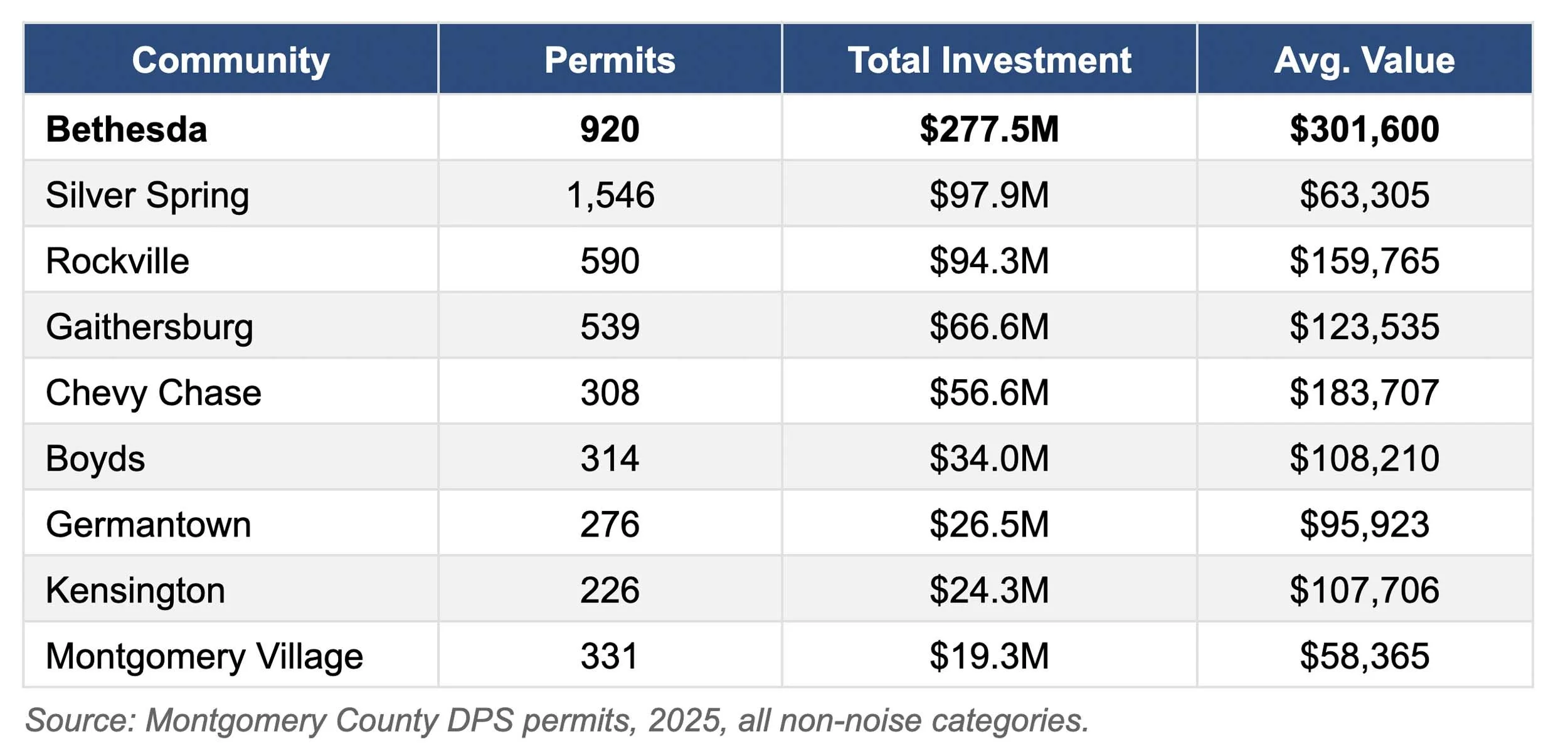
Top Maryland Communities Investing in Home Improvement, 2025
Bethesda alone accounted for $277.5 million in remodeling investment across 920 permits — nearly a quarter of the county's total. Silver Spring led in volume with 1,546 permits, reflecting the breadth of its housing stock and the diversity of project types. The data reveals a county that is reinvesting in itself at a historic rate — not by building new homes or adding new rooms, but by transforming the homes that already exist.
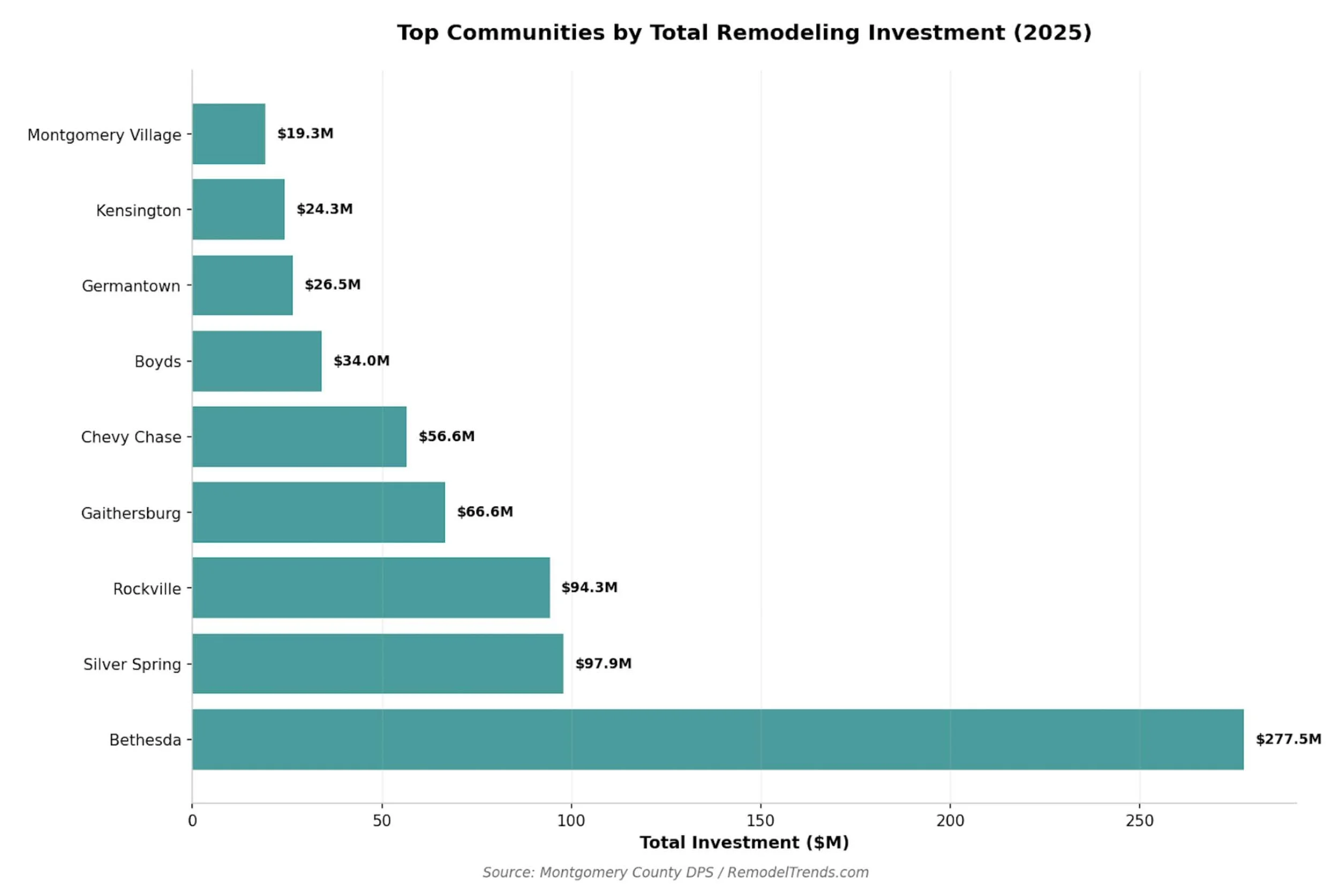
Top MD Communities by Home Improvement Investment, 2025
What This Means for Homeowners
Think Portfolio, Not Project
The era of the single big addition is giving way to a portfolio approach: a basement finish here, a kitchen remodel there, an outdoor living space that extends the home's footprint without a foundation pour. This approach is more flexible, more financeable, and often delivers greater total value than a single large build-out. Homeowners should think about their home's improvement trajectory over three to five years, not just the next project.
Additions Still Make Sense — in Specific Cases
The addition is not dead. It is specialized. The 490 addition permits issued in 2025, averaging $219,634, represent projects where no interior solution existed: a primary suite expansion, a second-story build-out on a rambler, or a family room that cannot be carved from existing space. When an addition is the right answer, it remains a powerful one. But the data suggests homeowners should exhaust interior and outdoor alternatives first — most will find they can achieve their goals at lower cost and with less disruption.
Work with a Contractor Who Sees the Whole Home
The shift from additions to interior renovations rewards contractors who understand a home's full potential. The best outcomes come from professionals who can evaluate whether a client's goal is best served by a basement build-out, a kitchen expansion, an outdoor living space, or — in some cases — an addition. A contractor who only builds additions will recommend an addition. A contractor who works across all categories will recommend the solution that delivers the most value for the investment.
Methodology
This analysis draws on 173,411 building permits from the Montgomery County Department of Permitting Services, spanning January 2000 through March 2026. Permits were classified into ten remodeling categories using keyword analysis and filtered to exclude non-residential and noise records. "Interior renovations" combines kitchen, basement, and bathroom categories. 2023 data reflects a county reporting gap and is excluded from trend comparisons.
About Four Seasons Home Improvement
Four Seasons Home Improvement is a full-service home improvement contractor serving the greater Washington, D.C. metro area, Maryland, Northern Virginia, specializing in roofing, siding, windows, flooring, bathrooms, kitchen remodels, and exterior upgrades. We aim to bring transparency to the local remodeling market through permit data analytics — because homeowners deserve to make decisions based on real data, not just sales pitches.
If you’re ready to start your home improvement project with a proven team that has served the DMV since 1976, get in touch for a free estimate today.
