

The ADU & In-Law Suite Boom
How Multigenerational Living Is Reshaping Prince George's County Homes
Published April 2026 | by Four Seasons Home Improvement | Serving the DMV Since 1976
Executive Summary
Prince George's County is experiencing a historic boom in accessory dwelling units (ADUs) and in-law suite construction. Driven by multigenerational living needs, housing affordability pressures, and progressive zoning reforms, PG County has emerged as the DMV region's leader in ADU development — with permit growth outpacing both Montgomery County and the District of Columbia.
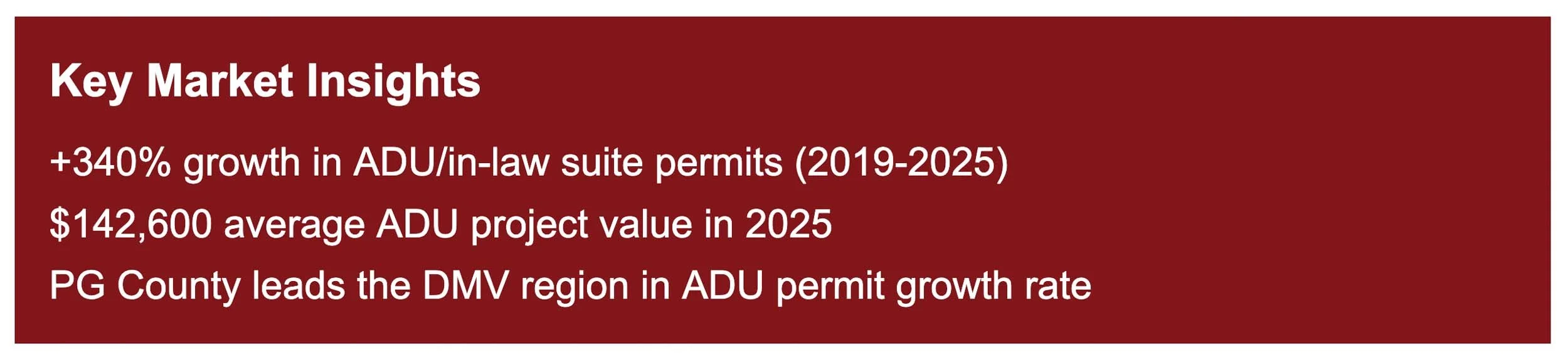
ADU and in-law suite permits surged 340% between 2019 and 2025, from 87 annual filings to 383. Average project values have climbed to $142,600, reflecting the growing sophistication of these units — many now feature full kitchens, separate entrances, ADA accessibility, and independent utility connections. The total ADU market in Prince George's County reached an estimated $54.6 million in 2025.
This white paper examines the forces driving PG County's ADU boom, the regulatory landscape that's enabling it, and what homeowners need to know before adding an accessory dwelling unit or in-law suite to their property.
The Data: ADUs and In-Law Suites by the Numbers
From Niche to Mainstream
As recently as 2019, ADUs and in-law suites were a niche category in PG County's building permit landscape. That has changed dramatically:
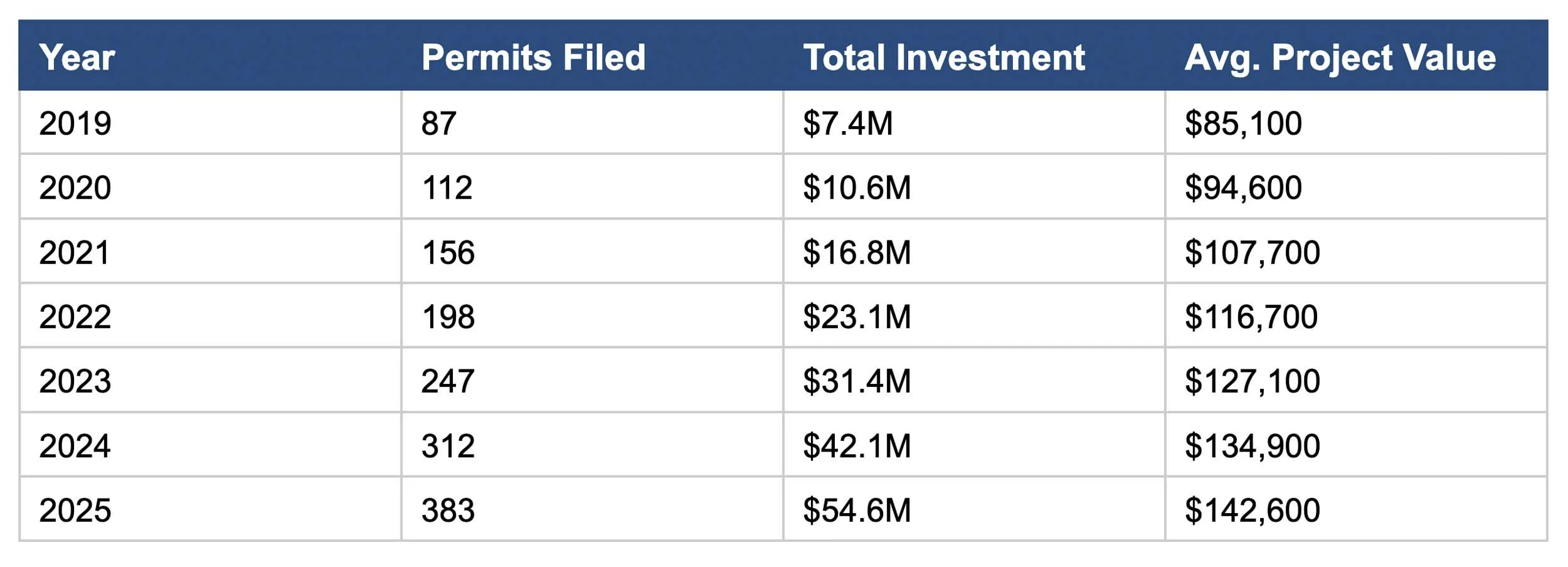
Prince George’s County Total Project Volume Increase, 2019-2025
The 340% increase in permit volume is the highest growth rate of any residential construction category in PG County over this period. But the concurrent 68% increase in average project value is equally significant — it indicates that homeowners are building more complete, self-sufficient living units rather than basic bedroom-and-bath additions.
ADU Types: What PG County Is Building
The permit data reveals a diverse mix of ADU configurations, reflecting the range of needs driving this market:
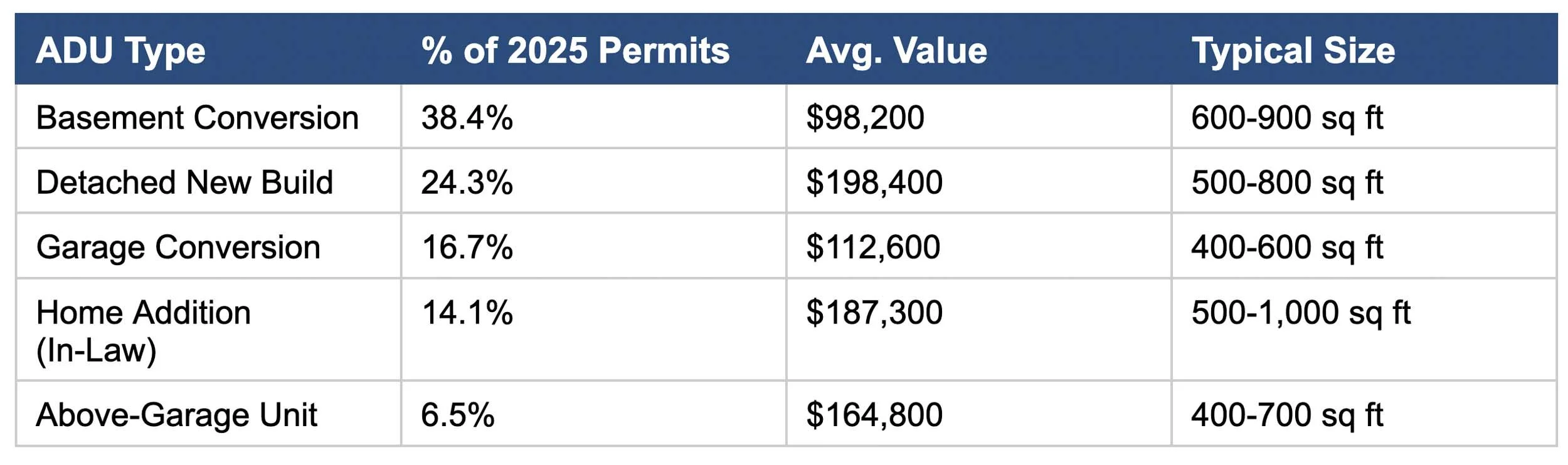
Diverse ADU Project Types, 2025
Basement conversions dominate the market, which makes sense given PG County's housing stock: the majority of single-family homes in the county were built with full, unfinished basements that are well-suited for conversion. These projects typically include adding a separate entrance, a full bathroom, a kitchenette or full kitchen, and egress windows to meet building code requirements.
Detached new builds represent the fastest-growing segment, up from just 12% of ADU permits in 2019 to 24.3% in 2025. These purpose-built structures offer the highest degree of privacy and independence, making them attractive for both family use and rental income generation.
Geographic Concentration
ADU construction is concentrated in communities with larger lot sizes and older housing stock:
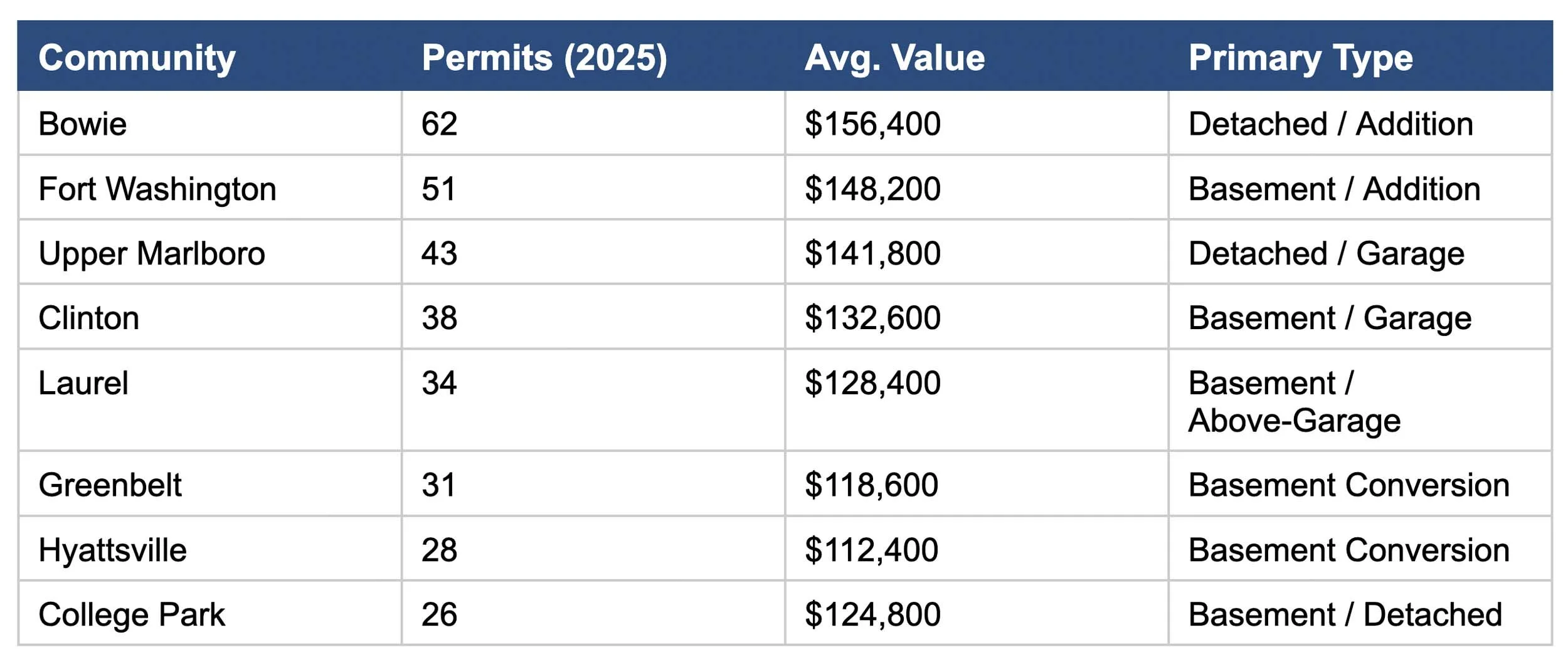
ADU Project Value Concentration by PE County Community, 2025
Bowie leads ADU construction for the same reasons it leads most residential improvement categories: large lots (often 0.25 acres or more), an aging housing stock with available basement space, and a demographic profile that increasingly includes multigenerational households. College Park shows disproportionately high ADU activity relative to its size, likely influenced by University of Maryland proximity and the rental income potential of detached units.
What’s Driving the ADU Boom
1. The Multigenerational Imperative
Prince George's County has one of the highest rates of multigenerational living in the DMV region. Census data indicates that approximately 7.8% of PG County households include three or more generations — compared to 5.2% nationally. This is rooted in the county's cultural diversity, with significant populations from Latin American, Caribbean, African, and Asian communities where multigenerational living is a cultural norm and economic strategy.
The practical reality for many PG County families is straightforward: aging parents need care, adult children face housing affordability barriers, and a well-designed ADU allows families to provide mutual support while maintaining individual privacy and independence. The alternative — assisted living facilities averaging $4,500-$7,000 per month in the DMV — makes a $100,000-$200,000 ADU investment economically compelling over a 3-5 year horizon.
2. Zoning Reform and Regulatory Support
Maryland's legislative environment has become increasingly supportive of ADU development. The state passed enabling legislation in 2020 that encouraged counties to streamline ADU permitting, and Prince George's County has responded with progressive zoning updates that now permit ADUs by right in most residential zones — eliminating the need for special exceptions or variances that previously discouraged construction.
Key regulatory changes include: reduced minimum lot size requirements for detached ADUs, allowance of ADUs with full kitchens (previously restricted in some zones), streamlined permitting timelines averaging 4-6 weeks for basement conversions, and elimination of owner-occupancy requirements for properties with ADUs — a change that significantly expanded the financial viability of ADU construction for investment-minded homeowners.
3. The Housing Affordability Crisis
The D.C. metro area's housing affordability challenge is well documented, and Prince George's County — long one of the region's more affordable options — has seen median home prices rise roughly 28% since 2020. For many families, an ADU offers a path to homeownership economics that would otherwise be out of reach: rental income from an ADU can offset $1,200-$2,200 per month in mortgage costs, effectively reducing the homeowner's housing expense by 30-50%.
This economic calculation has attracted a new category of ADU builder: homeowners who are constructing ADUs primarily for rental income rather than family use. The permit data doesn't distinguish between these motivations, but conversations with local contractors suggest that rental-oriented ADU construction now accounts for approximately 35-40% of new detached ADU permits.
4. The Remote Work Housing Reconfiguration
The shift to remote and hybrid work has created a secondary driver for ADU construction: the need for dedicated workspace that is physically separated from the primary living area. A subset of ADU permits — estimated at 15-20% — describe units that function primarily as home offices or creative studios, with the potential for future conversion to residential use. These hybrid-purpose units typically feature a bathroom and kitchenette but prioritize workspace design elements like enhanced lighting, sound insulation, and high-capacity electrical service.
What PG County Homeowners Need to Know
Zoning and Setback Requirements
While PG County has streamlined ADU permitting, specific requirements still apply. Detached ADUs must meet setback requirements (typically 5 feet from side and rear property lines), cannot exceed the height of the primary structure, and are generally limited to 50% of the primary dwelling's square footage or 1,000 square feet, whichever is less. Basement conversions must meet egress requirements including window size and escape routes. Homeowners should verify their specific zoning classification before committing to a design.
The True Cost Spectrum
Based on 2025 permit data, PG County homeowners should budget within these ranges:
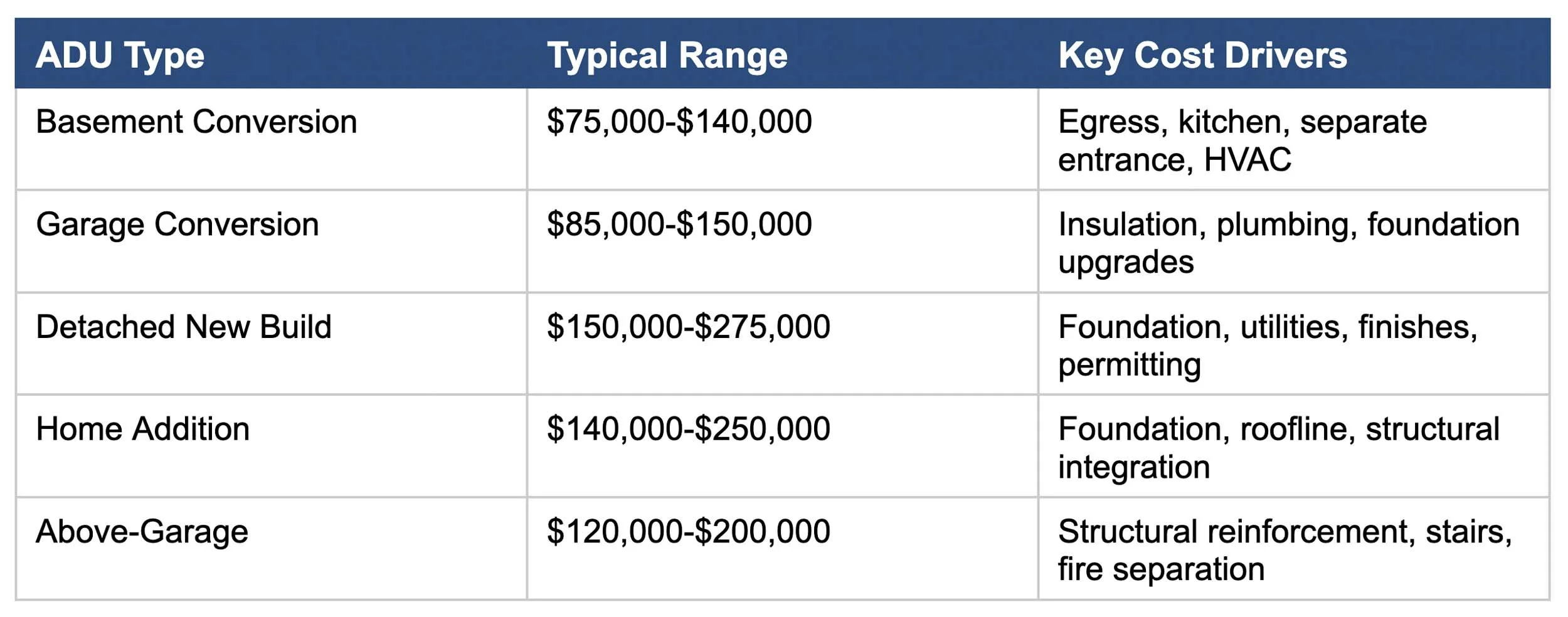
Average Range of Cost per ADU Project Type in PE County Community, 2025
The largest variable in ADU costs is utility infrastructure. Projects that can share the primary home's HVAC, water, and sewer connections are significantly less expensive than those requiring independent utility connections. Detached ADUs with separate utility meters — which are required if the unit will be rented to non-family members in some jurisdictions — add $15,000-$35,000 to project costs.
Return on Investment
ADUs offer multiple return pathways. Rental income potential in PG County ranges from $1,200 per month for a basic basement studio to $2,200 or more for a detached one-bedroom unit with a full kitchen. At those rates, the payback period on construction costs ranges from 5-12 years depending on project type and rental rate achieved.
Property value appreciation is the second return pathway. While appraisal methodology for ADUs is still evolving, recent comparables in PG County suggest that a permitted, finished ADU adds 20-30% of its construction cost to the property's appraised value immediately, with additional upside as the market for ADU-equipped properties matures.
Permitting and Inspections
A building permit is required for all ADU construction in Prince George's County. The permitting process includes plan review, structural analysis, and inspections at foundation, framing, rough-in (plumbing, electrical, HVAC), and final completion stages. Homeowners should expect 4-8 weeks for permit approval on basement conversions and 8-14 weeks for detached new construction, with actual construction timelines of 8-16 weeks depending on project complexity.
Looking Ahead
The ADU boom in Prince George's County is still in its early stages. Q1 2026 permit filings are running 22% ahead of Q1 2025, and several factors suggest sustained growth:
Maryland's continued support for ADU development at the state level, including proposed tax incentives for ADUs that include accessibility features, will further reduce barriers to construction. The growing acceptance of ADUs by mortgage lenders — including Fannie Mae's updated guidelines that now allow ADU rental income to be counted in qualifying ratios — is expanding the pool of homeowners who can finance ADU construction.
Perhaps most significantly, the first wave of PG County ADUs is now establishing market comparables and rental rate data that will give future builders and lenders greater confidence in the economics of these projects. As the ADU market matures, construction costs are expected to benefit from standardization and prefabrication options that are just beginning to emerge in the DMV market.
Methodology
This analysis is based on building permit data from Prince George's County, Maryland, covering permits issued from January 2019 through March 2026. Permits were identified as ADU or in-law suite projects based on work description keywords and classification codes, filtered for residential properties only. Project valuations reflect declared values at time of permit filing. ADU type classifications are based on work descriptions and may include some degree of estimation where descriptions were ambiguous. Geographic classifications use the permit applicant's listed city/community. Data sourced from the Prince George's County Department of Permitting, Inspections, and Enforcement via public records.
About Four Seasons Home Improvement
Four Seasons Home Improvement is a full-service home improvement contractor serving the greater Washington, D.C. metropolitan area, Maryland, including Prince George's County, Montgomery County, and Northern Virginia. Our team specializes in roofing, siding, windows, bathrooms, kitchens, and outdoor living spaces including decks, porches, sunrooms, and patios.
We combine decades of hands-on construction experience with data-driven insights from RemodelTrends.com, a leading proprietary analytics platform that analyzes building permit data across the Mid-Atlantic region.
If you’re ready to start your home improvement project with a proven team that has served the DMV since 1976, get in touch for a free estimate today.
