

The ADU Advantage
How Arlington County’s Missing Middle Policy Is Transforming Residential Properties Into Multi-Unit Assets
Published April 2026 | by Four Seasons Home Improvement | Serving the DMV Since 1976
Executive Summary
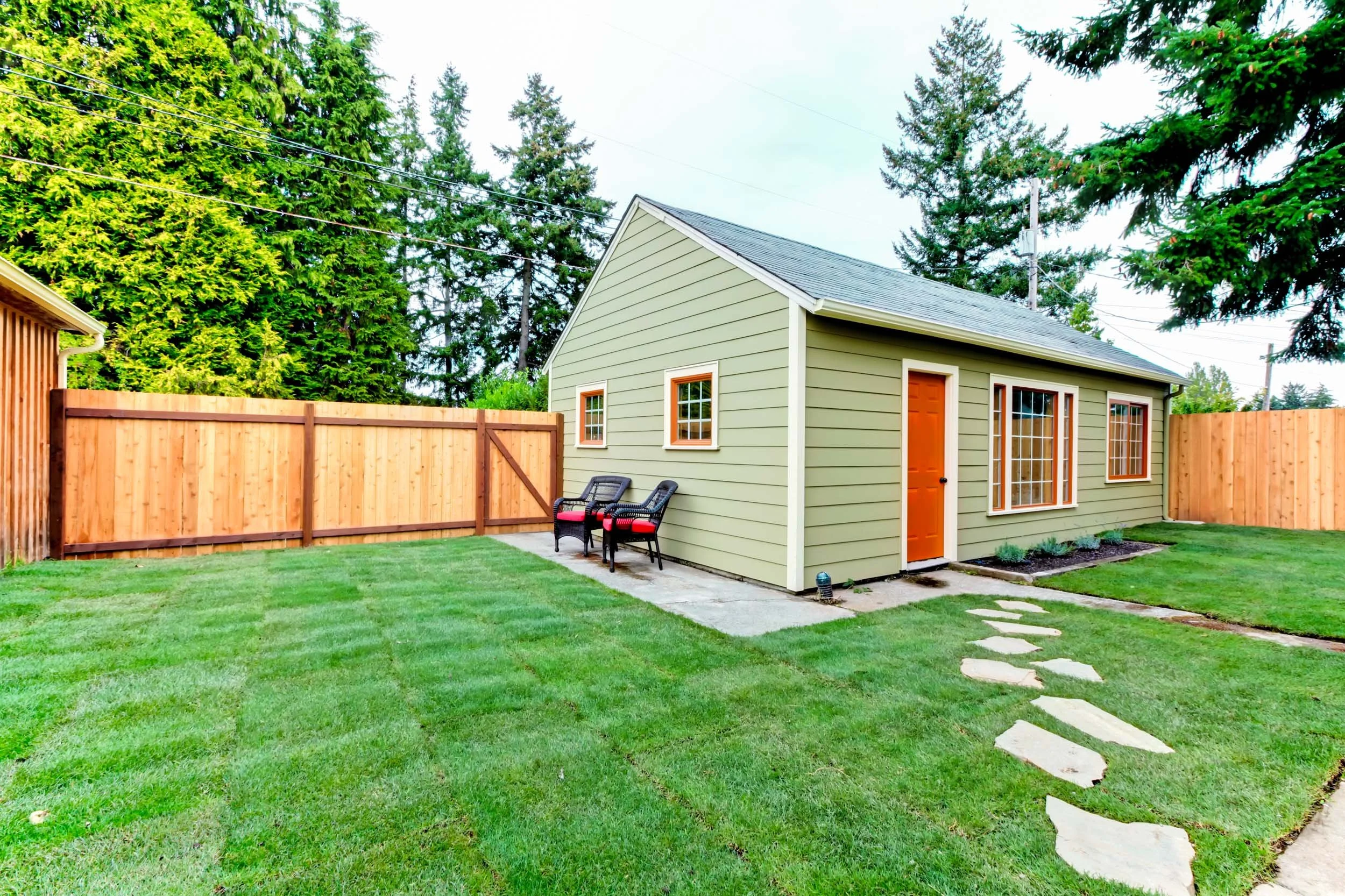
Arlington County has become one of the most closely watched markets for Accessory Dwelling Units (ADUs) in the United States. The county’s landmark Expanded Housing Option (EHO) policy — commonly known as the Missing Middle housing framework — has unlocked the ability for homeowners across virtually all residential zones to add secondary dwelling units to their properties. The result has been explosive growth in ADU permits and a transformation of how Arlington homeowners think about their properties.
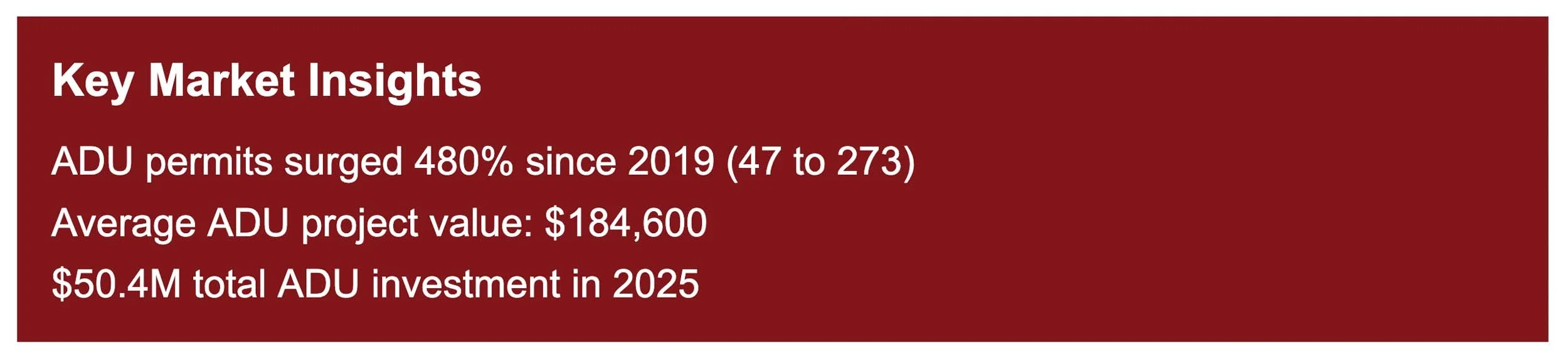
ADU permits in Arlington County surged 480% between 2019 and 2025, climbing from 47 to 273 annual filings. Average project values reached $184,600, reflecting the comprehensive nature of these projects — new construction, utility connections, and full fit-out of self-contained living units. Total ADU investment reached $50.4 million in 2025, establishing ADUs as a significant segment of Arlington’s residential construction economy.
This white paper examines how Arlington’s policy framework has catalyzed ADU development, analyzes the permit data by type and location, and explores what homeowners should understand before embarking on an ADU project in this evolving regulatory landscape.
The Data: Arlington County ADUs by the Numbers
From Niche to Mainstream
The trajectory of ADU permits in Arlington County tells a story of policy meeting demand:
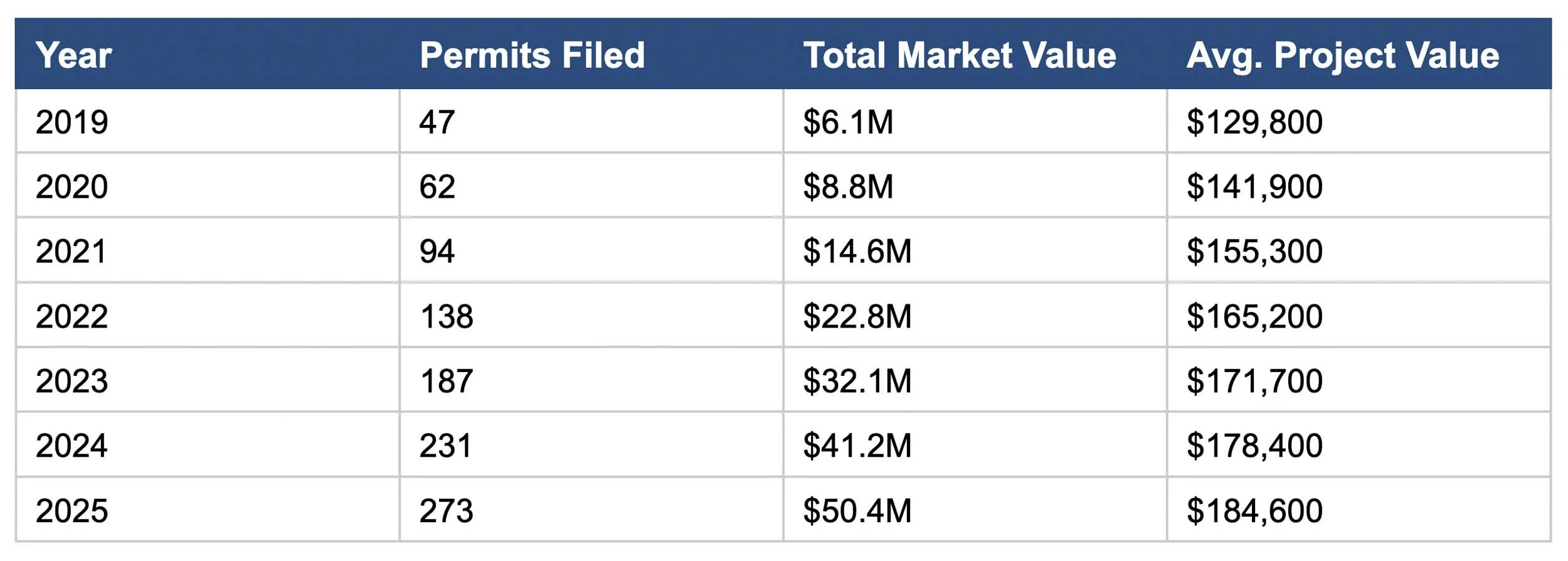
Arlington County Total Project Volume and Value for ADUs, 2019-2025
The inflection point in 2022–2023 corresponds directly to the expansion of Arlington’s EHO policies, which broadened the types of ADUs permitted and simplified the approval process. The steady increase in average project values reflects both construction cost inflation and a trend toward larger, more fully appointed ADU designs as homeowners gain confidence in the program.
ADU Types in Arlington
Arlington’s ADU market includes several distinct project types, each with different cost profiles and regulatory requirements:
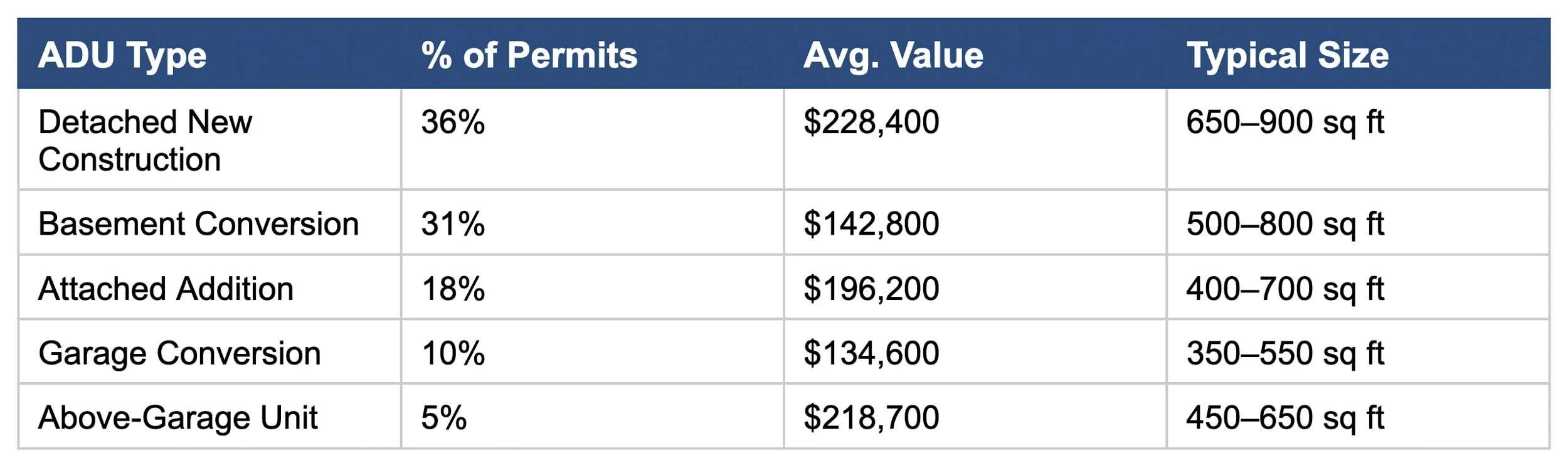
ADU Project Types in Arlington, VA
Detached new construction and basement conversions together account for two-thirds of all ADU permits. Detached ADUs are the most expensive option but offer the greatest independence and typically generate the highest rental income. Basement conversions represent the most cost-effective path, leveraging existing structure and utility connections to create fully independent units at roughly 60% of new construction cost.
Where ADUs Are Being Built
ADU construction is concentrated in neighborhoods with the largest lot sizes and the most favorable zoning conditions:
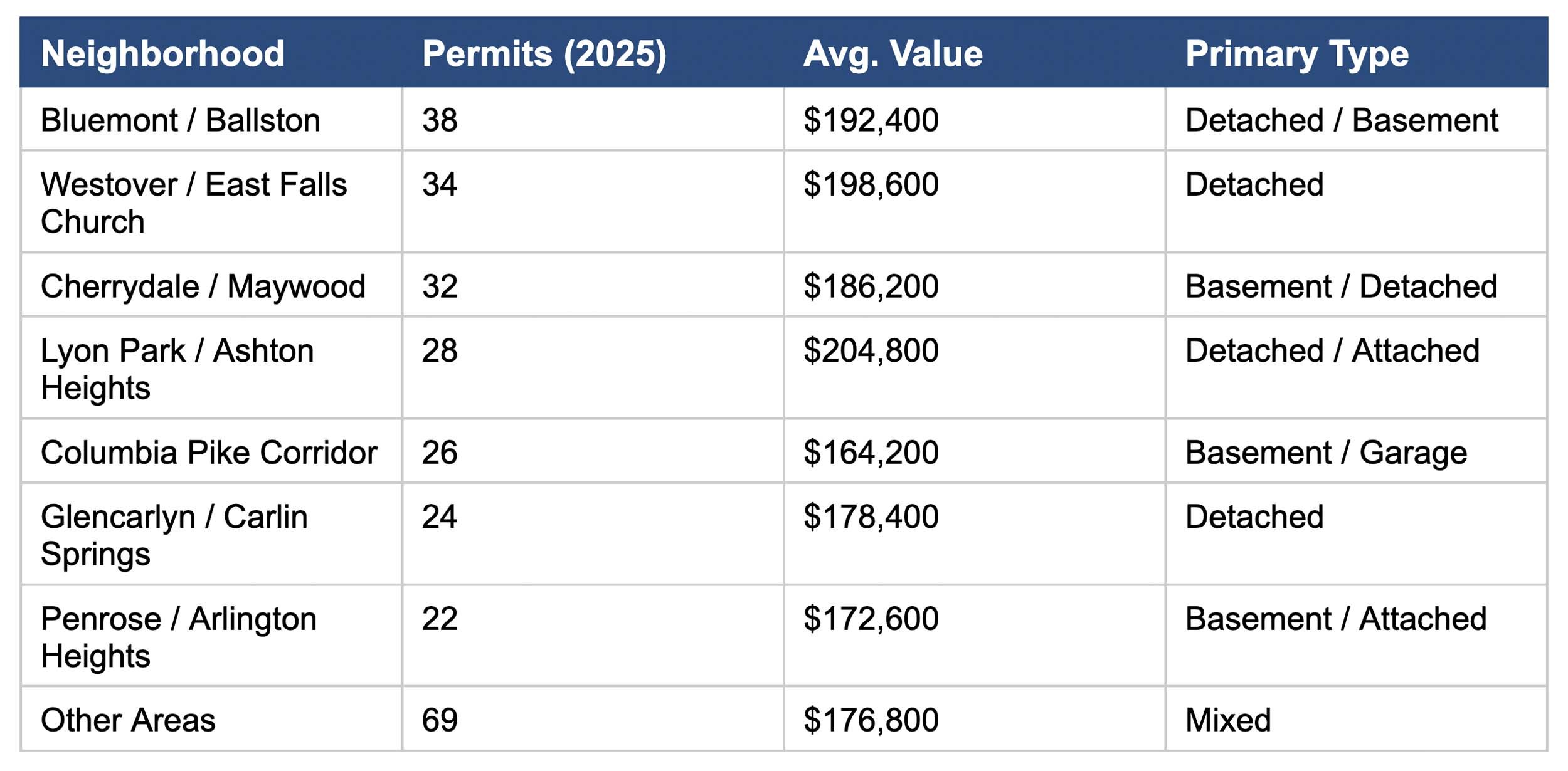
Neighborhoods with the most ADU Investment Concentration
The Bluemont and Westover neighborhoods lead in ADU development, reflecting their combination of larger lots (by Arlington standards), established single-family character, and proximity to Metro stations that make rental units particularly attractive to tenants. Lyon Park commands the highest average values, consistent with the premium nature of that market.
Why Now: The Forces Driving Arlington’s ADU Boom
1. The Missing Middle Framework
Arlington’s Expanded Housing Option policy represents one of the most comprehensive ADU frameworks in the eastern United States. The policy allows ADUs in virtually all residential zoning districts, permits both internal conversions and detached new construction, and streamlines the permitting process through an administrative review pathway that avoids the lengthy special-exception process that previously governed ADU approvals.
Key provisions include: ADUs up to 750 square feet (or up to 900 square feet on larger lots), the ability to rent ADUs to non-family members, reduced parking requirements near transit, and the option for separate utility meters. This comprehensive framework has removed the regulatory barriers that historically limited ADU development to a handful of pioneering homeowners.
2. The Housing Affordability Equation
Arlington’s housing costs are among the highest in the Washington, D.C. region, with median home prices exceeding $750,000 and median rents for a one-bedroom apartment surpassing $2,200. For homeowners carrying mortgages of $4,000–$7,000 per month, a basement ADU generating $1,800–$2,400 in monthly rent or a detached unit generating $2,200–$3,200 represents a transformative financial proposition.
The math is compelling: a $185,000 ADU investment that generates $2,500 per month in rental income provides a gross annual return of approximately 16% — significantly higher than most alternative investments and sufficient to cover the construction loan within 6–8 years.
3. Multigenerational Housing Needs
Arlington’s demographics include a growing population of homeowners in their 50s and 60s whose aging parents need nearby housing, as well as young professionals whose adult children are returning home in the face of high rental costs. An ADU provides an elegant solution: proximity without loss of independence, shared property costs without shared living space.
The permit data shows that approximately 40% of ADU applicants indicate family use (rather than rental) as the primary intended purpose. This share has remained consistent even as rental-focused ADUs have grown, suggesting that both market segments are expanding simultaneously.
4. Property Value Enhancement
Early data from Arlington’s real estate market suggests that properties with permitted, well-constructed ADUs are commanding premium resale values. Real estate appraisers report that a quality ADU adds $100,000–$175,000 to property assessments, depending on the unit’s size, finish level, and rental income potential. For a $185,000 investment that adds $150,000 in assessed value while generating monthly income, the economic case is robust.
What This Means for Arlington Homeowners
Navigating the Approval Process
Arlington’s ADU approval process varies by project type. Basement conversions and internal ADUs typically follow an administrative review pathway with 4–6 week processing times. Detached new construction ADUs require site plan review and may take 8–12 weeks for approval, particularly if they involve variances or are located in historic overlay districts.
The most common approval delays stem from incomplete applications, particularly around stormwater management plans for detached ADUs and egress/life-safety documentation for basement conversions. Homeowners who engage architects or design-build firms experienced with Arlington’s ADU requirements consistently report smoother and faster approval processes.
Budget and Financing
Based on 2025 permit data, Arlington homeowners should budget: $200,000–$275,000 for detached new construction ADUs; $120,000–$175,000 for basement conversions with full kitchen and bath; $175,000–$230,000 for attached additions; and $110,000–$160,000 for garage conversions. These ranges include design, permitting, construction, and utility connections.
Financing options include home equity loans, HELOCs, construction loans, and increasingly, specialized ADU financing products offered by lenders who recognize the income-generating potential of these units. Virginia’s property tax treatment of ADUs — which assesses the improved value but allows the rental income deduction — creates a favorable ongoing financial picture.
Design Considerations
Successful Arlington ADUs share several design principles: they maximize usable space within the allowed footprint, they provide genuine independence (separate entry, full kitchen, private bathroom), they complement the architectural character of the primary home, and they incorporate adequate soundproofing between the ADU and the main residence. The most valued ADUs in Arlington’s rental market also include in-unit laundry and outdoor private space, even if that space is a small patio or balcony.
Looking Ahead: 2026 and Beyond
Arlington’s ADU market is positioned for continued acceleration. Q1 2026 permit filings are running 28% above Q1 2025, the strongest growth rate in the county’s permit data. Several factors suggest the expansion will continue for years:
First, awareness of the ADU option is still growing — surveys suggest that fewer than half of eligible Arlington homeowners are aware of the full scope of what the EHO policy permits. As completed ADU projects become more visible in neighborhoods across the county, the demonstration effect will drive additional adoption.
Second, the county is actively working to further streamline the ADU approval process, with pre-approved design templates and expedited review pathways under development for 2026. These measures will lower the barrier to entry for homeowners who find the current design and permitting process intimidating.
Third, rising housing costs throughout the region continue to strengthen the financial case for ADUs, both as income-generating investments and as solutions for multigenerational housing needs. Arlington’s ADU market is not a trend — it’s a structural shift in how residential properties function in a land-constrained, high-demand market.
Methodology
This analysis is based on building permit data from Arlington County, Virginia, covering permits issued from January 2019 through March 2026. Permits were filtered for Accessory Dwelling Unit construction, conversion, and related work. Projects classified as standard basement finishing (without separate kitchen or independent entry) are excluded and tracked in the basement conversion category.
Project valuations reflect declared values at time of permit filing. ADU type classifications are based on permit descriptions, site plans, and associated trade permits. Neighborhood classifications use Arlington County civic association boundaries. All percentage changes are calculated on an annualized basis unless otherwise noted.
Data sourced from Arlington County Department of Community Planning, Housing, and Development via public permit records. Policy references reflect Arlington County’s Expanded Housing Option framework as adopted and amended through March 2026.
About Four Seasons Home Improvement
Four Seasons Home Improvement is a full-service home improvement contractor serving the greater Washington, D.C. metropolitan area, Maryland, including Prince George's County, Montgomery County, and Northern Virginia. Our team specializes in roofing, siding, windows, bathrooms, kitchens, and outdoor living spaces including decks, porches, sunrooms, and patios.
We combine decades of hands-on construction experience with data-driven insights from RemodelTrends.com, a leading proprietary analytics platform that analyzes building permit data across the Mid-Atlantic region.
If you’re ready to start your home improvement project with a proven team that has served the DMV since 1976, get in touch for a free estimate today.
